

[2026] Earn Quick And Easy Success With NSE5_FNC_AD_7.6 Dumps
Free NSE5_FNC_AD_7.6 pdf Files With Updated and Accurate Dumps Training
Fortinet NSE5_FNC_AD_7.6 Exam Syllabus Topics:
| Topic | Details |
|---|---|
| Topic 1 |
|
| Topic 2 |
|
| Topic 3 |
|
| Topic 4 |
|
NEW QUESTION # 12
An administrator wants to create a conference manager administrator account but would like to limit the number of conference accounts that can be generated to 30.
Which statement about conference accounts is true?
- A. Conference account limits are defined in the conference guest and contractor template.
- B. The administrator can set a maximum of 30 conference accounts in the administrative profile for the conference manager.
- C. The conference account limit is defined in the onboarding conference portal.
- D. In FortiNAC-F, conference accounts can be limited by multiples of 25, so the conference administrator could create 50 accounts.
Answer: B
Explanation:
In FortiNAC-F, the Conference Manager is a specialized administrative role designed for delegated administration, often used by receptionists or event organizers to create temporary guest accounts. To maintain security and prevent the over-provisioning of credentials, FortiNAC-F allows for granular restrictions on these accounts.
According to the FortiNAC-F Administration Guide regarding Administrative Profiles, when an administrator creates a profile for a Conference Manager, they can define specific "Account Limits." Under the profile settings (located in System > Settings > Admin Profiles), there is a field specifically for "Max Accounts." By entering "30" into this field, the administrator ensures that any user assigned to this profile cannot exceed 30 active conference accounts at any given time.
This setting is distinct from the Portal configuration or the Guest templates. While templates define the type of account (e.g., duration and access level), the Administrative Profile defines the capabilities and limitations of the person creating those accounts. This ensures that even if a guest template allows for unlimited registrations, the specific administrator is physically restricted by the system from generating more than the allotted 30.
"Administrative Profiles define what an administrator can see and do within the system. For delegated administration roles like the Conference Manager, the 'Max Accounts' field in the Administrative Profile is used to specify the maximum number of accounts the user is permitted to create. Once this limit is reached, the user will be unable to generate additional accounts until existing ones expire or are deleted." - FortiNAC-F Administration Guide: Administrative Profiles and Delegated Administration.
NEW QUESTION # 13
Which two statements are true about integrating a third-party device using SNMP traps from that device as input to generate an event? (Choose two.)
- A. The IP address OID and MAC address OID must be configured in the trap MIB file.
- B. The sending device must support SNMPv3.
- C. set allowaccess snmp must be configured using the CLI on the FortiNAC-F receiving interface.
- D. The sending device must be modeled in the inventory topology.
Answer: C,D
Explanation:
The correct answers are A and C . Fortinet's FortiNAC-F 7.6 documentation states that, to receive and interpret traps from devices or applications, those devices or applications must be modeled in FortiNAC and must have an associated IP address. That validates option A directly. The same Fortinet Trap MIB Files documentation also lists a FortiNAC-OS requirement: the snmp option must be included in the set allowaccess command. That validates option C .
Option B is wrong because Trap MIB integration is not limited to SNMPv3. Fortinet states that Trap MIB supports receiving SNMPv1 and SNMPv2 traps from external devices, while SNMPv3 is discussed separately for traps that populate host and user records.
Option D is the trap. The Fortinet documentation explicitly says IP address OID, MAC address OID, and user ID OID are not all required ; any one OID can be used to identify the host or user that triggered the trap. So the statement that both the IP address OID and MAC address OID must be configured is false.
NEW QUESTION # 14
Refer to the exhibit.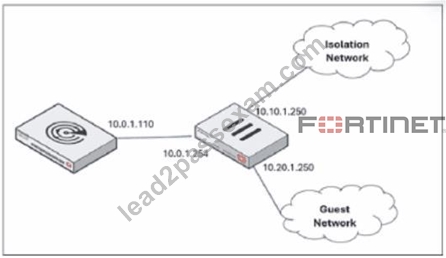
An administrator is configuring FortiNAC-F (or the onboarding of guest users. Which IP address would be used for the gateway defined in the DHCP scope?
- A. 10.10.1.250
- B. 10.20.1.250
- C. 10.0.1.254
- D. 10.0.1.110
Answer: B
Explanation:
The correct answer is D . The question is about guest onboarding , and the exhibit shows the Guest Network using gateway 10.20.1.250 . In a Layer 3 captive network design, FortiNAC-F provides DHCP and DNS services to isolated or captive-network hosts, but the DHCP scope must still give the endpoint the correct default gateway for the network where that endpoint is placed. The study guide specifically warns that, when configuring Layer 3 captive network scopes, the administrator must think from the isolated host's perspective for the IP pool and gateway configuration . It also states that each captive network interface configuration includes an IP address, subnet mask, default gateway, and one or more DHCP scopes.
Option A , 10.0.1.254 , is the infrastructure gateway on the FortiNAC-F service/production-side segment, not the guest network gateway. Option B , 10.0.1.110 , is the FortiNAC-F interface address shown in the diagram, not the default gateway for guest clients. Option C , 10.10.1.250 , is the gateway for the Isolation Network , not the Guest Network . Since the administrator is configuring guest onboarding, the DHCP scope for guest users must hand out 10.20.1.250 as the gateway.
NEW QUESTION # 15
A user was attempting to register their host through the registration captive portal. After successfully registering, the host remained in the registration VLAN. Which two conditions would cause this behavior?
(Choose two.)
- A. The wrong agent s installed.
- B. There is another unregistered host on the same port
- C. The port default VLAN is the same as the Registration VLAN.
- D. There is no agent installed on the host.
Answer: B,C
Explanation:
The process of moving a host from aRegistration VLANto aProduction VLAN(Access VLAN) is a fundamental part of the FortiNAC-F " VLAN steering " workflow. When a host successfully registers via the captive portal, FortiNAC-F evaluates its Network Access Policies to determine the correct VLAN. If the host remains stuck in the Registration VLAN despite a successful registration, it is typically due to port-level restrictions or the presence of other unregistered devices.
The two most common reasons for this behavior as per the documentation are:
The port default VLAN is the same as the Registration VLAN:If the " Default VLAN " field in the switch port
' s model configuration is set to the same ID as the Registration VLAN, the port will not change state because FortiNAC-F believes it is already in its " normal " or " forced " state.
There is another unregistered host on the same port:FortiNAC-F maintains the security posture of the physical port. If multiple hosts are connected to a single port (e.g., via a hub or unmanaged switch) and at least one host remains " Rogue " (unregistered), FortiNAC-F will generally keep the entire port in the isolation
/registration VLAN to prevent the unregistered host from gaining unauthorized access to the production network.
Issues with agents (A, B) typically prevent a host from completing compliance or registration but do not usually result in a " stuck " statusafterregistration has already been marked as successful in the system.
" If a port is identified as havingMultiple Hosts, and those hosts require different levels of access, FortiNAC remains in the most restrictive state (Registration or Isolation) until all hosts on that port are authorized...
Additionally, verify theDefault VLANsetting for the port; if the Default VLAN and Registration VLAN match, the system will not trigger a VLAN change upon registration. " -FortiNAC-F Administration Guide:
Troubleshooting Host Management.
NEW QUESTION # 16
While discovering network infrastructure devices, a switch appears in the inventory topology with a question mark (?) on the icon. What would cause this?
- A. A read-only SNMP community siring was used.
- B. The wrong SNMP community string was entered during discovery.
- C. SNMP is not enabled on the switch.
- D. The SNMP ObjectlD is not recognized by FortiNAC-F.
Answer: D
Explanation:
In FortiNAC-F, the Inventory topology uses specific icons to represent the status and model of discovered network infrastructure. When a switch or other network device is discovered via SNMP, FortiNAC-F retrieves its System ObjectID (sysObjectID) to identify the specific make and model. This OID is then compared against the internal database of supported device mappings.
A question mark (?) icon appearing on a discovered switch indicates that while the discovery process successfully communicated with the device (meaning SNMP credentials were correct), the SNMP ObjectID is not recognized or mapped in the current version of FortiNAC-F. This essentially means the device is "unsupported" by the current software out-of-the-box. Because the OID is unknown, FortiNAC-F does not know which CLI or SNMP command set to use for critical functions like L2 polling (host visibility) or VLAN switching (enforcement). To resolve this, an administrator can manually "Set Device Mapping" to a similar existing model or a "Generic SNMP Device" if only basic L3 visibility is required.
"Discovered devices displaying a '?' icon indicate the currently running version does not have a mapping for that device's System OID (device is not supported). Device mappings are used to manage the device by performing functions such as L2/L3 Polling, Reading, and Switching VLANs." - Fortinet Technical Tip: Options for devices unable to be modeled in Inventory.
NEW QUESTION # 17
When working with a FortiNAC-F Manager and cluster management, what will occur when a cluster manager recovers from a non-responsive state?
- A. It will be removed from the cluster and placed in a standalone group.
- B. It will perform a health check and be demoted to standby.
- C. It rejoins the cluster as a worker node.
- D. It automatically returns to the manager state.
Answer: C
Explanation:
The correct answer is C . In FortiNAC-F Manager clustering, the active cluster management role is the leader role, and other cluster members operate as worker nodes. Fortinet's FortiNAC-F 7.6 Manager Cluster Guide states that when a worker is promoted to leader during automatic transition, the original leader becomes a worker node when it comes back online. It also explains that a cluster has one leader and can have multiple workers, with leader/worker roles used for cluster management and heartbeat exchange.
So, if the cluster manager becomes non-responsive and another node takes over leadership, the recovered manager does not automatically reclaim the leader role. It rejoins as a worker node. Option A is wrong because recovery does not automatically remove it into a standalone group. Option B is wrong because automatic return to the previous manager/leader state would create instability and possible split-brain behavior. Option D is wrong because "standby" is not the role described for FortiNAC-F Manager clustering in this context; the documented cluster roles are leader and worker.
NEW QUESTION # 18
A healthcare organization is integrating FortiNAC-F with its existing MDM. Communication is failing between the systems.
What could be a probable cause?
- A. REST API communication is failing
- B. SOAP API communication is failing
- C. SSH communication is failing
- D. Security Fabric traffic is failing
Answer: A
Explanation:
The integration between FortiNAC-F and Mobile Device Management (MDM) platforms (such as Microsoft Intune, VMware Workspace ONE, or Jamf) is a critical component for providing visibility into mobile assets that do not connect directly to the managed infrastructure via standard wired or wireless protocols.
According to the FortiNAC-F MDM Integration Guide, the communication between the FortiNAC-F appliance and the MDM server is handled through REST API calls. FortiNAC-F acts as an API client, periodically polling the MDM server to retrieve device metadata, compliance status, and ownership information. If communication is failing, it is most likely because the API credentials (Client ID/Secret) are incorrect, the MDM's API endpoint is unreachable from the FortiNAC-F service port, or the SSL certificate presented by the MDM is not trusted by the FortiNAC-F root store.
While SSH (B) is used for switch CLI management and the Security Fabric (A) uses proprietary protocols for FortiGate synchronization, neither is the primary vehicle for MDM data exchange. SOAP API (D) is an older protocol that has been largely replaced by REST in modern FortiNAC integrations.
"FortiNAC integrates with MDM systems by utilizing REST API communication to query the MDM database for device information. To establish this link, administrators must configure the MDM Service Connector with the appropriate API URL and authentication credentials. If the 'Test Connection' fails, verify that the FortiNAC can reach the MDM provider via the REST API port (usually HTTPS 443)." - FortiNAC-F Administration Guide: MDM Integration and Troubleshooting.
NEW QUESTION # 19
Refer to the exhibit.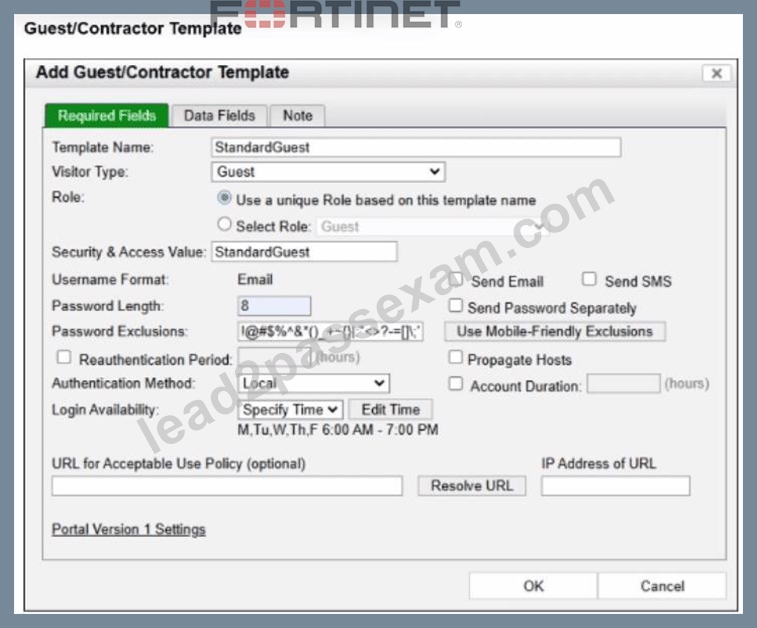
An administrator wants to ensure that guest accounts created from this template are not allowed network access outside of the designated times.
To achieve this, all necessary configurations must be made to force isolation of hosts in which state?
- A. Disabled
- B. At-risk
- C. Non-authenticated
- D. Rogue
Answer: C
Explanation:
The correct answer is C . The exhibit shows a guest template with Login Availability set to Specify Time , allowing login only Monday through Friday from 6:00 AM to 7:00 PM . The study guide explains that the Account Duration and Login Availability fields define when the account is deleted from the database or what days and times the account is enabled. Therefore, outside the allowed login window, the guest cannot authenticate successfully using that guest account.
To stop network access outside those permitted times, FortiNAC-F must isolate hosts that are in the Not Authenticated state. The guide maps the Authentication captive network to hosts in the Not Authenticated state, and the isolation logic table shows that hosts in the Not Authenticated state are moved to the Authentication network when the point of connection is in the Forced Authentication group.
Option A is wrong because At-risk hosts are isolated to remediation/quarantine due to compliance or security posture problems, not because a guest login is outside allowed hours. Option B is wrong because Disabled hosts are intentionally disabled and sent to the dead-end network; the account here is time-restricted, not necessarily disabled. Option D is wrong because Rogue applies to unregistered or unclassified devices, while this scenario is about a known guest account that is not allowed to authenticate outside its login schedule.
NEW QUESTION # 20
Refer to the exhibits.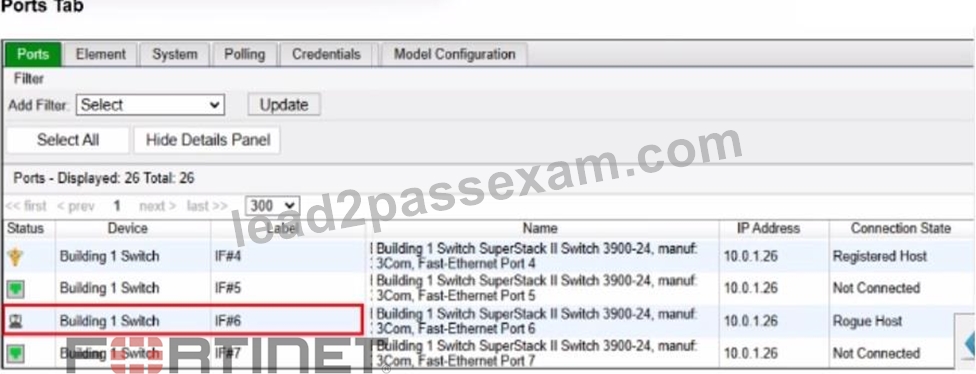
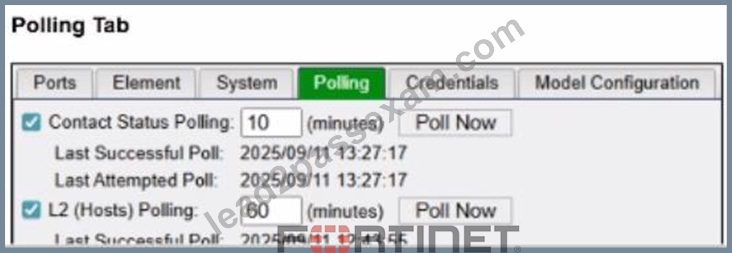
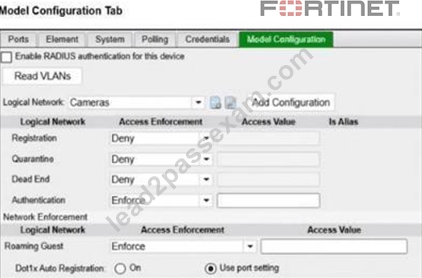
An administrator is troubleshooting visibility issues on a modeled switch The switch is configured to use link traps and to provision hosts based on network access policies. The administrator is seeing hosts on ports with no hosts connected and not seeing hosts on ports where hosts are known to be connected.
What is the most likely cause?
- A. The host has uninstalled the FortiNAC-F agent.
- B. The switch cannot be contacted by FortiNAC-F
- C. The credentials are incorrect.
- D. The logical networks are set to deny.
Answer: B
Explanation:
The correct answer is C . In a link-trap-based wired deployment, the switch sends a linkUp or linkDown SNMP trap to FortiNAC-F, but that trap does not contain the endpoint MAC address. After receiving the link trap, FortiNAC-F must contact the switch and perform a Layer 2 poll to read the forwarding table and determine which MAC address was added or removed on the port. The FortiNAC-F study guide states that link traps trigger FortiNAC-F to perform a Layer 2 poll to update its awareness of devices connected to the edge device, and the wired link-trap workflow specifically shows FortiNAC-F performing a Layer 2 poll before locating the host record and provisioning access.
The symptoms in the exhibit are classic stale Layer 2 visibility: FortiNAC-F still shows a rogue host on a port where no host is connected, while also failing to show hosts on ports where endpoints are actually connected.
That means FortiNAC-F is not successfully refreshing the switch MAC table information. Since link traps depend on FortiNAC-F being able to poll the switch after the trap, a contact failure with the modeled switch is the most likely cause.
Option A is wrong because logical network settings affect access enforcement, not whether FortiNAC-F can see current MAC-to-port mappings. Option B is wrong because the FortiNAC-F agent is not required for basic switch-port visibility; Layer 2 visibility comes from switch polling, MAC notification traps, or RADIUS. Option D is tempting, but the broader failure shown here is not merely a policy or endpoint-side issue-it is that FortiNAC-F cannot obtain current Layer 2 data from the switch. In practice, you would still verify SNMP/CLI credentials while troubleshooting, but the best answer to the symptom pattern is that FortiNAC-F cannot contact/query the switch successfully.
NEW QUESTION # 21
Refer to the exhibit.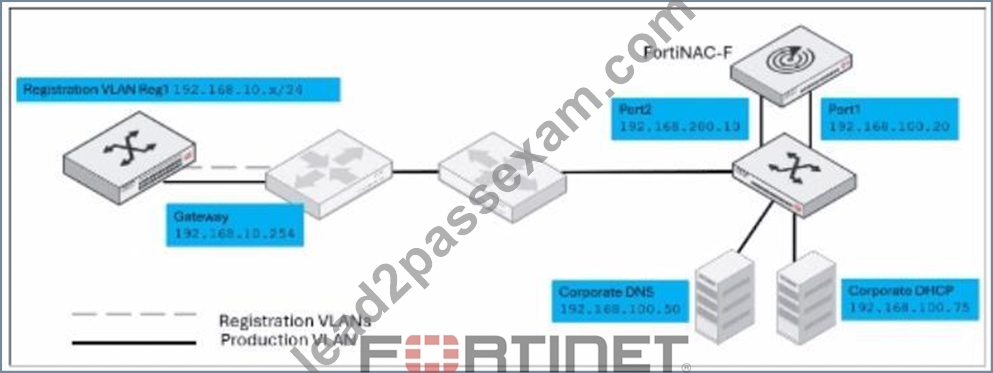
Given this topology, and a layer 3 registration network configuration, which IP address would be designated in the DHCP relay configuration for the registration network?
- A. 192.168.200.10
- B. 192.168.100.20
- C. 192.168.100 75
- D. 192.168.10.254
Answer: A
Explanation:
The correct answer is D . In a Layer 3 registration or isolation network design, DHCP requests from the isolated registration VLAN are not served locally on that VLAN by a normal production DHCP server.
Instead, the registration VLAN's DHCP relay must forward DHCP traffic to FortiNAC-F port2 , because port2 is the captive network service interface. The study guide states that in Layer 3 captive networks, DHCP traffic is relayed to port2 from the captive networks, and that the FortiNAC-F port2 interface provides DHCP, DNS, and captive portal services for hosts assigned to those captive networks.
In the exhibit, the registration VLAN is 192.168.10.x/24 , with gateway 192.168.10.254 . That gateway is where the DHCP relay would be configured, but it is not the relay destination. The relay destination must be the FortiNAC-F port2 address, shown as 192.168.200.10 . The corporate DHCP server 192.168.100.75 is for production network addressing, not registration isolation. The FortiNAC-F port1 address 192.168.100.20 is the administrative or production-facing interface, not the captive network service interface. Therefore, the DHCP relay should point to 192.168.200.10 .
NEW QUESTION # 22
When creating a device profiling rule, what are two advantages of registering the device in the host view? (Choose two.)
- A. The devices will have connection logs.
- B. The devices can be polled for connection status.
- C. The devices can be associated with a user.
- D. The devices can be managed as a generic SNMP device.
Answer: A,C
Explanation:
In FortiNAC-F, the Device Profiler is a rule-based engine that evaluates unknown "rogue" devices and classifies them based on fingerprints and behavior. When a profiling rule matches a device, the administrator can configure the rule to automatically register that device. The registration process can place the device record in two primary locations: the Topology View (as a device) or the Host View (as a registered host).
According to the FortiNAC-F Administration Guide, registering a device in the Host View provides significant advantages for identity management and historical tracking. First, the devices can be associated with a user (C). In the FortiNAC database architecture, the Host View is the primary repository for endpoint identity; placing a profiled device here allows the system to link that hardware (MAC address) to a specific user account, whether that user is an employee, guest, or a system-level "owner". This association is essential for Role-Based Access Control (RBAC) and for tracking accountability across the network fabric.
Second, devices registered in the Host View will have connection logs (B). FortiNAC-F maintains a detailed operational history for all host records, including every instance of the device connecting to or disconnecting from a port, its IP address assignments, and the specific policies applied during each session. These logs are invaluable for troubleshooting connectivity issues and for security forensic audits, as they provide a clear timeline of the device's lifecycle on the network. In contrast, devices managed only in the Topology View are typically treated as infrastructure components where the focus is on device availability rather than individual session history.
"Devices that are registered and associated with a user are placed in the Host View and removed from the Profiled Devices window... Placing a device in the Host View allows for the tracking of connection history and the association of the device with a specific identity or user record within the FortiNAC database." - FortiNAC-F Administration Guide: Device Profiler How it Works.
NEW QUESTION # 23
Refer to the exhibits.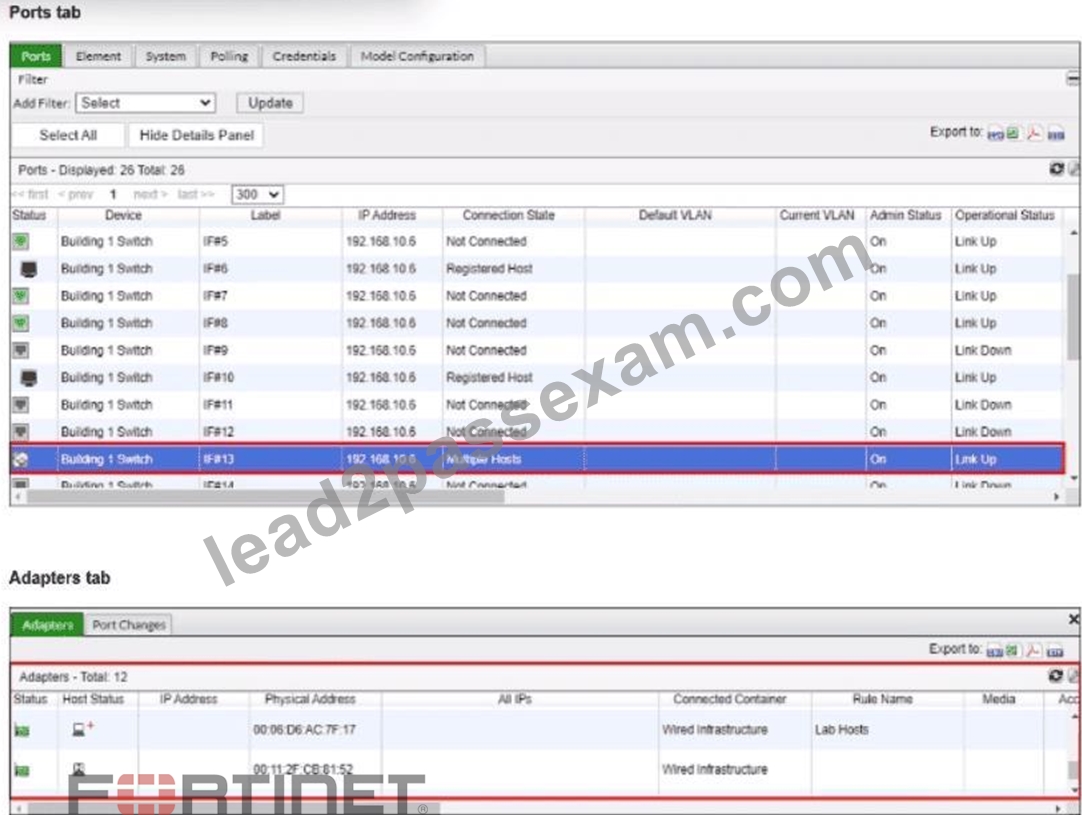
What would happen if the highlighted port with connected hosts was placed in both the Forced Registration and Forced Remediation port groups?
- A. Both types of enforcement would be applied
- B. Multiple enforcement groups could not contain the same port.
- C. Only the higher ranked enforcement group would be applied.
- D. Enforcement would be applied only to rogue hosts
Answer: C
Explanation:
In FortiNAC-F,Port Groupsare used to apply specific enforcement behaviors to switch ports. When a port is assigned to an enforcement group, such asForced RegistrationorForced Remediation, FortiNAC-F overrides normal policy logic to force all connected adapters into that specific state. The exhibit shows a port (IF#13) with " Multiple Hosts " connected, which is a common scenario in environments using unmanaged switches or hubs downstream from a managed switch port.
According to theFortiNAC-F Administrator Guide, it is possible for a single port to be a member of multiple port groups. However, when those groups have conflicting enforcement actions-such as one group forcing a registration state and another forcing a remediation state-FortiNAC-F utilizes aranking systemto resolve the conflict. In the FortiNAC-F GUI underNetwork > Port Management > Port Groups, each group is assigned a rank. The system evaluates these ranks, andonly the higher ranked enforcement group is appliedto the port. If a port is in both a Forced Registration group and a Forced Remediation group, the group with the numerical priority (rank) will dictate the VLAN and access level assigned to all hosts on that port.
This mechanism ensures consistent behavior across the fabric. If the ranking determines that " Forced Registration " is higher priority, then even a known host that is failing a compliance scan (which would normally trigger Remediation) will be held in the Registration VLAN because the port-level enforcement takes precedence based on its rank.
" A port can be a member of multiple groups. If more than one group has an enforcement assigned, the group with thehighest rank(lowest numerical value) is used to determine the enforcement for the port. When a port is placed in a group with an enforcement, that enforcement is applied toall hostsconnected to that port, regardless of the host ' s current state. " -FortiNAC-F Administration Guide: Port Group Enforcement and Ranking.
NEW QUESTION # 24
Refer to the exhibit.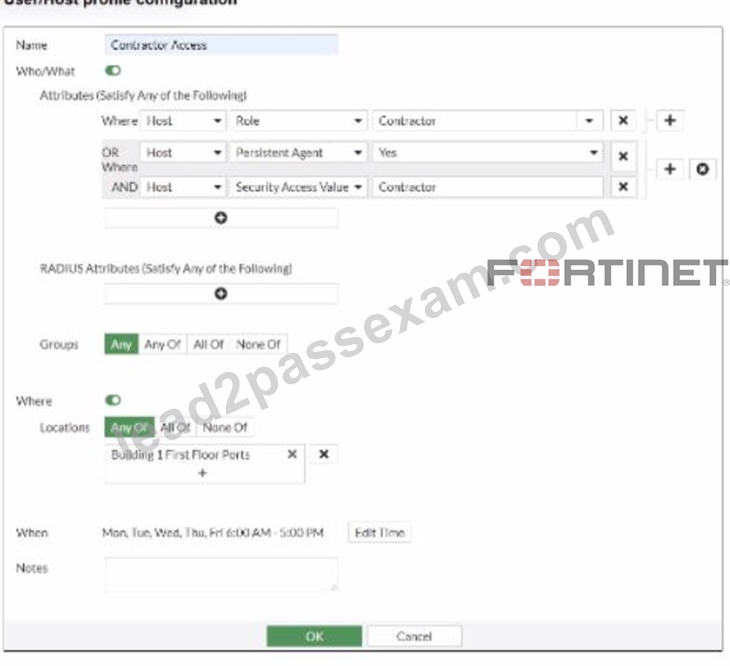
If a host is connected to a port in the Building 1 First Floor Ports group, what must also be true to match this user/host profile?
- A. The host must have a role value of contractor, an installed persistent agent or a security access value of contractor, and be connected between 6 AM and 5 PM.
- B. The host must have a role value of contractor or an installed persistent agent or a security access value of contractor, and be connected between 6 AM and 5 PM.
- C. The host must have a role value of contractor or an installed persistent agent, a security access value of contractor, and be connected between 9 AM and 5 PM.
- D. The host must have a role value of contractor or an installed persistent agent and a security access value of contractor, and be connected between 6 AM and 5 PM.
Answer: D
Explanation:
The User/Host Profile in FortiNAC-F is the fundamental logic engine used to categorize endpoints for policy assignment. As seen in the exhibit, the configuration uses a combination of Boolean logic operators (OR and AND) to define the "Who/What" attributes.
According to the FortiNAC-F Administrator Guide, attributes grouped together within the same bracket or connected by an OR operator require only one of those conditions to be met. In the exhibit, the first two attributes are "Host Role = Contractor" OR "Host Persistent Agent = Yes". This forms a single logical block. This block is then joined to the third attribute ("Host Security Access Value = Contractor") by an AND operator. Consequently, a host must satisfy at least one of the first two conditions AND satisfy the third condition to match the "Who/What" section.
Furthermore, the profile includes Location and When (time) constraints. The exhibit shows the location is restricted to the "Building 1 First Floor Ports" group. The "When" schedule is explicitly set to Mon-Fri 6:00 AM - 5:00 PM. For a profile to match, all enabled sections (Who/What, Locations, and When) must be satisfied simultaneously. Therefore, the host must meet the conditional contractor/agent criteria, possess the specific security access value, and connect during the defined 6 AM to 5 PM window.
"User/Host Profiles use a combination of attributes to identify a match. Attributes joined by OR require any one to be true, while attributes joined by AND must all be true. If a Schedule (When) is applied, the host must also connect within the specified timeframe for the profile to be considered a match. All criteria in the Who/What, Where, and When sections are cumulative." - FortiNAC-F Administration Guide: User/Host Profile Configuration.
NEW QUESTION # 25
Refer to the exhibits.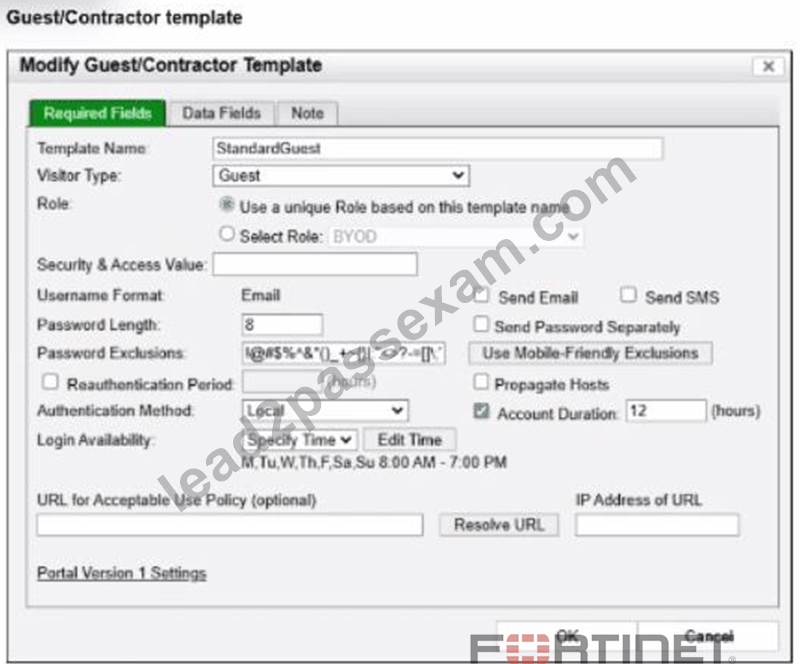
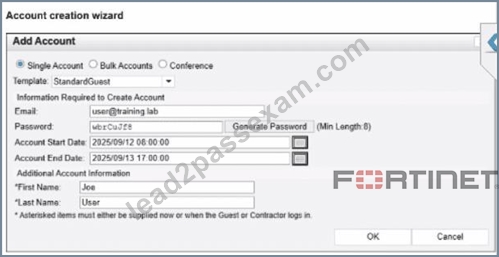
Based on the given configurations and settings, on which date and time would a guest account created at 8:00 AM on 2025/09/12 expire?
- A. 2025/09/12 at 7:00 PM
- B. 2025/09/12 at 17:00:00
- C. 2025/09/13 at 17:00:00
- D. 2025/09/12 at 8:00 PM
Answer: C
Explanation:
Questions no:22
Verified answer: D
Comprehensive and Detailed 250 to 300 words each Explanation with Exact Matched Extract from FortiNAC- F Administrator library and documentation for current versions (including F 7.2, 7.4, and 7.6) documents:
In FortiNAC-F, the expiration of a guest or contractor account is determined by the configuration settings within theAccount Creation Wizardand the associatedGuest/Contractor Template. While a template can define a default " Account Duration " (as seen in the 12-hour setting in the second exhibit), theAccount Creation Wizardallows an administrator to manually specify or override the start and end parameters for a specific user session.
According to theFortiNAC-F Administration Guideregarding guest management, theAccount End Datefield in the creation wizard is the definitive timestamp for when the account object will be disabled or deleted from the system. In the provided exhibit (Account Creation Wizard), the administrator has explicitly set theAccount Start Dateto2025/09/12 08:00:00and theAccount End Dateto2025/09/13 17:00:00.
Even though the template indicates an " Account Duration " of 12 hours, this value typically serves as a pre- populated default. When a manual date and time are entered into the wizard, those specific values take precedence for that individual account. The account will remain active and valid until5:00 PM (17:00:00)on the following day,2025/09/13. It is also important to note the " Login Availability " from the template (8:00 AM - 7:00 PM); while the accountexistsuntil the 13th at 17:00:00, the user would only be able to authenticate during the active hours defined by the login schedule on both days.
" When creating an account, the administrator can select a template to provide default settings. However, specific values such as theAccount End Datecan be modified within theAccount Creation Wizard. The date and time specified in the ' Account End Date ' field determines the absolute expiration of the account. Once this time is reached, the account is moved to an expired state and the user ' s network access is revoked. " - FortiNAC-F Administration Guide: Guest and Contractor Account Management.
NEW QUESTION # 26
Refer to the exhibit.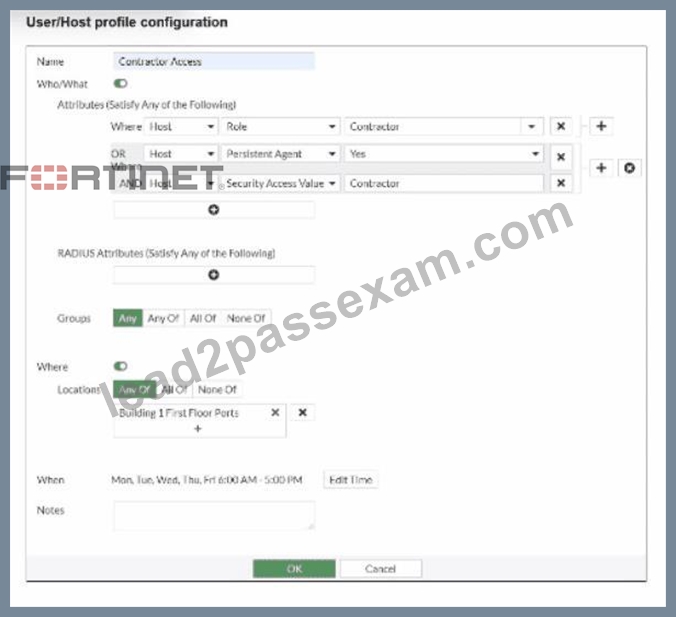
If a host is connected to a port in the Building 1 First Floor Ports group, what must also be true to match this user/host profile?
- A. The host must have a role value of contractor, an installed persistent agent or a security access value of contractor, and be connected between 6 AM and 5 PM.
- B. The host must have a role value of contractor or an installed persistent agent or a security access value of contractor, and be connected between 6 AM and 5 PM.
- C. The host must have a role value of contractor or an installed persistent agent, a security access value of contractor, and be connected between 9 AM and 5 PM.
- D. The host must have a role value of contractor or an installed persistent agent and a security access value of contractor, and be connected between 6 AM and 5 PM.
Answer: D
Explanation:
TheUser/Host Profilein FortiNAC-F is the fundamental logic engine used to categorize endpoints for policy assignment. As seen in the exhibit, the configuration uses a combination of Boolean logic operators (ORandAND) to define the " Who/What " attributes.
According to theFortiNAC-F Administrator Guide, attributes grouped together within the same bracket or connected by anORoperator require only one of those conditions to be met. In the exhibit, the first two attributes are " Host Role = Contractor " OR " Host Persistent Agent = Yes " . This forms a single logical block. This block is then joined to the third attribute ( " Host Security Access Value = Contractor " ) by anANDoperator. Consequently, a host must satisfyat least oneof the first two conditionsANDsatisfy the third condition to match the " Who/What " section.
Furthermore, the profile includesLocationandWhen(time) constraints. The exhibit shows the location is restricted to the " Building 1 First Floor Ports " group. The " When " schedule is explicitly set toMon-Fri 6:00 AM - 5:00 PM. For a profile to match,allenabled sections (Who/What, Locations, and When) must be satisfied simultaneously. Therefore, the host must meet the conditional contractor/agent criteria, possess the specific security access value, and connect during the defined 6 AM to 5 PM window.
" User/Host Profiles use a combination of attributes to identify a match. Attributes joined byORrequire any one to be true, while attributes joined byANDmust all be true. If aSchedule(When) is applied, the host must also connect within the specified timeframe for the profile to be considered a match. All criteria in the Who
/What, Where, and When sections are cumulative. " -FortiNAC-F Administration Guide: User/Host Profile Configuration.
NEW QUESTION # 27
When creating a user or host profile, which three criteria can you apply? (Choose three.)
- A. An applied access policy
- B. Host or user group memberships
- C. Host or user attributes
- D. Adapter current VLAN
- E. Location
Answer: B,C,E
Explanation:
The User/Host Profile is the primary mechanism in FortiNAC-F for identifying and categorizing endpoints to determine their level of network access. According to the FortiNAC-F Administration Guide, a profile is built using a combination of criteria that define "Who" is connecting, "What" device they are using, and "Where" they are located on the network.
The three main categories of criteria available in the configuration are:
Host or User Attributes (B): This includes specific details such as the host's operating system, the user's role (e.g., Employee, Contractor), or custom attributes assigned to the record.
Host or User Group Memberships (A): Profiles can be configured to match endpoints that are members of specific internal FortiNAC groups or synchronized directory groups (like LDAP or Active Directory groups). This allows for broad policy application based on organizational structure.
Location (E): The "Where" component allows administrators to restrict a profile match to specific physical or logical areas of the network, such as a particular switch, a group of ports, or a specific SSID.
Criteria like an "applied access policy" (D) are the outcome of a profile match rather than a criterion used to define the profile itself. Similarly, the "Adapter current VLAN" (C) is a dynamic state that changes based on enforcement and is not a standard static identifier used for profile matching.
"User/Host Profiles are used to identify the hosts and users to which a policy will apply. Profiles are created by selecting various criteria in the Who/What (Attributes and Groups) and Where (Locations) sections. Attributes can include Host Role, User Role, and OS. Group memberships allow matching based on internal or directory-based groups. Location criteria allow for filtering based on the device or port where the host is connected." - FortiNAC-F Administration Guide: User/Host Profile Configuration.
NEW QUESTION # 28
Refer to the exhibits.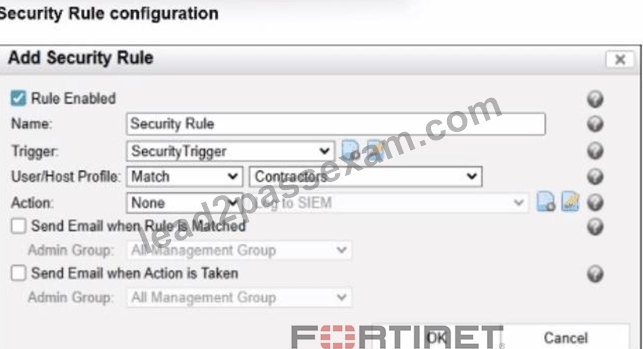
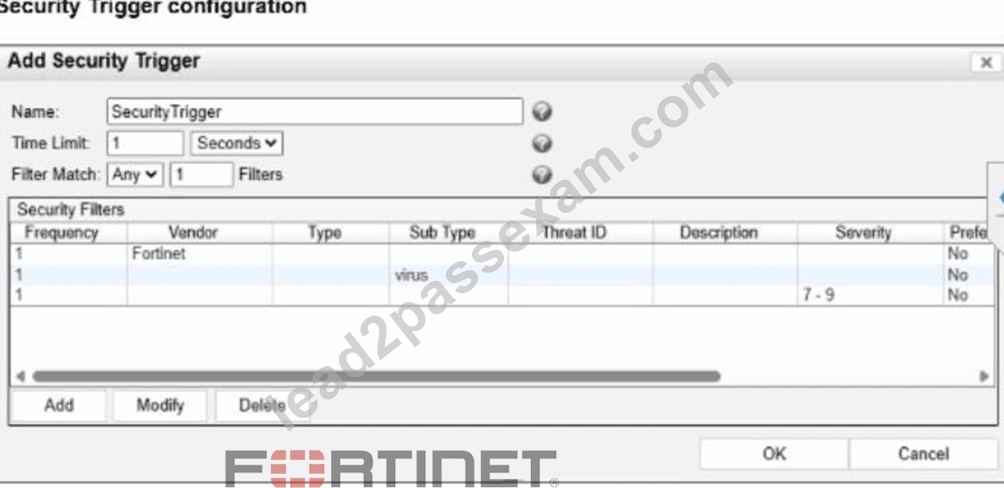
Given the current configuration, what would happen if a contractor triggered two of the defined security filters?
- A. Two security events would be generated, but no security alarm would be generated
- B. A security alarm and two security events would be generated.
- C. A security event and a security alarm would be generated.
- D. Three security events and one security alarm would be generated.
Answer: B
Explanation:
The correct answer is B . In the trigger exhibit, the Filter Match setting is configured as Any 1 Filters , meaning the security trigger is satisfied when any one of the defined filters matches within the configured time window. The contractor triggers two of the defined filters, so two separate security events are generated because FortiNAC-F creates a security event whenever a security filter matches. The study guide confirms that each matched filter generates a security event, and when a trigger contains multiple filters, multiple matched filters can be associated with the resulting alarm.
The security rule exhibit also shows User/Host Profile: Match Contractors . Because the triggering user is a contractor, the user/host profile condition is satisfied. Once the trigger is satisfied and the user/host profile matches, FortiNAC-F generates a security alarm . The fact that Action is set to None does not stop the alarm from being generated; it only means no automated or manual response action is executed from that rule.
Option A is wrong because the contractor profile matches, so an alarm is generated. Option C is wrong because only two filters were triggered, not three. Option D is wrong because two filters matched, so two events are generated, not one.
NEW QUESTION # 29
Refer to the exhibit.
A FortiNAC-F N+1 HA configuration is shown.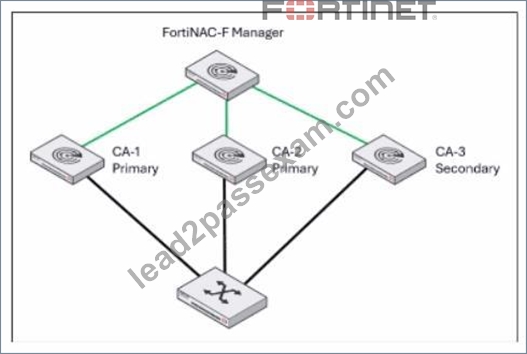
What will occur if CA-2 fails?
- A. CA-3 will be promoted to a primary and share management responsibilities with CA-1.
- B. CA-1 and CA-3 will operate as a 1+1 HA cluster with CA-3 acting as a hot standby.
- C. CA-3 will be promoted to a primary and FortiNAC-F manager will load balance between CA-1 and CA-
3. - D. CA-3 will continue to operate as a secondary in an N+1 HA configuration.
Answer: D
Explanation:
In anN+1 High Availability (HA)configuration, a single secondary Control and Application (CA) server provides backup for multiple primary CA servers. The FortiNAC-F Manager (FortiNAC-M) acts as the centralized orchestrator for this cluster, monitoring the health of all participating nodes.
According to theFortiNAC-F 7.6.0 N+1 Failover Reference Manual, when a primary CA (such asCA-2in the exhibit) fails, the secondary CA (CA-3) is automatically promoted by the Manager to take over the specific workload and database functions of that failed primary. Crucially, the documentation specifies that even after this promotion, the system architecture maintains its N+1 logic. The secondary CA effectively " assumes the identity " of the failed primary while continuing to operate within the N+1 framework established by the Manager.
It doesnotmerge with CA-1 to form a traditional 1+1 active/passive cluster (A), nor does it engage in load balancing (D), as FortiNAC-F HA is designed for redundancy and failover rather than active traffic distribution. Furthermore, CA-3 does not " share " management with CA-1 (C); it independently handles the tasks originally assigned to CA-2. Throughout this failover state, the Manager continues to oversee the group, and CA-3 remains the designated secondary unit currently acting in a primary capacity for the downed node until CA-2 is restored.
" In an N+1 Failover Group, theSecondary CAis designed to take over the functionality ofany single failed primary componentwithin the group. The FortiNAC Manager monitors the primaries and initiates the failover to the secondary... Once failover occurs, the secondary continues to operate as the backup unit for the failed primary while remaining part of the managed N+1 HA configuration. " -FortiNAC-F 7.6.0 N+1 Failover Reference Manual: Failover Behavior Section.
NEW QUESTION # 30
......
Real Updated NSE5_FNC_AD_7.6 Questions Pass Your Exam Easily: https://www.lead2passexam.com/Fortinet/valid-NSE5_FNC_AD_7.6-exam-dumps.html
Top-Class NSE5_FNC_AD_7.6 Question Answers Study Guide: https://drive.google.com/open?id=1K7KI_bb_eMCdfwj-DjcJyX5he-OkYqAX