

Latest HPE7-A01 Pass Guaranteed Exam Dumps Certification Sample Questions
New HPE7-A01 Test Materials & Valid HPE7-A01 Test Engine
HP HPE7-A01 Exam Syllabus Topics:
| Topic | Details |
|---|---|
| Topic 1 |
|
| Topic 2 |
|
| Topic 3 |
|
| Topic 4 |
|
| Topic 5 |
|
| Topic 6 |
|
HPE7-A01 exam and the ACCP certification are valuable credentials for IT professionals who work with Aruba wireless networks. They demonstrate a high level of expertise and can help professionals advance their careers in the field of wireless networking.
NEW QUESTION # 35
In AOS 10. which session-based ACL below will only allow ping from any wired station to wireless clients but will not allow ping from wireless clients to wired stations"? The wired host ingress traffic arrives on a trusted port.
- A. ip access-list session pingFromWired any any svc-icmp deny any user svc-icmp permit
- B. ip access-list session pingFromWired user any svc-icmp deny any any svc-icmp permit
- C. ip access-list session pingFromWired any user any permit
- D. ip access-list session pingFromWired any any svc-icmp permit user any svc-icmp deny
Answer: A
Explanation:
A session-based ACL is applied to traffic entering or leaving a port or VLAN based on the direction of the session initiation. To allow ping from any wired station to wireless clients but not vice versa, a session-based ACL should be used to deny icmp echo traffic from any source to any destination, and then permit icmp echo-reply traffic from any source to user destination. The user role represents wireless clients in AOS 10. Reference: https://techhub.hpe.com/eginfolib/Aruba/OS-CX_10.04/5200-6692/GUID-BD3E0A5F-FE4C-4B9B-BE1D-FE7D2B9F8C3A.html https://techhub.hpe.com/eginfolib/networking/docs/arubaos-switch/security/GUID-EA0A5B3C-FE4C-4B9B-BE1D-FE7D2B9F8C3A.html
NEW QUESTION # 36
What is the order of operations tor Key Management service for a wireless client roaming from AP1 to AP2?
Answer:
Explanation: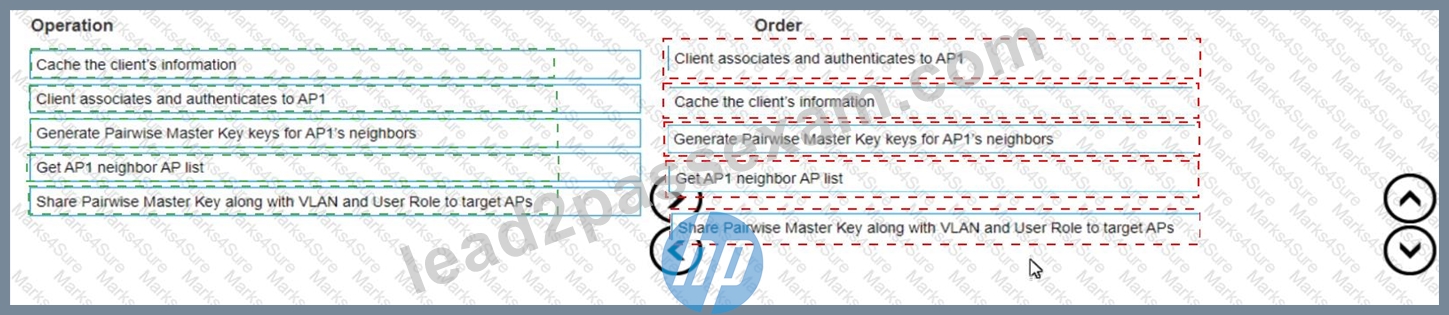
Explanation
https://www.arubanetworks.com/techdocs/Instant_85_WebHelp/Content/instant-ug/wlan-ssid-conf/conf-fast-roa
NEW QUESTION # 37
Using Aruba best practices what should be enabled for visitor networks where encryption is needed but authentication is not required?
- A. Opportunistic Wireless Encryption
- B. Wi-Fi Protected Access 3 Enterprise
- C. Wired Equivalent Privacy
- D. Open Network Access
Answer: A
Explanation:
Explanation
Opportunistic Wireless Encryption (OWE) is a feature that provides encryption for open wireless networks without requiring authentication. OWE uses an enhanced version of the 4-way handshake to establish a pairwise key between the client and the AP, which is then used to encrypt the wireless traffic using WPA2 or WPA3 protocols. OWE can be used for visitor networks where encryption is needed but authentication is not required. References: https://www.arubanetworks.com/assets/tg/TG_OWE.pdf
NEW QUESTION # 38
What is used to retrieve data stored in a Management Information Base (MIS)?
SNMPv3
DSCP
TLV
CDP
Answer:
Explanation:
SNMPv3.
SNMPv3 is a protocol that is used to retrieve data stored in a Management Information Base (MIB), which is a database of managed objects in a network. SNMPv3 provides security and access control features that are not available in earlier versions of SNMP. SNMPv3 can also use encryption to protect the data from unauthorized access or modification.
According to the Aruba Certified Professional - Campus Access document1, one of the skills that this certification validates is:
Implement and Analyze the output from common network monitoring tools
Configure Port Mirroring to collect PCAPs
Configure NAE agents 9.4
Configure UXI sensors for internal and external tests
Describe how API scan be used to configure, manage, monitor, and troubleshoot your network The document also mentions that the candidate should have a distinguished understanding of different protocols across vendors, which implies that they should be familiar with SNMPv3 and how it can be used to access MIB data.
Explanation:
The correct answer is
NEW QUESTION # 39
What is true regarding 802.11k?
- A. It reduces roaming delay by pre-authenticating clients with multiple target APs before a client roams to an AP
- B. It extends radio measurements to define mechanisms for wireless network management of stations
- C. It provides mechanisms for APs and clients to dynamically measure the available radio resources.
- D. It considers several metrics before it determines if a client should be steered to the 5GHz band, including client RSSI
Answer: C
Explanation:
802.11k is a standard that provides mechanisms for APs and clients to dynamically measure the available radio resources in a wireless network. 802.11k defines radio resource management (RRM) functions, such as neighbor reports, link measurement, beacon reports, etc., that allow APs and clients to exchange information about the RF environment and make better roaming decisions. The other options are incorrect because they describe other standards, such as 802.11r, 802.11v, or 802.11ax. Reference: https://www.arubanetworks.com/assets/wp/WP_WiFi6.pdf https://www.arubanetworks.com/assets/ds/DS_AP510Series.pdf
NEW QUESTION # 40
How is Multicast Transmission Optimization implemented in an HPE Aruba wireless network?
- A. The optimal rate for sending multicast frames is based on the lowest broadcast rate across all associated clients.
- B. The optimal rate for sending multicast frames is based on the lowest unicast rate across all associated clients.
- C. When this option is enabled the minimum default rate for multicast traffic is set to 12 Mbps for 5 GHz
- D. "The optimal rate for sending multicast frames is based on the highest broadcast rate across all associated clients
Answer: B
Explanation:
Explanation
multicast transmission optimization is a feature that allows the IAP to select the optimal rate for sending broadcast and multicast frames based on the lowest of unicast rates across all associated clients1. When this option is enabled, multicast traffic can be sent at up to 24 Mbps. The default rate for sending frames for 2.4 GHz is 1 Mbps and 5.0 GHz is 6 Mbps. This option is disabled by default1.
NEW QUESTION # 41
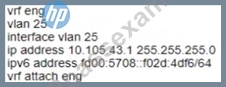
You are configuring an SVI on an Aruba CX switch that needs to have the following characteristics:
* VLANID = 25
. IPv4 address 10 105 43 1 with mask 255 255 255.0
* IPv6 address fd00:5708::f02d:4df6 with a 64 bit prefix length
* member of VRF eng
* VRF eng and VLAN 25 have not yet been created
Which command lists will satisfy the requirements with the least number of commands?
- A.
- B.

- C.

- D.

Answer: D
Explanation:
The other options either use more commands or do not create the VRF or the VLAN.
Option C uses the following commands:
vrf eng: This command creates a VRF named eng and enters the VRF configuration mode1.
vlan 25: This command creates a VLAN with ID 25 and enters the VLAN configuration mode2.
interface vlan 25: This command creates an SVI on VLAN 25 and enters the interface configuration mode3.
ip address 10.105.43.1/24 ipv6 address fd00:5780::102d:4df6/64 vrf attach eng: This command assigns an IPv4 address of 10.105.43.1 with a subnet mask of 255.255.255.0 and an IPv6 address of fd00:5780::102d:4df6 with a prefix length of 64 to the SVI, and attaches it to the VRF eng.
NEW QUESTION # 42
By default, Best Effort is higher priority than which priority traffic type?
- A. Background
- B. All queues
- C. Internet Control
- D. Network Control
Answer: A
Explanation:
This is because Best Effort traffic is all other kinds of non-detrimental traffic that are not sensitive to Quality of Service metrics (jitter, packet loss, latency). A typical example would be peer-to-peer and email applications2. Background traffic is a type of traffic that is used for system maintenance or backup purposes and does not affect the performance or availability of the network3.
Therefore, Best Effort traffic has a higher priority than Background traffic in terms of network resources allocation and management.
1: https://www.arubanetworks.com/techdocs/ArubaDocPortal/content/docportal.htm 2: https://stackoverflow.com/questions/33854306/best-effort-traffic-and-real-time-traffic-difference 3: https://www.informit.com/articles/article.aspx?p=25315&seqNum=4
NEW QUESTION # 43
Which statements are true about VSX LAG? (Select two.)
- A. Up to 255 VSX lags can be configured on all 83xx and 84xx model switches.
- B. Outgoing traffic is preferentially switched to local members of the LAG.
- C. Outgoing traffic is switched to a port based on a hashing algorithm which may be either switch in the pair
- D. LAG traffic is passed over VSX ISL links only while upgrading firmware on the switch pair
- E. The total number of configured links may not exceed 8 for the pair or 4 per switch
Answer: B,E
Explanation:
The correct answers are A and D.
According to the web search results, VSX LAG is a feature that allows multiple PSKs to be used on a single SSID, providing device-specific or group-specific passphrases for enhanced security and deployment flexibility for headless IoT devices1. VSX LAGs span both aggregation switches and appear as one device to partner downstream or upstream devices or both when forming a LAG with the VSX pair2.
One of the statements that is true about VSX LAG is that the total number of configured links may not exceed 8 for the pair or 4 per switch1. This means that a VSX LAG across a downstream switch can have at most a total of eight member links, and a switch can have a maximum of four member links. When creating a VSX LAG, it is recommended to select an equal number of member links in each segment for load balancing1.
Another statement that is true about VSX LAG is that outgoing traffic is preferentially switched to local members of the LAG2. This means that when active forwarding and active gateway are enabled, north-south and south-north traffic bypasses the ISL link and uses the local ports on the switch. This optimizes the traffic path and reduces the load on the ISL link2.
The other statements are false or not relevant for VSX LAG. Outgoing traffic is not switched to a port based on a hashing algorithm, which may be either switch in the pair. This is a characteristic of MLAG (Multi-Chassis Link Aggregation), which is a different feature from VSX LAG. LAG traffic is not passed over VSX ISL links only while upgrading firmware on the switch pair. This is a scenario that may occur when performing hitless upgrades, which is a feature that allows software updates without impacting network availability. The number of VSX lags that can be configured on all 83xx and 84xx model switches is not 255, but depends on the switch model and firmware version. For example, the AOS-CX 10.04 supports up to 64 VSX lags for 8320 switches and up to 128 VSX lags for 8325 and 8400 switches.
NEW QUESTION # 44
Your Director of Security asks you to assign AOS-CX switch management roles to new employees based on their specific job requirements. After the configuration was complete, it was noted that a user assigned with the auditors role did not have the appropriate level of access on the switch.
The user was not allowed to perform firmware upgrades and a privilege level of 15 was not assigned to their role. Which default management role should have been assigned for the user?
- A. sysadmin
- B. config
- C. sysops
- D. administrators
Answer: C
Explanation:
The correct answer is B. sysops.
The sysops user role is a predefined role that allows users to perform system operations on the switch, such as backup, restore, upgrade, or reboot. The sysops user role also has access to the PUT and POST methods for REST API, which can be used to modify the switch configuration. The sysops user role has a privilege level of 15, which is the highest level of access on the switch1.
The other options are incorrect because:
A) sysadmin: The sysadmin user role is a predefined role that allows users to view and modify the switch configuration using the CLI or the Web UI. The sysadmin user role does not have access to the REST API methods, and cannot perform firmware upgrades1.
C) administrators: The administrators user role is a predefined role that has full access to all switch configuration information and all REST API methods. This role is more than what the Director of Security requires1.
D) config: The config user role is a predefined role that allows users to view and modify the switch configuration using the CLI or the Web UI. The config user role does not have access to the REST API methods, and cannot perform firmware upgrades1.
NEW QUESTION # 45
A company recently upgraded its campus switching infrastructure with Aruba 6300 CX switches. They have implemented 802.1X authentication on edge ports where laptop and loT devices typically connect An administrator has noticed that for PoE devices the pons are delivering the maximum wattage instead of what the device actually needs Upon connecting the loT devices, the devices request their specific required wattage through information exchange
- A. Enable AAA authentication to exempt LLDP and/or CDP information
- B. Globally enable the QoS trust setting for LLDP and/or CDP
- C. Concerned about this waste of electricity, what should the administrator implement to solve this problem?
- D. Create device profiles with the correct power definitions.
- E. implement a classifier policy with the correct power definitions.
Answer: D
Explanation:
According to the Aruba Documentation Portal1, the Aruba 6300 CX switches support various features to control the PoE devices on specific ports, such as device profiles and classifier policies. These features can help reduce the power consumption and improve the performance of the PoE devices.
1: https://www.arubanetworks.com/techdocs/AOS-CX/10.10/HTML/monitoring_6300-6400/Content/Chp_LEDs/fro-pan-led-630.htm 2: https://www.arubanetworks.com/products/switches/6300-series/ 3: https://docs.samsungknox.com/admin/knox-manage/configure/profile/configure-profile-policies/configure-profile-policies-by-device-platform/
NEW QUESTION # 46
A customer is concerned about me unprotected traffic between an AOS-CX switch and a gateway, running on AOStO. What is a feasible option to protect this traffic?
- A. Implement a GRE tunnel to protect PAPI between the AOS-CX switches and the gateway
- B. Implement an IPSec tunnel to protect PAPI between the AOS-CX switches and the gateway
- C. no action is needed, an RSA certificate already encrypts the traffic
- D. Implement an MD5 HMAC function lo protect PAPI between the AOS-CX switches and the gateway
Answer: B
Explanation:
Explanation
According to the Aruba Documentation Portal1, PAPI (Port Aggregation Protocol) is a protocol that allows multiple physical ports to be aggregated into a single logical port for increased bandwidth and performance.
PAPI can be used between AOS-CX switches and gateways, or between AOS-CX switches and other devices.
Option A: Implement an IPSec tunnel to protect PAPI between the AOS-CX switches and the gateway This is because option A shows how to implement an IPSec tunnel between two devices using the interface command and the ipsec command. An IPSec tunnel can provide encryption and authentication for PAPI traffic between two devices, such as an AOS-CX switch and a gateway2.
Therefore, option A is a feasible option to protect this traffic.
I hope this helps you. If you need more information, please let me know.
1:
https://www.arubanetworks.com/techdocs/AOS-CX/10.06/HTML/5200-7727/Content/Chp_prev_traf_loss/Act_g
https://community.arubanetworks.com/blogviewer?blogkey=989fc43a-e0df-42db-9c0b-f96d6565a1fa
NEW QUESTION # 47
Refer to the image.
Your customer is complaining of weak Wi-Fi coverage in their office. They mention that the office on the other side of the hall has much better signal What is the likely cause of this issue7
- A. The AP is a remote access point.
- B. The AP is an outdoor access point.
- C. The AP is using a directional antenna.
- D. The AP is configured in Mesh mode
Answer: C
Explanation:
Explanation
The likely cause of the issue of weak Wi-Fi coverage in the office is that the AP is using a directional antenna.
A directional antenna is an antenna that radiates or receives radio waves more strongly in one or more directions, creating a focused beam of signal. A directional antenna can provide better coverage and performance for a specific area, but it can also create dead zones or weak spots for other areas. The other options are incorrect because they either do not affect the Wi-Fi coverage or do not match the scenario.
References:
https://www.arubanetworks.com/techdocs/ArubaOS_86_Web_Help/Content/arubaos-solutions/wlan-rf/rf-fundam
https://www.arubanetworks.com/techdocs/ArubaOS_86_Web_Help/Content/arubaos-solutions/wlan-rf/antennas.
NEW QUESTION # 48
How do you allow a new VLAN 100 between VSX pair inter-switch-link 256 for port 1/45 and 2/45?
- A. vlan trunk add 100 in LAG256
- B. vlan trunk allowed 100 in LAG256
- C. vlan trunk add 100 in MLAG256
- D. vlan trunk allowed 100 for ports 1/45 and 1/46
Answer: B
Explanation:
Explanation
To allow a new VLAN 100 between VSX pair inter-switch-link 256 for port 1/45 and 2/45, you need to use the command vlan trunk allowed 100 in LAG256. This will add VLAN 100 to the list of allowed VLANs on the trunk port LAG256, which is part of the inter-switch-link between VSX peers. The other options are incorrect because they either do not use the correct command or do not specify the correct port or VLAN.
References: https://www.arubanetworks.com/techdocs/AOS-CX/10.04/HTML/5200-6728/bk01-ch07.html
https://www.arubanetworks.com/techdocs/AOS-CX/10.04/HTML/5200-6728/bk01-ch02.html
NEW QUESTION # 49
You need to have different routing-table requirements with Aruba CX 6300 VSF configuration Assuming the correct layer-2 VLAN already exists how would you create a new OSPF configuration for a separate routing table?
- A. Attach OSPF process ID in the VRF configuration.
- B. Create a new OSPF process ID with vrf name.
- C. Create a new OSPF area, and attach VRF name.
- D. Attach a new OSFP process ID with a custom routing table
Answer: B
Explanation:
Explanation
To create a new OSPF configuration for a separate routing table, you need to create a new OSPF process ID with vrf name. This will create a new OSPF instance that is associated with the specified VRF and its routing table. The other options are incorrect because they either do not create a new OSPF instance or do not associate it with a VRF. References:
https://www.arubanetworks.com/techdocs/AOS-CX/10.04/HTML/5200-6728/bk01-ch02.html
https://www.arubanetworks.com/techdocs/AOS-CX/10.04/HTML/5200-6728/bk01-ch03.html
NEW QUESTION # 50
A new network design is being considered to minimize client latency in a high-density environment. The design needs to do this by eliminating contention overhead by dedicating subcamers to clients.
Which technology is the best match for this use case?
- A. QWMM
- B. MU-MIMO
- C. OFDMA
- D. Channel Bonding
Answer: C
Explanation:
Explanation
OFDMA (Orthogonal Frequency Division Multiple Access) is a technology that can minimize client latency in a high-density environment by eliminating contention overhead by dedicating subcarriers to clients. OFDMA allows multiple clients to transmit simultaneously on different subcarriers within the same channel, reducing contention and increasing efficiency. MU-MIMO (Multi-User Multiple Input Multiple Output) is a technology that allows multiple clients to transmit simultaneously on different spatial streams within the same channel, but it does not eliminate contention overhead. QWMM (Quality of Service Wireless Multimedia) is a technology that prioritizes traffic based on four access categories, but it does not eliminate contention overhead. Channel Bonding is a technology that combines two adjacent channels into one wider channel, increasing bandwidth but not eliminating contention overhead. References:
https://www.arubanetworks.com/assets/ds/DS_AP510Series.pdf
https://www.arubanetworks.com/assets/wp/WP_WiFi6.pdf
NEW QUESTION # 51
Which statements regarding 0SPFv2 route redistribution are true for Aruba OS CX switches? (Select two.)
- A. The "redistribute ospf" command will redistribute routes from all OSPF V2 and V3 processes
- B. The "redistribute connected" command will redistribute all connected routes for the switch except local loopback addresses.
- C. The "redistribute static route-map connected-routes" command will redistribute all static routes with a matching permit in the route map "connected-routes-
- D. The "redistribute static route-map connected-routes" command will redistribute all static routes without a matching deny in the route map "connected-routes".
- E. The "redistribute connected" command will redistribute all connected routes for the switch including local loopback addresses
Answer: C,E
Explanation:
These are two correct statements regarding OSPFv2 route redistribution for Aruba OS CX switches. Route redistribution is a process that allows routes from one routing protocol or source to be injected into another routing protocol or destination. OSPFv2 is a link-state routing protocol that supports route redistribution from various sources, such as connected, static, BGP, etc. The "redistribute connected" command will redistribute all connected routes for the switch, including local loopback addresses, into OSPFv2. The "redistribute static route-map connected-routes" command will redistribute all static routes that have a matching permit statement in the route map named "connected-routes" into OSPFv2. The other statements are incorrect because they either do not reflect the correct behavior of route redistribution commands or do not exist as valid commands. Reference: https://www.arubanetworks.com/techdocs/AOS-CX/10.04/HTML/5200-6728/bk01-ch02.html https://www.arubanetworks.com/techdocs/AOS-CX/10.04/HTML/5200-6728/bk01-ch03.html
NEW QUESTION # 52
......
HPE7-A01 certification exam is an excellent opportunity for IT professionals to validate their skills and expertise in wireless networking using Aruba solutions. Aruba Certified Campus Access Professional Exam certification demonstrates a professional's ability to design, deploy, and support secure and reliable wireless networks and can lead to exciting career opportunities in the wireless networking field. With preparation and dedication, IT professionals can pass the HPE7-A01 exam and distinguish themselves in the industry as Aruba Certified Campus Access Professionals.
HPE7-A01 Sample with Accurate & Updated Questions: https://www.lead2passexam.com/HP/valid-HPE7-A01-exam-dumps.html
HPE7-A01 Updated Exam Dumps [2024] Practice Valid Exam Dumps Question: https://drive.google.com/open?id=19eii9QTMKb0PrtqybpVdOYSGHoDTO5Lc