

New 2026 Realistic SD-WAN-Engineer Dumps Test Engine Exam Questions in here
Updated Official licence for SD-WAN-Engineer Certified by SD-WAN-Engineer Dumps PDF
Palo Alto Networks SD-WAN-Engineer Exam Syllabus Topics:
| Topic | Details |
|---|---|
| Topic 1 |
|
| Topic 2 |
|
| Topic 3 |
|
| Topic 4 |
|
| Topic 5 |
|
NEW QUESTION # 33
By default, how many days will Prisma SD-WAN VPNs stay operational before the keys expire when an ION device loses connection with the controller?
- A. 0
- B. 1
- C. 2
- D. 3
Answer: D
Explanation:
Comprehensive and Detailed Explanation
The Prisma SD-WAN (CloudGenix) solution is designed with a separation of the control plane (Controller) and the data plane (ION devices).1 In the event that an ION device loses connectivity to the Cloud Controller (often referred to as running in "headless mode"), the device continues to forward traffic and maintain existing VPN tunnels using the keys it currently holds.2 However, for security purposes, the VPN session keys (shared secrets) used for the Secure Fabric have a finite validity period. The system is designed such that these keys are rotated regularly.3 If the controller is unreachable, the ION device can continue to rotate keys locally and maintain the VPNs for a maximum default period of 72 hours (exactly 3 days).4 If the connection to the controller is not restored within this 72-hour window, the keys will eventually expire, and the ION will be unable to retrieve new authorized key material from the controller.5 Consequently, the VPN tunnels will go down, and the "out of shared secret key" error will be observed in the VPN status logs. This mechanism ensures that a permanently compromised or stolen device cannot maintain network access indefinitely without central authorization.
NEW QUESTION # 34
What are two requirements for implementing user/group-based path policies? (Choose two.)
- A. Data center ION
- B. Internal host detection
- C. Cloud Identity Engine
- D. Autonomous Digital Experience Manager (ADEM)
Answer: A,C
Explanation:
Comprehensive and Detailed Explanation
To implement User/Group-based policies (Path, QoS, or Security) in Prisma SD-WAN, the system requires two specific components to resolve user identities and map them to IP addresses within the fabric.
Cloud Identity Engine (CIE): This is the primary requirement for identity management. The Cloud Identity Engine connects the Prisma SD-WAN controller to your directory service (e.g., Active Directory, Azure AD/Entra ID). It allows the system to retrieve and resolve User and Group attributes (e.g., "Marketing Group," "User: john.doe") so they can be selected in policy rules. Without CIE, the controller cannot interpret the group names or user identities defined in the policies.
Data Center ION: In the standard deployment model for User-ID, a Data Center (DC) ION is required to act as the bridge or collector for IP-to-User mappings. The DC ION connects to the User-ID Agent (running on a PAN-OS firewall or Windows Server) to learn the mapping of IP addresses to usernames. It then redistributes this information to the controller or other branch IONs so they can identify which user is associated with the traffic flows originating from a specific private IP address.
NEW QUESTION # 35
What are two potential causes when a secondary public circuit has been added to the branch site, but the Prisma SD-WAN tunnel is not forming to the data center? (Choose two.)
- A. Interface role is not selected as "internet."
- B. Interface scope is set to "local."
- C. DNS is not configured.
- D. Circuit label is missing from interface type.
Answer: A,B
Explanation:
Comprehensive and Detailed Explanation
In Prisma SD-WAN (formerly CloudGenix), the establishment of Secure Fabric (VPN) tunnels is automated but relies heavily on the correct definition of the Network Context for each interface. If a tunnel fails to form on a newly added s2econdary circuit, it is typically due to a misconfiguration in how the interface is defined in the ION portal.
1. Interface Scope (Statement D):
The Scope setting on an interface determines its function in the network topology.
Global Scope: This defines the interface as a WAN-facing port. The ION device will only attempt to build VPN tunnels (overlay) on interfaces configured with Global scope.
Local Scope: This defines the interface as a LAN-facing port (for users, switches, or APs). If the administrator mistakenly sets the scope to "Local" for the new internet line, the ION treats it as a private LAN segment and will not initiate any tunnel negotiation or WAN signaling on that port.
2. Interface Role/Circuit Category (Statement A):
Prisma SD-WAN uses Circuit Categories (often referred to as Interface Roles in general networking terms, or specifically "Circuit Category" in the ION UI) to determine peering logic.
To form a tunnel over a public internet link to a Data Center, the circuit attached to the interface must be categorized as "Internet".
The controller uses this category to match compatible endpoints. It knows that a "Private WAN" (MPLS) link cannot directly tunnel to an "Internet" link without a gateway. If the new circuit is not correctly selected/categorized as "Internet" (e.g., left undefined or set to a different category), the system will not attempt to build the standard IPSec overlay to the Data Center's public IP address.
NEW QUESTION # 36
In a data center (DC) with two ION devices, all of the remote branch Prisma SD-WAN VPNs are active only on DC ION-1.
Why are no VPNs active on DC ION-2?
- A. The DC and branches are in a different domain.
- B. The ION device is behind a NAT.
- C. The BGP core peer is down.
- D. The static route to core as a next hop is missing.
Answer: C
Explanation:
Comprehensive and Detailed Explanation
In a Prisma SD-WAN Data Center deployment, the operational state of the Secure Fabric VPNs (overlay tunnels) is directly tied to the health of the BGP Core Peer configuration.4
* Core Peer Dependency: DC ION devices typically peer with the data center core switch (Core Router) via BGP to learn the subnets (prefixes) for the applications hosted in the DC. The Prisma SD-WAN controller monitors this BGP peering status.5
* Controller Logic: If the BGP Core Peer on a DC ION goes down (or is not established), the controller automatically marks the VPN tunnels terminating at that specific ION as "Inactive".6 This is a fail- safe mechanism designed to prevent remote branches from sending traffic to a DC ION that has lost conne7ctivity to the internal data center network (and thus the applications).
* Scenario Analysis: In this scenario, DC ION-1 has active VPNs, meaning its BGP Core Peer is UP and it is successfully advertising reachability. DC ION-2 has no active VPNs, which strongly indicates that its BGP Core Peer is down.8 Because the controller sees the peer is down, it suppresses the tunnel establishment or marks existing tunnels as inactive to ensure traffic is only directed to the healthy node (ION-1).
NEW QUESTION # 37
When integrating Prisma SD-WAN with Prisma Access, what is the specific role of the Service Connection (SC)?
- A. It is the peering link between different Prisma Access regions to optimize global traffic.
- B. It is the IPSec tunnel that connects a Branch site to the Prisma Access gateway for internet access.
- C. It connects the Prisma Access cloud infrastructure back to the customer's Headquarters or Data Center for access to internal private resources (e.g., AD, DNS, Intranet).
- D. It is the SSL VPN portal used by mobile users to connect to the network.
Answer: C
Explanation:
Comprehensive and Detailed Explanation
In the Prisma Access architecture (integrated with SD-WAN), distinct connection types serve different purposes.
Remote Networks: These are the connections from your Branch sites (using ION devices) into the cloud. They allow branches to get to the internet or other branches.
Service Connections (SC): This is a specialized high-bandwidth connection used to bridge the Prisma Access Cloud to your Private Data Center or Headquarters.
The primary use case for a Service Connection (Option A) is to allow mobile users and branch users (who are connected to the Prisma cloud) to reach private, centralized resources that still reside on-premise, such as Active Directory controllers, legacy databases, or mainframes. Without a Service Connection, users in the cloud would be able to reach the internet and each other, but not the servers physically located in your HQ data center. The CloudBlade automates the creation of these tunnels, but architecturally, the "Service Connection" is the "cloud-to-HQ" bridge.
NEW QUESTION # 38
1000 branches are to be deployed on Prisma SD-WAN with the following constraints:
* Devices will be shipped in batches directly to the site
* Configuration Management Database (CMDB) has all the necessary details for a site deployment
* Field tech will be responsible for rack, stack, and cabling of the IONs at each site
* Field tech will need to spend minimum amount of time at each branch site to reduce the cost
* The NOC operates in shifts and is responsible for remote cutover support Which method will achieve the mass deployment in shortest possible time?
- A. Connect the device to the ISP modem or use cellular, use device shell to pre-create the configuration for a site, assign the device to the template when device is online, and connect the LAN switch to the ION.
- B. Use site templates and device shells to pre-create the configuration using CSV bulk upload, connect the device to the ISP modem or using cellular, assign the device to the template when device is online, and connect the LAN switch to the ION.
- C. Connect the device to the ISP modem or use cellular, use Prisma SD-WAN Software Development Kit (SDK) using API method for site deployment once the device is online, connect the LAN switch to the ION.
- D. Connect the ION to the LAN switch to bring it online, configure the device using the legacy network, connect the ISP modem or cellular, and cutover the site once the ION is configured.
Answer: B
Explanation:
For a massive rollout involving 1,000 branch sites, Prisma SD-WAN (formerly CloudGenix) provides a specialized workflow known as Bulk Site Configuration. This method is designed to minimize manual intervention and maximize deployment velocity by leveraging Site Templates and Device Shells.
In this scenario, the primary architectural advantage of Option C is the use of Pre-Staging. By exporting an empty SD-WAN device CSV from the Prisma SD-WAN Controller and populating it with data from the corporate CMDB, administrators can perform a bulk upload to create hundreds or thousands of sites and device shells simultaneously in the management portal. A "Device Shell" acts as a placeholder for a physical ION device that has not yet connected to the cloud. It contains all the site-specific configuration-such as interface roles, circuit labels, and IP addressing-waiting for a serial number to be associated with it.
When the field technician performs the physical "rack and stack," they simply connect the ION device to the internet (via ISP modem or cellular). Through Zero Touch Provisioning (ZTP), the device automatically
"phones home" to the Prisma SD-WAN Cloud Controller using its Manufacturer Installed Certificate (MIC).
Because the configuration was pre-created via the CSV bulk upload, the controller recognizes the device (once assigned to its shell) and immediately pushes the complete configuration. This eliminates the need for the field tech to access a console port or perform local configuration, reducing their on-site time to the bare minimum. While APIs (Option D) can be used for automation, the built-in CSV template workflow is the standard, documented "best practice" for rapidly translating CMDB data into a functioning SD-WAN fabric at this scale.
NEW QUESTION # 39
What is the purpose of Secure Group Tag (SGT) propagation in Prisma SD-WAN?
- A. To clarify the intent of rules or configuration objects and improve rule organization
- B. To integrate with external identity-based security solutions
- C. To enable or disable SGT settings at the interface level and initiate services like NTP, DHCP, and App Probes
- D. To manage QoS policies for traffic based on user and application type
Answer: B
Explanation:
In modern enterprise environments, maintaining a consistent security posture across disparate network domains is a major challenge. Prisma SD-WAN addresses this by supporting Secure Group Tag (SGT) propagation. SGTs are a key component of Cisco's TrustSec architecture, used to classify traffic based on the identity of the source (users, devices, or groups) rather than just IP addresses. By supporting SGT propagation, Prisma SD-WAN allows organizations to integrate with external identity-based security solutions seamlessly.
When traffic enters an ION device from a LAN segment where SGTs are already applied (typically by an access layer switch or an Identity Services Engine), the ION device can be configured to preserve or
"propagate" these tags as the traffic traverses the SD-WAN fabric.6 This ensures that the identity context remains intact even after the traffic has crossed the WAN.7 When the traffic reaches its destination-whether that is a data center, another branch, or a security gateway-the receiving device can use the SGT to enforce granular security policies.
This integration is vital for organizations moving toward a Zero Trust architecture. Instead of rewriting complex firewall rules at every hop, the SGT acts as a portable identity badge. Prisma SD-WAN's ability to handle these tags allows it to participate in a larger security ecosystem, ensuring that a "Finance" user is treated with the same security restrictions at a remote branch as they would be at the corporate headquarters.
This eliminates the need for manual IP-to-Group mapping across the WAN, reducing administrative overhead and minimizing the risk of security gaps during lateral movement of traffic.
NEW QUESTION # 40
An ION 3000 device at a remote branch has suffered a critical hardware failure and must be replaced via the RMA process. The administrator has received the replacement unit.
What is the correct procedure to transfer the configuration and license from the defective unit to the replacement unit to ensure minimal downtime and retention of historical data?
- A. Backup the configuration of the old device to a USB drive and restore it to the new device using the local console.
- B. Manually configure the new device from scratch, then open a support ticket to transfer the license.
- C. Use the "Replace Device" workflow in the Prisma SD-WAN portal, which automatically transfers the configuration (Device Shell) and re-associates the site to the new serial number.
- D. Delete the old device from the portal, create a new site for the replacement device, and rebuild the policies manually.
Answer: C
Explanation:
Comprehensive and Detailed Explanation
The RMA replacement process in Prisma SD-WAN is designed to be seamless, leveraging the decoupling of logical configuration from physical hardware.
Replace Device Workflow: The administrator should use the "Replace Device" (or RMA) function within the portal. This workflow allows you to select the "Defective" device (old serial) and the "Replacement" device (new serial).
Configuration Transfer: Once executed, the system automatically binds the existing Device Shell (which contains all interface configs, routing policies, and site associations) to the new hardware's serial number. The new device, once connected to the internet, will "call home," identify itself, and download the exact configuration of the previous unit.
License Transfer: While the configuration moves automatically, the Support License transfer typically requires a specific step in the Customer Support Portal (CSP) or happens automatically if processed as a formal RMA order. Options A and D are incorrect because they involve manual reconfiguration, which is unnecessary and error-prone. Option C is incorrect as the ION platform relies on cloud-based config management, not local USB backups for hardware swaps.
NEW QUESTION # 41
In which modes can a Prisma SD-WAN branch be deployed?
- A. Testing, Control, POV
- B. Disabled, Analytics, Control
- C. POV, Production, Analytics
- D. Production, Control, Disabled
Answer: B
Explanation:
Comprehensive and Detailed Explanation
Prisma SD-WAN (formerly CloudGenix) defines three distinct Operational Modes for a branch site, which determine how the ION device processes traffic and interacts with the network.
* Analytics Mode (Monitor): In this mode, the ION device is typically deployed inline or in a
"promiscuous" monitor state to gain visibility into network traffic without actively enforcing path selection policies.1 It "learns" applications, bandwidth usage, and network characteristics (auditing) but does not steer traffic or block flows.2 This is often used during Proof of Concepts (POVs) or the initial
"burn-in" phase of a deployment to generate reports without risking network disruption.
* Control Mode: This is the full production state. In Control Mode, the ION device actively enforces Path Policies, QoS Policies, and Security Policies. It builds Secure Fabric VPN tunnels, steers traffic based on application SLAs (e.g., sending voice over MPLS and bulk data over Broadband), and handles failover events.3 This is the required mode for a fully functional SD-WAN site.
* Disabled Mode: This mode effectively shuts down the site's SD-WAN functionality from the controller's perspective. It is an administrative state used when a site is being decommissioned, provisioned but not yet live, or isolated for troubleshooting. In this state, the device does not participate in the fabric.
NEW QUESTION # 42
While designing a greenfield Prisma SD-WAN solution for a retailer, the risk management group requires segmentation of the retail network to avoid one large fault domain.
The following data points are provided:
* Two data centers and all sites need to access applications in both data centers
* 1000 retail branches with stores concentrated in multiple metropolitan areas
* Data Center 1 and Data Center 2 have different sets of applications that are not replicated
* Maintaining application availability is the primary goal
Which action will segment the retail network and reduce regional outages?
- A. Add more data center aggregation devices within the same cluster to enhance the scalability and resilience.
- B. Create more than one data center cluster for a larger pool of resources and resiliency.
- C. Implement a single, large data center cluster spanning both data centers to centralize management and optimize resource use.
- D. Create more than one data center cluster in each data center and assign sites to clusters so nearby retail locations can be spread on separate clusters.
Answer: D
Explanation:
In large-scale Prisma SD-WAN deployments, such as a retail network with 1,000 branches, architectural resilience is achieved through a strategy known as Hub Clustering. A Data Center Cluster is a logical grouping of ION devices at a hub site that provides termination for branch-to-DC VPN tunnels. To prevent the creation of a massive, single fault domain, Palo Alto Networks best practices recommend segmenting the branch population across multiple clusters.
By creating more than one data center cluster in each data center and strategically assigning sites to these clusters, an administrator can effectively isolate failure events. In a metropolitan area where stores are concentrated, spreading nearby retail locations across different clusters ensures that a localized resource failure or a cluster-specific misconfiguration only impacts a subset of the stores in that region rather than causing a complete regional outage.
This design directly addresses the requirement for maintaining application availability. Since Data Center 1 and Data Center 2 host different applications, each branch site must maintain active paths to both DCs. By using multiple clusters at each DC, the risk management group's goal of avoiding a large fault domain is met through "blast radius" containment. If Cluster A at Data Center 1 fails, the 1,000 sites are not all affected simultaneously; instead, only the specific sites bound to Cluster A lose connectivity to that hub, while their neighbors bound to Cluster B remain functional. This approach provides the highest level of regional resiliency and operational stability for high-density retail environments.
NEW QUESTION # 43
A customer wants to deploy Prisma SD-WAN ION devices at small home offices that use consumer-grade broadband routers. These routers typically use Symmetric NAT and do not allow static port forwarding.
Which standard mechanism does Prisma SD-WAN utilize to successfully establish direct Branch-to-Branch (Dynamic) VPN tunnels through these Symmetric NAT devices?
- A. STUN (Session Traversal Utilities for NAT)
- B. UPnP (Universal Plug and Play)
- C. Manual GRE Tunnels
- D. SSL VPN encapsulation
Answer: A
Explanation:
Comprehensive and Detailed Explanation
Prisma SD-WAN utilizes STUN (Session Traversal Utilities for NAT) to facilitate NAT Traversal for its Secure Fabric overlay.
Discovery: When an ION device connects to the internet behind a NAT router, it reaches out to the Prisma SD-WAN Controller. The controller acts as a STUN server, identifying the public IP address and port that the ION's traffic is originating from.
Symmetric NAT Challenge: In Symmetric NAT, the mapping changes for every destination. However, the Prisma SD-WAN architecture is designed to handle this by having the controller coordinate the connection attempt.
Hole Punching: The controller shares the discovered public mapping information between two peer ION devices. They then simultaneously initiate traffic to each other's public IP/Port (a technique called "UDP Hole Punching"). This tricks the intermediate NAT devices into allowing the inbound traffic, establishing a direct P2P IPSec tunnel without requiring manual port forwarding or static IPs at the edge.
NEW QUESTION # 44
A network installer is attempting to claim a new ION device using the "Claim Code" method. The device is connected to the internet, but the status in the portal remains stuck at "Claimed" and does not transition to
"Online". The installer connects a laptop to the LAN port of the ION and can successfully browse the internet, confirming the uplink is active.
What is the most likely cause of the device failing to reach the "Online" state?
- A. The device is missing the "Site" assignment in the portal.
- B. The "Circuit Label" has not been applied to the WAN interface.
- C. The upstream firewall is blocking outbound TCP port 443 or UDP port 123 (NTP).
- D. The device has not yet downloaded the latest software image.
Answer: C
Explanation:
Comprehensive and Detailed Explanation
The transition from "Claimed" to "Online" depends entirely on the ION device's ability to establish a secure, persistent management tunnel to the Prisma SD-WAN Controller.
* Connectivity Requirements: The ION device initiates an outbound connection to the controller on TCP Port 443 (HTTPS). It also requires accurate time synchronization to validate SSL certificates, necessitating access to NTP (UDP Port 123).
* Scenario Analysis: Since the installer can browse the internet from the LAN, we know the physical link and basic routing/NAT are functional. The issue is specific to the management plane traffic.
* Root Cause: If an upstream firewall (e.g., a corporate edge firewall or ISP filter) is inspecting SSL traffic or blocking specific FQDNs/Ports required by the ION, the device cannot complete the handshake. Consequently, it remains "Claimed" (registered in the database) but cannot go "Online" (active management session). Options A, C, and D prevent provisioning (configuration push) but generally do not prevent the device from initially checking in and going "Online" if the pipe is open.
NEW QUESTION # 45
When defining a Path Quality Profile (SLA) for a "Transactional" application group (e.g., Citrix, Oracle), the administrator sets the "Packet Loss" threshold to 1%.
What happens to the traffic for this application if all active paths currently exceed this 1% loss threshold?
- A. The system selects the best available path (lowest loss) among the active paths, even if it violates the profile.
- B. The traffic is dropped to prevent data corruption.
- C. The system automatically enables a Backup path, even if the Active paths are technically "Up" but degraded.
- D. The traffic is queued indefinitely until a path recovers.
Answer: A
Explanation:
Comprehensive and Detailed Explanation
This behavior describes the "Best Available Path" logic inherent in Prisma SD-WAN's availability design.
* SLA Thresholds: Path Quality Profiles act as filters to identify compliant paths.
* Total Violation: If all configured "Active" paths violate the SLA (e.g., Path A has 2% loss, Path B has
5% loss, and the threshold is 1%), the system does not drop the traffic (Option A) because maintaining connectivity is prioritized over perfect quality.
* Selection Logic: The system enters a fallback state where it compares the available active paths and selects the "Least Bad" one-the path that is closest to meeting the SLA (in this case, Path A with 2% loss).
* Backup Paths: Traffic would only move to a Backup path (Option D) if the policy explicitly configures the backup path to engage upon SLA violation of the active set. However, strictly speaking, if only active paths are considered and all fail, it picks the best of the active group rather than blackholing the traffic.
NEW QUESTION # 46
A network engineer is troubleshooting a user complaint regarding "slow application performance" for an internal web application. While viewing the Flow Browser in the Prisma SD-WAN portal, the engineer notices that the Server Response Time (SRT) is consistently high (over 500ms), while the Network Transfer Time (NTT) and Round Trip Time (RTT) are low (under 50ms).
What does this data indicate about the root cause of the issue?
- A. The issue is due to a misconfigured DNS server at the branch.
- B. The issue is likely caused by congestion on the WAN circuit, requiring a QoS policy adjustment.
- C. The issue is caused by a high packet loss rate on the internet path.
- D. The issue is likely on the application server itself (e.g., high CPU, slow database query), not the network.
Answer: D
Explanation:
Comprehensive and Detailed Explanation
The Flow Browser and App Response Time metrics in Prisma SD-WAN are critical tools for isolating the fault domain-determining whether a problem lies in the "Network" or the "Application." Network Transfer Time (NTT) / Round Trip Time (RTT): These metrics measure the time it takes for packets to traverse the network (WAN/LAN) and for acknowledgments to return. A low NTT (e.g., <50ms) confirms that the network pipes (SD-WAN overlay, Underlay circuits) are healthy and transporting packets quickly.
Server Response Time (SRT): This metric specifically measures the time between the server receiving a request and the server sending the first byte of the response. It essentially measures the "processing time" of the backend server.
In the scenario described, the network metrics (NTT/RTT) are excellent, effectively ruling out WAN congestion, packet loss, or latency (Option A and C). However, the Server Response Time (SRT) is very high (500ms). This signature is a definitive indicator that the network delivered the request instantly, but the application server took a long time to process it. This points the troubleshooting effort toward the server infrastructure (e.g., a slow SQL query, an overloaded web server, or lack of compute resources) rather than the SD-WAN environment.
NEW QUESTION # 47
Which condition, when configured within a performance policy, is a trigger for generating an incident related to application performance or path degradation?
- A. Physical WAN interface transitioning from an "up" to a "down" state, resulting in a NETWORK_ANYNETLINK_DOWN event.
- B. Exceeding the configured threshold for total concurrent flows in the ION device, resulting in a SYSTEM_CONCURRENT_FLOW_THRESHOLD_EXCEEDED incident.
- C. Violation of defined service-level agreement (SLA) thresholds for application performance or link quality.
- D. Loss of a BGP peering session on a data center ION device, leading to potential routing instability.
Answer: C
Explanation:
In Prisma SD-WAN, Performance Policies are the primary mechanism used to define the expected quality of experience for specific applications. Unlike traditional monitoring that relies solely on "up/down" interface states, Prisma SD-WAN focuses on the actual health of the application path. An incident is triggered when the system detects a violation of defined service-level agreement (SLA) thresholds, such as excessive latency, jitter, or packet loss, even if the physical link remains active.
When an administrator configures a performance policy, they set specific bounds for these metrics. For example, a VoIP application might have an SLA requiring latency below 150ms and packet loss below 1%. If the ION device detects that the current path (e.g., a broadband circuit) exceeds these limits, it generates a performance incident. This incident serves two purposes: first, it alerts the administrator to the degradation; second, it triggers the Path Selection engine to proactively steer the application traffic to a more suitable
"Backup" or "Available" path that currently meets the SLA requirements.
Options B, C, and D represent system-level or network-level events that generate different types of alerts or incidents (System or Network incidents), but they are not the triggers defined within a Performance Policy.
Performance policies are specifically concerned with the application's perceived performance across the fabric. By focusing on SLA violations rather than just physical link status, Prisma SD-WAN ensures that business-critical applications remain functional even during "brownout" conditions where a circuit is technically "up" but performing poorly.
NEW QUESTION # 48
A network installer is at a remote branch site to deploy a new ION 3000 device. The device has been racked, cabled to the internet, and powered on. The installer has the "Claim Code" displayed on the email sent by the administrator.
When the administrator enters this Claim Code into the Prisma SD-WAN portal, what is the immediate status of the device before the configuration is fully pushed?
- A. Active
- B. Provisioned
- C. Online
- D. Claimed
Answer: D
Explanation:
Comprehensive and Detailed Explanation
In the Prisma SD-WAN (CloudGenix) Zero Touch Provisioning (ZTP) lifecycle, the device status transitions through specific stages that indicate its readiness and connectivity.
When an administrator enters the Claim Code (or Serial Number/Claim Code pair) into the portal, the device status immediately updates to "Claimed".
This status confirms that the portal has registered the device's unique identity and associated it with the customer's tenant. However, "Claimed" does not necessarily mean the device is fully operational or passing traffic yet. It simply signifies that the ownership is verified.
Once the physical device at the site successfully connects to the internet and reaches the Prisma SD-WAN Controller (using the call-home function), it will authenticate using its installed certificate. Upon successful authentication and the establishment of the secure control channel, the status will transition from "Claimed" to "Online".
Only after the device is "Online" can the controller push the specific site configuration (Device Shell), policies, and IP addressing required for the device to become "Provisioned" and eventually "Active" in the data path. If the device remains in the "Claimed" state for an extended period, it indicates that the hardware has not yet successfully contacted the controller, which prompts troubleshooting of the physical internet circuit or firewall rules upstream.
NEW QUESTION # 49
An administrator has configured a Path Policy for "ERP_Traffic". The policy allows two public internet links, "ISP-A" and "ISP-B", both marked as "Active". The Path Quality Profile (SLA) requires a latency of less than 150ms. Currently, both ISP-A and ISP-B have a latency of 40ms, well within the SLA.
How does the Prisma SD-WAN ION determine which link to use for a new flow of "ERP_Traffic" when both active paths meet the SLA requirements?
- A. It selects the path with the highest available bandwidth capacity.
- B. It selects the path with the lowest numerical latency (e.g., if ISP-A drops to 39ms).
- C. It duplicates the packets across both paths (Packet Duplication) to ensure delivery.
- D. It selects the path that appears first in the interface configuration list.
Answer: A
Explanation:
Comprehensive and Detailed Explanation
Prisma SD-WAN utilizes a sophisticated decision engine for Application-Based Path Selection that goes beyond simple failover. When configuring a Path Policy, the administrator defines "Active" paths and a "Path Quality Profile" (SLA).
SLA Compliance (The Filter): First, the system filters the available paths based on the Path Quality Profile. In this scenario, both ISP-A and ISP-B have 40ms latency against a 150ms threshold. Both are "green" or compliant paths.
Selection Criteria (The Tie-Breaker): When multiple paths are configured as "Active" and all meet the performance SLA, the ION device aims to optimize the overall user experience and network utilization. The default behavior for load balancing across healthy, compliant active paths is to select the path with the highest available bandwidth capacity.
By steering new flows to the link with the most "headroom" (available Mbps), the system prevents the saturation of a smaller link (e.g., a 20Mbps DSL line) while a larger link (e.g., 1Gbps Fiber) sits underutilized. This maximizes the aggregate throughput for the site. While latency is the qualifier, bandwidth availability is often the selector for compliant paths. Note that if the application was defined as "Real-Time" and configured for packet duplication, behavior would differ, but for standard traffic, capacity-based distribution is the standard active/active logic.
NEW QUESTION # 50
When configuring a Path Policy rule for a "Real-Time Video" application, the administrator wants to ensure the traffic uses the path with the lowest packet loss.
How does the Prisma SD-WAN ION determine the "Packet Loss" metric for a given path when there is no active user traffic flowing on that link?
- A. It sends Active Probes (synthetic UDP packets) across the Secure Fabric to measure path quality continuously.
- B. It queries the ISP's router via SNMP to retrieve interface error counters.
- C. It relies solely on Passive Monitoring of TCP retransmissions from other user traffic on that link.
- D. It defaults to a static value of 0% loss until user traffic begins.
Answer: A
Explanation:
Comprehensive and Detailed Explanation
Prisma SD-WAN utilizes Link Quality Monitoring (LQM) to maintain a real-time health score for every WAN path.
To ensure the system knows the quality of a path before sending critical user traffic onto it, the ION device uses Active Probing.
Mechanism: The ION sends synthetic probe packets (typically UDP) across the Secure Fabric (VPN tunnels) and Direct Internet paths to its peers. These probes measure Latency, Jitter, and Packet Loss.
Active vs. Passive: While the system does use Passive Monitoring (observing actual user flows) when traffic is present to reduce overhead, Active Probes are essential for idle links or backup paths. Without active probing, the ION would have no data to make an intelligent steering decision for the first packet of a new video call. This ensures that "Real-Time" policies always have up-to-date metrics to select the best path immediately.
NEW QUESTION # 51
In a Prisma SD-WAN deployment, what is the defining characteristic of a "Standard VPN" compared to a
"Secure Fabric Link"?
- A. Standard VPNs use GRE encapsulation, while Secure Fabric Links use VXLAN.
- B. Standard VPNs are automatically built between ION devices, while Secure Fabric Links require manual configuration.
- C. Standard VPNs support BGP, whereas Secure Fabric Links only support static routing.
- D. Standard VPNs are manually configured IPSec tunnels to non-ION endpoints, while Secure Fabric Links are automated tunnels between ION devices.
Answer: D
Explanation:
Comprehensive and Detailed Explanation
In the Prisma SD-WAN architecture, the terminology distinguishes between "Native" automation and
"Legacy" interoperability.
* Secure Fabric Links: These are the proprietary, automated overlay tunnels created between two Prisma SD-WAN ION devices (e.g., Branch ION to Data Center ION). The controller automatically manages the IP addressing, key rotation, and routing for these links. You do not manually configure
"Phase 1" or "Phase 2" parameters for Secure Fabric links.
* Standard VPNs: These are traditional, standards-based IPSec tunnels configured to connect an ION device to a Non-ION endpoint (Third-Party Peer). This is used for "Data Center to Data Center" connections where one side is a legacy firewall (e.g., Cisco ASA, Palo Alto Networks NGFW) or for connecting to cloud security services (SSE) that do not have a specific CloudBlade integration. For a Standard VPN, the administrator must manually define the IKE/IPSec profiles, pre-shared keys, and peer IP addresses to match the third-party device's configuration.
NEW QUESTION # 52
When identifying devices for IoT classification purposes, which two methods does Prisma SD-WAN use to discover devices that are not directly connected to the branch ION? (Choose two.)
- A. SNMP
- B. LLDP
- C. Syslog
- D. CDP
Answer: A,C
Explanation:
Comprehensive and Detailed Explanation
Prisma SD-WAN (formerly CloudGenix) integrates with Palo Alto Networks IoT Security to provide comprehensive visibility into all devices at a branch, including those that are not directly connected to the ION device. While the ION automatically detects and classifies devices connected directly to its interfaces via traffic inspection (DPI), DHCP, and ARP analysis, gaining visibility into off-branch devices (devices connected to downstream switches or access points) requires additional discovery mechanisms that can query the network infrastructure or ingest its logs.
1. SNMP (Simple Network Management Protocol): This is the primary active discovery method for off- branch devices. The Prisma SD-WAN ION device acts as a sensor that actively polls local network switches and wireless controllers using SNMP. By querying the ARP tables and MAC address tables (Bridge MIBs) of these intermediate network devices, the ION can identify endpoints that are connected to the switch ports, even if those endpoints are not currently sending traffic through the ION. This allows the system to map the topology and discover silent or lateral-traffic-only devices.
2. Syslog: In conjunction with SNMP, the IoT Security solution can utilize Syslog messages to discover and profile devices. Network infrastructure devices (like switches and WLAN controllers) can be configured to send Syslog messages to the collection point (which enables the IoT Security service) whenever a device connects or disconnects (e.g., port up/down events, DHCP snooping logs, or 802.1x authentication logs).
These logs provide real-time data about device presence and identity (MAC/IP mappings) for devices that are not directly adjacent to the ION, ensuring 100% visibility across the branch network segments. LLDP (A) and CDP (B) are typically Link Layer discovery protocols used for discovering directly connected neighbors and do not propagate beyond the immediate link, making them unsuitable for discovering devices multiple hops away or behind a switch.
NEW QUESTION # 53
Based on the HA topology image below, which two statements describe the end-state when power is removed from the ION 1200-S labeled "Active", assuming that the ION labeled "Standby" becomes the active ION? (Choose two.)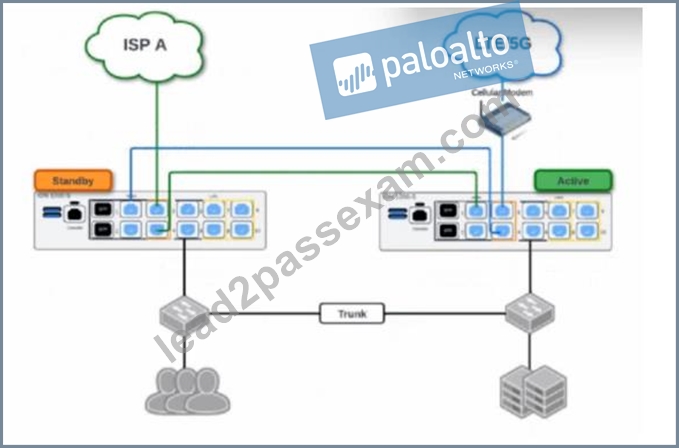
- A. The newly active ION will send a gratuitous ARP to the LAN for the IP address of any SVIs.
- B. Both the connection to ISP A and the connection to LTE/5G will be usable.
- C. The connection to ISP A will be usable, but the connection to LTE/5G will not.
- D. The VRRP Virtual IP address assigned to any SVIs will be moved to the newly active ION.
Answer: A,B
Explanation:
Comprehensive and Detailed Explanation at least 150 to 250 words each from Palo Alto Networks SD-WAN Engineer documents:
Prisma SD-WAN High Availability (HA) for branch ION devices, particularly the Gen-2 ION 1200-S, is designed to provide "100% WAN Capacity" preservation during a hardware or power failure. This is achieved through the use of Bypass Pairs (Fail-to-Wire). In the provided topology, the ISP A and LTE/5G circuits are cross-connected using the bypass ports (typically ports 3 and 4 on the ION 1200-S).
When the "Active" ION device loses power, the internal physical relays in its bypass ports transition to a closed state, effectively creating a physical bridge between the ports. In this scenario, the LTE/5G signal-which enters the Active ION's port 4-is mechanically bridged to port 3, allowing it to pass through to port 4 of the Standby ION. Simultaneously, ISP A is already connected to the Standby ION. Consequently, once the Standby device completes its transition to the "Active" state, it has physical access to both WAN circuits, validating Statement A.
Regarding the LAN transition, Prisma SD-WAN does not use standard VRRP for ION-to-ION HA; instead, it uses a proprietary Control Plane HA mechanism. When the failover occurs, the newly active ION takes over the IP addresses of all configured Switch Virtual Interfaces (SVIs) and LAN interfaces. To ensure the downstream Layer 2 infrastructure (like the LAN switches shown in the diagram) updates its MAC address tables to point to the new physical hardware for those IPs, the newly active ION immediately broadcasts a Gratuitous ARP (GARP). This ensures that LAN traffic is correctly steered to the new device without a significant timeout, validating Statement C.
NEW QUESTION # 54
Based on the HA topology image below, which two statements describe the end-state when power is removed from the ION 1200-S labeled "Active", assuming that the ION labeled "Standby" becomes the active ION? (Choose two.)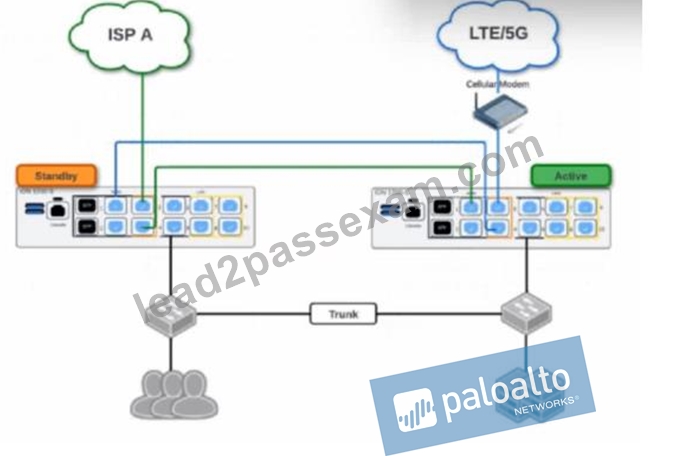
- A. The newly active ION will send a gratuitous ARP to the LAN for the IP address of any SVIs.
- B. Both the connection to ISP A and the connection to LTE/5G will be usable.
- C. The connection to ISP A will be usable, but the connection to LTE/5G will not.
- D. The VRRP Virtual IP address assigned to any SVIs will be moved to the newly active ION.
Answer: A,B
Explanation:
Comprehensive and Detailed Explanation
This scenario depicts a High Availability (HA) topology utilizing the ION 1200-S model's Fail-to-Wire (bypass) capabilities to share WAN links between two devices without needing external switches for every WAN connection.
1. WAN Link Availability (Statement A):
The diagram illustrates a "daisy-chain" cabling method supported by the ION 1200-S bypass pairs.
ISP A (Green): Connects directly to the "Standby" (Left) unit first. Since the Standby unit remains powered on, it maintains direct access to ISP A.
LTE/5G (Blue): Connects to the "Active" (Right) unit first. The connection then loops through a bypass pair on the Active unit to the Standby unit. When power is removed from the "Active" unit, the fail-to-wire relays on its Ethernet ports close physically. This creates a passive electrical bridge that connects the LTE modem directly to the Standby unit. The Standby unit (now becoming Active) will detect the link state change and successfully utilize the LTE connection. Therefore, both WAN links remain usable.
2. LAN Failover Mechanism (Statement C):
Prisma SD-WAN ION devices typically use a VRRP-like mechanism for LAN redundancy.
When the "Active" node fails (loses power), the "Standby" node stops receiving keepalives and promotes itself to the Active state.
To ensure downstream switches and clients immediately send traffic to the new Active unit, it must update their ARP tables. It does this by broadcasting a Gratuitous ARP (GARP) packet for the Virtual IP (VIP) address of the Switch Virtual Interfaces (SVIs). This action informs the network that the MAC address associated with the Gateway I1P is now reachable via the port connected to the new Active ION.234
NEW QUESTION # 55
How can a network administrator detect a site outage or a service-level agreement (SLA) violation using controller-generated incidents?
- A. Priority alerts, informational alerts, and audit logs
- B. Device logs, alerts, and incidents
- C. Incidents, alerts, statistics, and audit logs
- D. Incidents, SNMP traps, and audits
Answer: C
Explanation:
In the Prisma SD-WAN ecosystem, the centralized cloud controller provides a robust multi-layered visibility framework to ensure network reliability. To effectively detect critical events like site outages or application performance issues (SLA violations), the controller aggregates several types of operational data. Incidents are the primary mechanism for high-level alerting; they are automatically generated when the system detects significant state changes, such as an ION device going offline (site outage) or a path failing to meet the required performance metrics.
While Incidents provide the "what" and "where," Alerts offer granular notifications for specific events that may not yet have escalated to a full-scale incident. To provide deep context, the controller also utilizes Statistics, which include real-time and historical telemetry regarding bandwidth, latency, jitter, and packet loss. These statistics allow administrators to visualize the specific SLA violation as it occurs. Furthermore, Audit logs are essential for tracking configuration changes or administrative actions that might have preceded an outage, helping engineers correlate human intervention with network behavior.
By combining these four elements-Incidents for major events, Alerts for specific notifications, Statistics for performance validation, and Audit logs for change tracking-a network administrator gains a 360-degree view of the fabric. This comprehensive approach moves beyond simple "up/down" monitoring, allowing for
"Day 2" operational excellence where performance degradation is identified and remediated before it impacts the end-user experience.
NEW QUESTION # 56
What is the default action for real-time media applications if link performance is poor?
- A. Move flows.
- B. Apply Forward Error Correction (FEC).1
- C. Raise an alarm.
- D. Drop the flow.
Answer: A
Explanation:
Comprehensive and Detailed Explanation
According to the Prisma SD-WAN Performance Policy Default Behavior documentation, the default action configured for applications (including real-time media) when a path experiences poor performance (violates the SLA thresholds for latency, jitter, or packet loss) is to Move Flows.
The Prisma SD-WAN ION device continuously monitors the health of all available paths. If the active path for a media application degrades and fails to meet the specified SLA, the default policy dictates that the traffic should be steered (moved) to an alternate, compliant path that meets the performance criteria.
While Forward Error Correction (FEC) is a powerful feature available in Prisma SD-WAN to mitigate packet loss for real-time applications, it is an optional action that must be explicitly enabled or configured within the performance policy rules. It is not the default action in the base system configuration; the primary default mechanism for handling performance issues is to leverage the multi-path fabric to switch to a better link.
NEW QUESTION # 57
When an ION device has been claimed, the cloud-based controller generates and communicates with the device by which method?
- A. Self-signed certificate
- B. Existing customer public key infrastructure (KPI)
- C. Manufacturer Installed Certificate (MIC)
- D. Customer Installed Certificate (CIC)
Answer: C
Explanation:
In the Prisma SD-WAN (formerly CloudGenix) architecture, the security and authenticity of device-to- controller communication are paramount. When a new ION (Instant-On Network) device is powered on and connected to the internet, it initiates a secure "phone home" process to the Prisma SD-WAN Cloud Controller.
To ensure that the controller is communicating with a genuine Palo Alto Networks hardware or software instance, the system utilizes a Manufacturer Installed Certificate (MIC).
The MIC is a unique digital certificate burned into the hardware's Trusted Platform Module (TPM) or secure storage during the manufacturing process. This certificate acts as the device's foundational identity. When a customer "claims" a device in the Prisma SD-WAN portal using its serial number, the controller maps that serial number to the specific MIC associated with that unit.
Once the device is claimed and attempts to connect, a mutual TLS (mTLS) handshake occurs. The ION device presents its MIC to the controller to prove its identity, and the controller validates this against its records. This method eliminates the need for manual staging, pre-configuration, or the complexity of managing a Customer Installed Certificate (CIC) or a private Public Key Infrastructure (PKI) during the initial deployment phase. By leveraging the MIC, Prisma SD-WAN achieves true Zero Touch Provisioning (ZTP), ensuring that only authorized, authentic devices can join the fabric and receive configuration policies, thereby maintaining a secure and automated onboarding workflow.
NEW QUESTION # 58
......
Grab latest Palo Alto Networks SD-WAN-Engineer Dumps as PDF Updated: https://www.lead2passexam.com/Palo-Alto-Networks/valid-SD-WAN-Engineer-exam-dumps.html
Newly Released SD-WAN-Engineer Dumps for Network Security Administrator Certified: https://drive.google.com/open?id=1e3m_Z-vAYKngsSpJ6kNzsnhN_FUhbn6Z