

Share Latest Jun-2026 CICTest Practice Test Questions, Exam Dumps
Positive Aspects of Valid Dumps CIC Exam Dumps!
NEW QUESTION # 117
During an infection control round in the operating room, the infection preventionist (IP) notices that sterile instrument pouches do not have a sterilization expiration date. What is the MOST appropriate action for the IP to take?
- A. Allow the use of pouches, as long as they appear clean and their integrity is intact.
- B. Require the Sterile Processing Department to apply a standard expiration date of 30 days on all sterile pouches.
- C. Confirm that the facility follows an event-related shelf-life policy and verify the integrity of the pouches and storage conditions.
- D. Instruct staff to discard all sterile instrument pouches without an expiration date immediately.
Answer: C
Explanation:
The CBIC Certified Infection Control Exam Study Guide (6th edition) explains that sterile items are no longer managed using time-related expiration dating but rather by event-related shelf life. Under an event-related shelf-life system, sterile items remain sterile indefinitely unless an event occurs that compromises their integrity, such as package damage, moisture exposure, improper handling, or poor storage conditions.
Therefore, the absence of an expiration date on sterile instrument pouches does not automatically indicate noncompliance or require disposal. The most appropriate action for the infection preventionist is to verify that the facility has a written event-related shelf-life policy and to assess whether sterile packages are intact, properly sealed, clean, dry, and stored under appropriate environmental conditions. This approach aligns with nationally recognized standards and current evidence-based practice.
Option A is incomplete because it does not ensure that a formal policy and appropriate storage practices are in place. Option B is unnecessary and wasteful when no compromise of sterility has occurred. Option C is incorrect because arbitrarily assigning a time-based expiration (e.g., 30 days) contradicts modern sterilization principles and is not evidence-based.
For the CIC exam, this question reinforces the principle that sterility is event-related, not time-related, and that infection preventionists must evaluate policies, storage conditions, and package integrity rather than defaulting to unnecessary disposal.
NEW QUESTION # 118
Which of the following active surveillance screening cultures would be appropriate for carbapenem-resistant Enterobacterales (previously known as carbapenem-resistant Enterobacteriaceae) (CRE)?
- A. Nares or axillary cultures
- B. Rectal or peri-rectal cultures
- C. Abscess or blood cultures
- D. Throat or nasopharyngeal cultures
Answer: B
Explanation:
Carbapenem-resistant Enterobacterales (CRE) colonization is most commonly found in the gastrointestinal (GI) tract. Therefore, rectal or peri-rectal cultures are recommended for active surveillance screening.
Why the Other Options Are Incorrect?
* B. Nares or axillary cultures - CRE is not primarily found in the nasal or axillary region; this method is more relevant for detecting MRSA.
* C. Abscess or blood cultures - While CRE may be present in clinical infections, these cultures are not used for screening asymptomatic carriers.
* D. Throat or nasopharyngeal cultures - CRE does not commonly colonize the upper respiratory tract, so these are not ideal for active screening.
CBIC Infection Control Reference
The CDC and APIC guidelines emphasize rectal or peri-rectal swabbing as the most effective active surveillance method for CRE detection.
NEW QUESTION # 119
What rate is expressed by the number of patients who acquire infections over a specified time period divided by the population at risk of acquiring an infection during that time period?
- A. Incidence rate
- B. Point prevalence
- C. Period prevalence
- D. Disease specific
Answer: A
Explanation:
The incidence rate measures new cases of infection in a population over a defined time period using the formula:
Why the Other Options Are Incorrect?
B). Disease specific - Refers to infections caused by a particular pathogen, not the general rate of new infections.
C). Point prevalence - Measures existing cases at a specific point in time, not new cases.
D). Period prevalence - Includes both old and new cases over a set period, unlike incidence, which only considers new cases.
CBIC Infection Control Reference
APIC defines incidence rate as the number of new infections in a population over a given period.
NEW QUESTION # 120
Which of the following options describes a correct use of personal protective equipment?
- A. Surgical masks should be worn during lumbar puncture procedures.
- B. Eye protection should be worn when providing patient care it at risk of spreading respiratory disease after unprotected exposure.
- C. Personal eyeglasses should be worn during suctioning.
- D. Gloves should be worn when handling or touching a cardiac monitor that has been disinfected.
Answer: A
Explanation:
According to CDC and APIC guidelines, a surgical mask is required when performing lumbar punctures to prevent bacterial contamination (e.g., meningitis caused by droplet transmission of oral flora).
Why the Other Options Are Incorrect?
* A. Personal eyeglasses should be worn during suctioning - Incorrect because eyeglasses do not provide adequate eye protection. Goggles or face shields should be used.
* C. Gloves should be worn when handling or touching a cardiac monitor that has been disinfected
- Not necessary unless recontamination is suspected.
* D. Eye protection should be worn when providing patient care after unprotected exposure - Eye protection should be used before exposure, not just after.
CBIC Infection Control Reference
APIC states that surgical masks must be worn for procedures such as lumbar puncture to reduce infection risk.
NEW QUESTION # 121
What method of evaluation will BEST identify a staff member's competency with reprocessing medical devices?
- A. Obtain a score of 100% on a post-test following a reprocessing course.
- B. Describe the facility's sterilization policies and procedures.
- C. Verbalize the importance of reprocessing.
- D. Demonstrate the appropriate sterilization procedure.
Answer: D
Explanation:
The correct answer is B, "Demonstrate the appropriate sterilization procedure," as this method of evaluation will best identify a staff member's competency with reprocessing medical devices. According to the Certification Board of Infection Control and Epidemiology (CBIC) guidelines, competency in reprocessing medical devices-such as cleaning, disinfection, and sterilization-requires not only theoretical knowledge but also the practical ability to perform the tasks correctly and safely. Demonstration allows the infection preventionist (IP) to directly observe the staff member's hands-on skills, adherence to protocols (e.g., AAMI ST79), and ability to handle equipment, ensuring that the reprocessing process effectively prevents healthcare- associated infections (HAIs) (CBIC Practice Analysis, 2022, Domain IV: Education and Research, Competency 4.3 - Assess competence of healthcare personnel). This method provides tangible evidence of proficiency, as it tests the application of knowledge in a real or simulated setting, which is critical for ensuring patient safety.
Option A (verbalize the importance of reprocessing) assesses understanding and awareness, but it is a theoretical exercise that does not confirm the ability to perform the task, making it insufficient for evaluating competency. Option C (describe the facility's sterilization policies and procedures) tests knowledge of guidelines, which is a component of competence but lacks the practical demonstration needed to verify skill execution. Option D (obtain a score of 100% on a post-test following a reprocessing course) measures theoretical knowledge and retention, but a perfect score does not guarantee practical ability, as it does not assess hands-on performance or problem-solving under real conditions.
The focus on demonstration aligns with CBIC's emphasis on assessing competence through observable performance, ensuring that staff can reliably reprocess devices to maintain a sterile environment (CBIC Practice Analysis, 2022, Domain III: Infection Prevention and Control, Competency 3.3 - Ensure safe reprocessing of medical equipment). This method supports a comprehensive evaluation, aligning with best practices for training and competency assessment in healthcare settings.
References: CBIC Practice Analysis, 2022, Domain III: Infection Prevention and Control, Competency 3.3 - Ensure safe reprocessing of medical equipment; Domain IV: Education and Research, Competency 4.3 - Assess competence of healthcare personnel. AAMI ST79:2017, Comprehensive guide to steam sterilization and sterility assurance in health care facilities.
NEW QUESTION # 122
An infection preventionist is providing education to a group of medical device reprocessing staff on critical steps in cleaning instruments. Which of the following actions is recommended while using washer-disinfector?
- A. Close hinged instruments prior to placing in the machine
- B. Stack instruments inside the machine
- C. Use circulating water with a pH of 3
- D. Disassemble instruments as much as possible
Answer: D
Explanation:
Best practices for using a washer-disinfector includedisassembling instrumentsandopening hinged instrumentsto ensure proper cleaning and decontamination.
* TheAPIC Textexplains:
"Open hinged instruments and disassemble all instruments... Confirm that spray will be able to reach all loaded items without impedance."
* This ensures water and detergents reach all surfaces. Avoid stacking instruments and ensure proper placement to allow full cleaning.
References:
APIC Text, 4th Edition, Chapter 108 - Sterile Processing
NEW QUESTION # 123
What domain of educational learning involves growth in feelings or emotions?
- A. Affective
- B. Psychomotor
- C. Perceptive
- D. Cognitive
Answer: A
Explanation:
The CBIC Certified Infection Control Exam Study Guide (6th edition) describes three primary domains of educational learning: cognitive, psychomotor, and affective. The affective domain specifically involves growth in feelings, emotions, attitudes, values, motivation, and professional behaviors. This domain addresses how learners internalize information and how education influences beliefs, attitudes, and commitment to practice change.
In infection prevention and control, the affective domain is particularly important because compliance with practices such as hand hygiene, isolation precautions, and use of personal protective equipment depends not only on knowledge or skill, but also on attitudes and values. Education that targets the affective domain helps foster accountability, ethical responsibility, and sustained behavior change among healthcare personnel.
The cognitive domain (Option B) focuses on knowledge acquisition, comprehension, and critical thinking- such as understanding guidelines or surveillance definitions. The psychomotor domain (Option C) involves physical skills and task performance, such as donning PPE or performing aseptic technique. Option D, perceptive, is not a recognized educational learning domain in standard instructional theory.
For the CIC exam, it is essential to recognize that affective learning influences attitudes and behaviors, making it a key component of successful infection prevention education and culture change initiatives.
NEW QUESTION # 124
Assume the mean age of onset for patients with tuberculosis (TB) is 62 years, with one standard deviation of
5 years, and the age of onset follows a normal distribution. What is the percentage of patients expected to have the age of onset ranging from 57 to 67 years?
- A. 95%
- B. 68%
- C. 99%
- D. 34%
Answer: B
Explanation:
To determine the percentage of patients with an age of onset ranging from 57 to 67 years, we need to apply the properties of a normal distribution. In a normal distribution, the mean represents the central point, and the standard deviation defines the spread of the data. Here, the mean age of onset is 62 years, and the standard deviation is 5 years. The range of 57 to 67 years corresponds to one standard deviation below the mean (62 - 5
= 57) to one standard deviation above the mean (62 + 5 = 67).
In a normal distribution, approximately 68% of the data falls within one standard deviation of the mean (i.e., between # - # and # + #, where # is the mean and # is the standard deviation). This is a well-established statistical principle, often referred to as the 68-95-99.7 rule (or empirical rule) in statistics. Specifically, 34% of the data lies between the mean and one standard deviation above the mean, and another 34% lies between the mean and one standard deviation below the mean, totaling 68% for the range spanning one standard deviation on both sides of the mean.
Let's verify this:
* The lower bound (57 years) is exactly one standard deviation below the mean (62 - 5 = 57).
* The upper bound (67 years) is exactly one standard deviation above the mean (62 + 5 = 67).
* Thus, the range from 57 to 67 years encompasses the middle 68% of the distribution.
Option A (34%) represents the percentage of patients within one standard deviation on only one side of the mean (e.g., 62 to 67 or 57 to 62), not the full range. Option C (95%) corresponds to approximately two standard deviations from the mean (62 ± 10 years, or 52 to 72 years), which is wider than the given range.
Option D (99%) aligns with approximately three standard deviations (62 ± 15 years, or 47 to 77 years), which is even broader. Since the question specifies a range of one standard deviation on either side of the mean, the correct answer is 68%, corresponding to Option B.
In infection control, understanding the distribution of disease onset ages can help infection preventionists identify at-risk populations and allocate resources effectively, aligning with the CBIC's focus on surveillance and data analysis (CBIC Practice Analysis, 2022). While the CBIC does not directly address statistical calculations in its core documents, the application of normal distribution principles is a standard epidemiological tool endorsed in public health guidelines, which inform CBIC practices.
References:
* CBIC Practice Analysis, 2022.
* Public Health Epidemiology Guidelines, Normal Distribution and Empirical Rule (commonly accepted statistical standards).
NEW QUESTION # 125
During a COVID outbreak with hospital-associated transmission cases, the infection preventionist (IP) receives a news media call about what is being done to reduce the transmission. The IP's BEST response is to
- A. give vague answers to ensure patient privacy.
- B. inform the reporter that the conversation must be recorded to ensure accuracy.
- C. refer the reporters to the hospital's media spokesperson.
- D. answer the questions truthfully.
Answer: C
Explanation:
The best response for an infection preventionist (IP) when receiving a news media call during a COVID outbreak with hospital-associated transmission cases is to refer the reporters to the hospital's media spokesperson. This approach aligns with the principles outlined in the Certification Board of Infection Control and Epidemiology (CBIC) guidelines, which emphasize the importance of maintaining professionalism, protecting patient privacy, and ensuring accurate communication. The IP's primary role is to focus on infection prevention and control activities rather than serving as a public relations representative. Engaging directly with the media can risk divulging sensitive patient information or operational details that may not be fully contextualized, potentially violating the Health Insurance Portability and Accountability Act (HIPAA) or other privacy regulations.
Option A (answer the questions truthfully) is not ideal because, while truthfulness is important, the IP may not have the authority or full context to provide a comprehensive and accurate public statement, and doing so could inadvertently compromise patient confidentiality or misrepresent hospital policies. Option B (give vague answers to ensure patient privacy) might protect privacy but could lead to miscommunication or lack of trust if the responses appear evasive without a clear referral process. Option D (inform the reporter that the conversation must be recorded to ensure accuracy) is a procedural step but does not address the core issue of who should handle media inquiries.
Referring to the hospital's media spokesperson (Option C) ensures that a trained individual handles the communication, adhering to CBIC's emphasis on collaboration with organizational leadership and adherence to institutional communication protocols (CBIC Practice Analysis, 2022, Domain III: Infection Prevention and Control, Competency 3.1 - Collaborate with organizational leaders). This also aligns with best practices for managing public health crises, where centralized and coordinated messaging is critical to avoid misinformation.
References: CBIC Practice Analysis, 2022, Domain III: Infection Prevention and Control, Competency 3.1 - Collaborate with organizational leaders.
NEW QUESTION # 126
The appropriate method to obtain cultures for the diagnosis of catheter-associated urinary tract infections (CAUTI) is:
- A. Disconnection of the catheter from the drainage tubing
- B. Aseptic technique via the drainage port of the collection bag
- C. Removal with culture of the urinary catheter tip
- D. Aseptic technique via the collection port
Answer: D
Explanation:
The CBIC Certified Infection Control Exam Study Guide (6th edition) clearly states that the correct and recommended method for obtaining urine cultures in patients with an indwelling urinary catheter is to collect the specimen using aseptic technique from the catheter's designated sampling (collection) port. This method minimizes the risk of contamination and provides the most accurate reflection of organisms present in the urinary tract.
Urine collected from the sampling port is obtained after disinfecting the port and aspirating urine with a sterile syringe. This approach maintains the integrity of the closed drainage system and reduces the introduction of microorganisms. Accurate culture collection is essential for correct diagnosis of catheter-associated urinary tract infection (CAUTI) and for distinguishing true infection from colonization or contamination.
Option B is incorrect because culturing the catheter tip is not recommended for diagnosing CAUTI; it does not reliably represent urinary tract pathogens and may reflect biofilm colonization. Option C is inappropriate because disconnecting the catheter from the drainage tubing breaks the closed system and increases infection risk. Option D is incorrect because urine from the drainage bag is often contaminated and does not accurately represent bladder urine.
For CIC exam preparation, it is critical to recognize that aseptic aspiration from the catheter sampling port is the standard of care for urine culture collection in catheterized patients and is a core infection prevention principle related to CAUTI surveillance and diagnosis.
NEW QUESTION # 127
The MOST common reason for contamination of compounded pharmaceutical products is:
- A. Inappropriate storage of pharmaceutical items
- B. Inadequate laminar airflow
- C. Infrequent environmental sampling
- D. Direct touch by personnel
Answer: D
Explanation:
The CBIC Certified Infection Control Exam Study Guide (6th edition) identifies direct touch contamination by personnel as the most common cause of contamination of compounded pharmaceutical products. Human contact-particularly hands, gloves, sleeves, or improper manipulation of sterile components-is the greatest source of microbial contamination during compounding activities.
Even when engineering controls such as laminar airflow workbenches and cleanrooms are functioning correctly, contamination can occur if aseptic technique is not strictly followed. Touching sterile vial stoppers, syringe tips, needle hubs, or critical sites with nonsterile hands or gloves introduces microorganisms directly into the product. The Study Guide emphasizes that aseptic technique, hand hygiene, glove use, and competency validation are essential to preventing contamination.
Option B, inadequate laminar airflow, can contribute to contamination but is less common than direct touch errors and is usually detected through certification and monitoring. Option C, infrequent environmental sampling, does not cause contamination but may delay detection of problems. Option D, inappropriate storage, can affect product stability but is not the primary cause of contamination during compounding.
For CIC exam preparation, it is critical to recognize that human factors are the leading source of contamination in sterile compounding. Infection prevention strategies therefore focus heavily on staff training, competency assessment, observation, and adherence to aseptic technique standards to reduce contamination risk.
NEW QUESTION # 128
What question would be appropriate for an infection preventionist to ask when reviewing the discussion section of an original article?
- A. Is the study question important, appropriate, and stated clearly?
- B. Are criteria used to measure the exposure and the outcome explicit?
- C. Was the correct sample size and analysis method chosen?
- D. Could alternative explanations account for the observed results?
Answer: D
Explanation:
When reviewing the discussion section of an original article, an infection preventionist must focus on critically evaluating the interpretation of the study findings, their relevance to infection control, and their implications for practice. The discussion section typically addresses the meaning of the results, compares them to existing literature, and considers limitations or alternative interpretations. The appropriate question should align with the purpose of this section and reflect the infection preventionist's need to assess the validity and applicability of the research. Let's analyze each option:
* A. Was the correct sample size and analysis method chosen?: This question pertains to the methodology section of a research article, where the study design, sample size, and statistical methods are detailed.
While these elements are critical for assessing the study's rigor, they are not the primary focus of the discussion section, which interprets results rather than re-evaluating the study design. An infection preventionist might ask this during a review of the methods section, but it is less relevant here.
* B. Could alternative explanations account for the observed results?: The discussion section often explores whether the findings can be explained by factors other than the hypothesized cause, such as confounding variables, bias, or chance. This question is highly appropriate foran infection preventionist, as it encourages a critical assessment of whether the results truly support infection control interventions or if other factors (e.g., environmental conditions, patient factors) might be responsible. This aligns with CBIC's emphasis on evidence-based practice, where understanding the robustness of conclusions is key to applying research to infection prevention strategies.
* C. Is the study question important, appropriate, and stated clearly?: This question relates to the introduction or background section of an article, where the research question and its significance are established. While important for overall study evaluation, it is not specific to the discussion section, which focuses on interpreting results rather than revisiting the initial question. An infection preventionist might consider this earlier in the review process, but it does not fit the context of the discussion section.
* D. Are criteria used to measure the exposure and the outcome explicit?: This question is relevant to the methods section, where the definitions and measurement tools for exposures (e.g., a specific intervention) and outcomes (e.g., infection rates) are described. The discussion section may reference these criteria but focuses more on their implications rather than their clarity. This makes it less appropriate for the discussion section specifically.
The discussion section is where authors synthesize their findings, address limitations, and consider alternative explanations, making option B the most fitting. For an infection preventionist, evaluating alternative explanations is crucial to ensure that recommended practices (e.g., hand hygiene protocols or sterilization techniques) are based on solid evidence and not confounded by unaddressed variables. This critical thinking is consistent with CBIC's focus on applying research to improve infection control outcomes.
:
CBIC Infection Prevention and Control (IPC) Core Competency Model (updated 2023), Domain I:
Identification of Infectious Disease Processes, which emphasizes critical evaluation of research evidence.
CBIC Examination Content Outline, Domain V: Management and Communication, which includes assessing the validity of research findings for infection control decision-making.
NEW QUESTION # 129
Which of the following processes is MOST important for the infection preventionist (IP) to review when evaluating a third-party reprocessor for single-use devices?
- A. Review the facility's blueprints and policies.
- B. Ensure air and water cultures are performed regularly.
- C. Observe all steps for reprocessing.
- D. Obtain feedback from other IPs who use the reprocessor.
Answer: C
Explanation:
The correct answer is A, "Observe all steps for reprocessing," as this is the most important process for the infection preventionist (IP) to review when evaluating a third-party reprocessor for single-use devices.
According to the Certification Board of Infection Control and Epidemiology (CBIC) guidelines, the reprocessing of single-use devices (SUDs) by third-party entities must adhere to stringent infection control standards to ensure they are safe for reuse and do not contribute to healthcare-associated infections (HAIs).
Observing all steps-such as cleaning, disinfection, sterilization, packaging, and quality control-allows the IP to directly assess compliance with manufacturer instructions, regulatory requirements (e.g., FDA guidelines), and best practices (e.g., AAMI ST91) (CBIC Practice Analysis, 2022, Domain III: Infection Prevention and Control, Competency 3.3 - Ensure safe reprocessing of medical equipment). This hands-on evaluation is critical because any deviation in the reprocessing chain can compromise device sterility and patient safety.
Option B (review the facility's blueprints and policies) provides context about the physical layout and procedural framework, but it is a preliminary step that does not directly verify the reprocessing process's effectiveness. Option C (ensure air and water cultures are performed regularly) is important for monitoring environmental contamination risks, particularly in sterile processing areas, but it is a supportive measure rather than the primary focus of evaluating the reprocessor's core activities. Option D (obtain feedback from other IPs who use the reprocessor) offers valuable peer insights, but it is subjective and secondary to direct observation, which provides firsthand evidence of compliance and performance.
The priority on observing reprocessing steps aligns with CBIC's emphasis on ensuring the safety and efficacy of reprocessed medical devices, a key responsibility for IPs when outsourcing to third-party reprocessors (CBIC Practice Analysis, 2022, Domain III: Infection Prevention and Control, Competency 3.5 - Evaluate the environment for infection risks). This process enables the IP to identify specific weaknesses, validate adherence to standards, and make informed decisions about the reprocessor's suitability.
References: CBIC Practice Analysis, 2022, Domain III: Infection Prevention and Control, Competencies 3.3 - Ensure safe reprocessing of medical equipment, 3.5 - Evaluate the environment for infection risks. AAMI ST91:2015, Flexible and semi-rigid endoscope processing in health care facilities.
NEW QUESTION # 130
Following recent renovations on an oncology unit, three patients were identified with Aspergillus infections.
The infections were thought to be facility-acquired. Appropriate environmental microbiological monitoring would be to culture the:
- A. Air
- B. Ice
- C. Carpet
- D. Aerators
Answer: A
Explanation:
The scenario describes an outbreak of Aspergillus infections among three patients on an oncology unit following recent renovations, with the infections suspected to be facility-acquired. Aspergillus is a mold commonly associated with environmental sources, particularly airborne spores, and its presence in immunocompromised patients (e.g., oncology patients) poses a significant risk. The infection preventionist must identify the appropriate environmental microbiological monitoring strategy, guided by the Certification Board of Infection Control and Epidemiology (CBIC) and CDC recommendations. Let's evaluate each option:
* A. Air: Aspergillus species are ubiquitous molds that thrive in soil, decaying vegetation, and construction dust, and they are primarily transmitted via airborne spores. Renovations can disturb these spores, leading to aerosolization and inhalation by vulnerable patients. Culturing the air using methods such as settle plates, air samplers, or high-efficiency particulate air (HEPA) filtration monitoring is a standard practice to detect Aspergillus during construction or post-renovation in healthcare settings, especially oncology units where patients are at high risk for invasive aspergillosis. This aligns with CBIC's emphasis on environmental monitoring for airborne pathogens, making it the most appropriate choice.
* B. Ice: Ice can be a source of contamination with bacteria (e.g., Pseudomonas, Legionella) or other pathogens if improperly handled or stored, but it is not a typical reservoir for Aspergillus, which is a mold requiring organic material and moisture for growth. While ice safety is important in infection control, culturing ice is irrelevant to an Aspergillus outbreak linked to renovations and is not a priority in this context.
* C. Carpet: Carpets can harbor dust, mold, and other microorganisms, especially in high-traffic or poorly maintained areas. Aspergillus spores could theoretically settle in carpet during renovations, but carpets are not a primary source of airborne transmission unless disturbed (e.g., vacuuming). Culturing carpet might be a secondary step if air sampling indicates widespread contamination, but it is less direct and less commonly recommended as the initial monitoring site compared to air sampling.
* D. Aerators: Aerators (e.g., faucet aerators) can harbor waterborne pathogens like Pseudomonas or Legionella due to biofilm formation, but Aspergillus is not typically associated with water systems unless there is significant organic contamination or aerosolization from water sources (e.g., cooling towers). Culturing aerators is relevant for waterborne outbreaks, not for an Aspergillus outbreak linked to renovations, making this option inappropriate.
The best answer is A, culturing the air, as Aspergillus is an airborne pathogen, and renovations are a known risk factor for spore dispersal in healthcare settings. This monitoring strategy allows the infection preventionist to confirm the source, assess the extent of contamination, and implement control measures (e.g., enhanced filtration, construction barriers) to protect patients. This is consistent with CBIC and CDC guidelines for managing fungal outbreaks in high-risk units.
CBIC Infection Prevention and Control (IPC) Core Competency Model (updated 2023), Domain IV:
Environment of Care, which recommends air sampling for Aspergillus during construction-related outbreaks.
CBIC Examination Content Outline, Domain III: Prevention and Control of Infectious Diseases, which includes environmental monitoring for facility-acquired infections.
CDC Guidelines for Environmental Infection Control in Healthcare Facilities (2022), which advocate air culturing to detect Aspergillus post-renovation in immunocompromised patient areas.
NEW QUESTION # 131
An infection preventionist has been asked to consult on disinfectant products for use in a long term care home. What should their primary concern be?
- A. Patient care items are cleaned whenever visibly soiled.
- B. Disinfectant products should be compatible with the patient care devices used by the facility.
- C. An appropriate disinfectant should be available whenever items are used on patients known to be colonized with multi drug resistant organisms.
- D. Disinfectant products should have a mild odor to reduce allergy concerns.
Answer: B
Explanation:
The most critical factor in choosing disinfectants in long-term care iscompatibility with medical devicesto prevent damage and ensure safety. Improper selection can compromise disinfection efficacy and equipment longevity.
* TheAPIC/JCR Workbookhighlights:
"Organizations should evaluate compatibility of disinfectant products with the materials used in patient care equipment. Incompatibility can lead to equipment degradation or malfunction".
* This ensures compliance with manufacturer instructions and preserves warranty and functionality.
References:
APIC/JCR Workbook, 4th Edition, Chapter 8 - Disinfection and Sterilization
NEW QUESTION # 132
An infection preventionist (IP) is asked to participate on a team to decrease ventilator-associated pneumonia (VAP) rates in a 20-bed ICU. The IP provides the following information. What is the first quarter ventilator utilization ratio?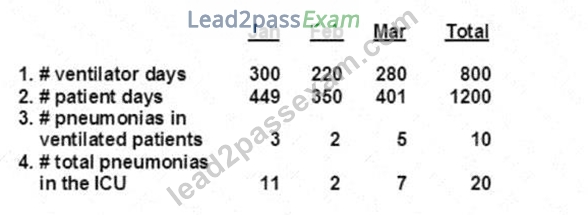
Data Provided (First Quarter):
Ventilator days (Jan-Mar total): 800
Patient days (Jan-Mar total): 1200
- A. 0.13
- B. 1.67
- C. 1.50
- D. 0.67
Answer: D
Explanation:
The Certification Study Guide (6th edition) defines the ventilator utilization ratio (VUR) as a device utilization measure used in surveillance to describe the proportion of patient time during which a specific medical device-in this case, mechanical ventilation-is in use. It is calculated by dividing the total number of ventilator days by the total number of patient days for the same location and time period.
Using the first-quarter data provided, the calculation is as follows:
Ventilator Utilization Ratio = Ventilator Days ÷ Patient Days
Ventilator Utilization Ratio = 800 ÷ 1200 = 0.67
This means that ventilators were in use for 67% of all patient days in the ICU during the first quarter. The study guide emphasizes that device utilization ratios are essential for interpreting device-associated infection data, such as VAP rates, because they reflect the level of patient exposure to the device. Higher utilization increases the population at risk and can influence infection rates independently of prevention practices.
The other answer options are incorrect because they do not reflect the correct calculation. A ratio greater than
1.0 (options C and D) would imply more device days than patient days, which is not possible in this context.
Option A underestimates utilization and does not match the provided data.
Understanding and correctly calculating utilization ratios is a core CIC exam competency, as these metrics support accurate surveillance, benchmarking, and performance improvement efforts.
Reference: Certification Study Guide (CBIC/CIC Exam Study Guide), 6th edition, Chapter 4: Surveillance and Epidemiologic Investigation.
NEW QUESTION # 133
An infection preventionist (IP) is asked to evaluate a series of published sources about CAUTI prevention strategies. Which source shows the strongest evidence for the IP to implement change?
- A. Data from a case study from a well-designed case-control or cohort study
- B. Evidence from reports written by authorities who are on expert committees
- C. A systematic review of relevant controlled studies and evidence-based practices
- D. A randomized controlled trial from another hospital
Answer: C
Explanation:
When an IP is selecting evidence to support practice change, the "strength" of evidence is typically judged using an evidence hierarchy. In most evidence pyramids, systematic reviews (often with meta-analysis) of well-designed studies sit at or near the top because they use explicit methods to search for, appraise, and synthesize findings across multiple studies-reducing the influence of chance results and individual-study bias.
Option D is therefore strongest: a systematic review of relevant controlled studies and evidence-based practices provides the most robust overall summary for decision-making compared with any single study.
Randomized controlled trials (option A) are strong primary studies, but they represent one setting/population and can be affected by local factors; a high-quality systematic review places RCTs in context and evaluates consistency across multiple trials.
Observational designs (option C, cohort/case-control) are generally lower in the hierarchy for intervention effectiveness due to confounding risk, and expert committee reports (option B) are typically considered lower- level evidence unless they are explicitly based on systematic evidence review methods. For implementing CAUTI prevention changes, relying first on systematic syntheses best supports standardized, evidence-based practice.
NEW QUESTION # 134
An infection preventionist (IP) encounters a surgeon at the nurse's station who loudly disagrees with the IP's surgical site infection findings. The IP's BEST response is to:
- A. Calmly explain that the findings are credible.
- B. Ask the surgeon to change their tone and leave the nurses' station if they refuse.
- C. Report the surgeon to the chief of staff.
- D. Ask the surgeon to speak in a more private setting to review their concerns.
Answer: D
Explanation:
The scenario involves a conflict between an infection preventionist (IP) and a surgeon regarding surgical site infection (SSI) findings, occurring in a public setting (the nurse's station). The IP's response must align with professional communication standards, infection control priorities, and the principles of collaboration and conflict resolution as emphasized by the Certification Board of Infection Control and Epidemiology (CBIC).
The "best" response should de-escalate the situation, maintain professionalism, and facilitate a constructive dialogue. Let's evaluate each option:
* A. Report the surgeon to the chief of staff: Reporting the surgeon to the chief of staff might be considered if the behavior escalates or violates policy (e.g., harassment or disruption), but it is an escalation that should be a last resort. This action does not address the immediate disagreement about the SSI findings or attempt to resolve the issue collaboratively. It could also strain professional relationships and is not the best initial response, as it bypasses direct communication.
* B. Calmly explain that the findings are credible: Explaining the credibility of the findings is important and demonstrates the IP's confidence in their work, which is based on evidence-based infection control practices. However, doing so in a public setting like the nurse's station, especially with a loud disagreement, may not be effective. The surgeon may feel challenged or defensive, potentially worsening the situation. While this response has merit, it lacks consideration of the setting and the need for privacy to discuss sensitive data.
* C. Ask the surgeon to speak in a more private setting to review their concerns: This response is the most appropriate as it addresses the immediate need to de-escalate the public confrontation and move the discussion to a private setting. It shows respect for the surgeon's concerns, maintains professionalism, and allows the IP to review the SSI findings (e.g., data collection methods, definitions, or surveillance techniques) in a controlled environment. This aligns with CBIC's emphasis on effective communication and collaboration with healthcare teams, as well as the need to protect patient confidentiality and maintain a professional atmosphere. It also provides an opportunity to educate the surgeon on the evidence behind the findings, which is a key IP role.
* D. Ask the surgeon to change their tone and leave the nurses' station if they refuse: Requesting a change in tone is reasonable given the loud disagreement, but demanding the surgeon leave if they refuse is confrontational and risks escalating the conflict. This approach could damage the working relationship and does not address the underlying disagreement about the SSI findings. While maintaining a respectful environment is important, this response prioritizes control over collaboration and is less constructive than seeking a private discussion.
The best response is C, as it promotes a professional, collaborative approach by moving the conversation to a private setting. This allows the IP to address the surgeon's concerns, explain the SSI surveillance methodology (e.g., NHSN definitions or CBIC guidelines), and maintain a positive working relationship, which is critical for effective infection prevention programs. This strategy reflects CBIC's focus on leadership, communication, and teamwork in healthcare settings.
References:
* CBIC Infection Prevention and Control (IPC) Core Competency Model (updated 2023), Domain V:
Management and Communication, which stresses effective interpersonal communication and conflict resolution.
* CBIC Examination Content Outline, Domain V: Leadership and Program Management, which includes collaborating with healthcare personnel and addressing disagreements professionally.
* CDC Guidelines for SSI Surveillance (2023), which emphasize the importance of clear communication of findings to healthcare teams.
NEW QUESTION # 135
An infection preventionist (IP) is notified that a patient who underwent an endoscopic brain biopsy the night before has been diagnosed with prion disease. Because the diagnosis was thought to be unlikely but possible at the time of the biopsy, the endoscope was sequestered. The endoscope manufacturer's instructions for reprocessing indicate that the endoscope can be reprocessed using high-level disinfection or low-temperature sterilization. The IP should recommend that the endoscope be:
- A. Sterilized using ethylene oxide or hydrogen peroxide gas plasma.
- B. Autoclaved at 134°C (273°F) for 18 minutes.
- C. Bagged as biohazardous waste and discarded.
- D. Disinfected with a 1:10 dilution of household bleach or 1N NaOH.
Answer: C
Explanation:
The CBIC Certified Infection Control Exam Study Guide (6th edition) identifies prion diseases (such as Creutzfeldt-Jakob disease) as unique and extremely challenging from an infection prevention standpoint due to the extraordinary resistance of prions to conventional disinfection and sterilization methods. Prions are not destroyed by standard high-level disinfection, low-temperature sterilization, ethylene oxide, or hydrogen peroxide gas plasma, even when manufacturer instructions for use suggest these methods for routine pathogens.
Invasive neurologic procedures involving high-risk tissues (brain, spinal cord, posterior eye) pose the greatest transmission risk. When a reusable device such as an endoscope is used on high-risk tissue in a patient with known or suspected prion disease, and the device cannot tolerate validated prion-inactivation protocols, the Study Guide recommends removal from service and disposal.
While harsh chemical treatments such as 1N sodium hydroxide or high-concentration bleach combined with extended steam sterilization may be effective for heat-resistant surgical instruments, flexible endoscopes and similar devices cannot safely undergo these processes without damage. Therefore, reprocessing is not acceptable in this scenario.
Autoclaving alone and low-temperature sterilization methods are ineffective against prions. As a result, the safest and recommended action is to bag the device as biohazardous waste and discard it, preventing any risk of iatrogenic transmission.
For the CIC exam, this question tests recognition that manufacturer IFUs do not supersede prion-specific infection prevention guidance, and patient safety requires device destruction when prion exposure cannot be reliably mitigated.
NEW QUESTION # 136
Which of the following study designs provides the STRONGEST evidence of a causal relationship between a risk factor and the outcome of interest?
- A. Cross-sectional study
- B. Randomized clinical trial
- C. Case-control study
- D. Cohort study
Answer: B
Explanation:
The CBIC Certified Infection Control Exam Study Guide (6th edition) identifies the randomized clinical trial (RCT) as the study design that provides the strongest evidence of a causal relationship between a risk factor (or intervention) and an outcome. RCTs are considered the gold standard because they use random assignment to allocate participants to either an intervention group or a control group, which minimizes bias and balances both known and unknown confounding variables between groups.
By controlling exposure and randomly assigning participants, RCTs establish temporality, ensuring that the exposure precedes the outcome-an essential criterion for causality. This design also allows for direct comparison of outcomes under controlled conditions, making it possible to attribute observed differences in outcomes to the intervention or risk factor with a high degree of confidence.
In contrast, cohort studies and case-control studies are observational and can identify associations but are more susceptible to confounding and bias. While cohort studies can demonstrate temporal relationships and estimate risk, they cannot control exposures as precisely as RCTs. Case-control studies are particularly vulnerable to recall and selection bias. Cross-sectional studies assess exposure and outcome simultaneously and cannot establish causation.
For the CIC exam, it is critical to recognize that randomized clinical trials offer the highest level of evidence for causality, particularly when evaluating interventions, preventive measures, or treatment effectiveness in infection prevention and healthcare epidemiology.
NEW QUESTION # 137
An infection preventionist has been asked to participate in a process improvement team to standardize disinfection and sterilization practices. Team activities should include all of the following EXCEPT:
- A. Performing a literature review on central supply and sterilization.
- B. Conducting outcome measurement after all changes are implemented.
- C. Asking central supply and operating room managers to join the team.
- D. Observing disinfection and sterilization practices.
Answer: B
Explanation:
The CBIC Certified Infection Control Exam Study Guide (6th edition) emphasizes that effective process improvement relies on a structured, data-driven approach that includes baseline assessment, intervention, and ongoing evaluation. A key principle of quality improvement is that outcomes must be measured before and after changes are implemented in order to determine whether an intervention resulted in improvement.
Option D is the correct "EXCEPT" choice because limiting outcome measurement to only after changes are implemented prevents meaningful comparison and makes it impossible to determine effectiveness. Without baseline data, improvements cannot be quantified, trends cannot be assessed, and unintended consequences may go unrecognized. The Study Guide stresses that baseline measurements are essential to evaluate process performance and to support evidence-based decision-making.
Options A, B, and C are all appropriate and expected activities. Direct observation helps identify workflow gaps and variation in practice. Inclusion of central supply and operating room leadership ensures multidisciplinary engagement and operational insight. Conducting a literature review supports alignment with current evidence, standards, and best practices for disinfection and sterilization.
For the CIC exam, it is important to recognize that continuous measurement throughout the improvement cycle-not only after implementation-is required for successful standardization and sustainability of infection prevention practices.
NEW QUESTION # 138
......
Practice LATEST CIC Exam Updated 302 Questions: https://www.lead2passexam.com/CBIC/valid-CIC-exam-dumps.html
First Attempt Guaranteed Success in CIC Exam: https://drive.google.com/open?id=1i1gwWH32RMXtKHMQQBFQi4B8IJCVo9hg