

1z0-1066-23 Dumps - Grab Out For [NEW-2024] Oracle Exam
1z0-1066-23 Exam Dumps PDF Guaranteed Success with Accurate & Updated Questions
NEW QUESTION # 16
Which option outlines changes you can make to a simulation plan when evaluating demand and supply?
- A. Change item specification values, change item lead times, create mass changes for items
- B. Add demands, cancel demands, reschedule demands, add new planned orders, reschedule supplies
- C. Change item specification values, change item lead times, change item-organization specification values
- D. Change item specification values, change item lead times, create mass changes for items all at once, change item-organization specification values
- E. Add demands, cancel demands, reschedule demands, add supply, cancel supply, reschedule supplies
Answer: E
NEW QUESTION # 17
In order for Supply and Demand Plans to run successfully, which three Configure Planning Analytic tasks must be completed? (Choose three.)
- A. Set up Dimension Catalogs
- B. Set up Default Catalogs
- C. Set up Hierarchy Attributes
- D. Set up Levels and Attributes
- E. Set up Measure Catalogs
- F. Run the Configure Dimension Catalog process
Answer: A,D,E
NEW QUESTION # 18
Planners are complaining about getting too many exception messages, some of which have minima value for evaluating plan health.
Which three solutions could reduce message clutter? (Choose three.)
- A. Go to Configure Exception Sets, duplicate the currently used exception set, remove the undesired messages from the duplicate set. then assign the duplicate set to all plans.
- B. Go to Configure Exception Sets, create a new set with only the messages the planners care about, and then, set all supply plans to use this new exception set.
- C. Go to Configure Exception Sets, and for the currently used exception set. specify a threshold for various messages.
- D. Go to Configure Exceptions, and specify a threshold for various messages.
Answer: A,B,C
NEW QUESTION # 19
During the FIFO pegging process, what is the correct order in which the supplies are sorted?
- A. Peg demands with reservations first and then peg demands that do not have reservations
- B. Pegging process does not respect reservation, and demands are sorted based on demand and supply types
- C. Pegging process does not respect reservation, and demands are sorted based on due dates
- D. Pegging process sorts demands by due dates followed by reservation status
- E. Peg unreserved demands first and then demands with reservations
Answer: A
NEW QUESTION # 20
The marketing department of a company needs to analyze the forecast based on type of demand (large retailer versus specialty store) and item cost (low versus high).
After creating a segment group with demand class and product for segment granularity, what additional sequence of actions must they also perform to satisfy marketing?
- A. Define four segments based on demand type and item cost, execute segmentation, and use the selector tool to create a new table or graph.
- B. Define two segments based on demand type and item cost, execute segmentation, and use the selector tool to create a new table or graph.
- C. Define four segments based on demand type and item cost, define each segment's criteria, execute segmentation, and use the selector tool to create a new table or graph.
- D. Define four segmentation based on demand type and item cost, define each segment's criteria, execute segmentation, configure planning analytics to update the dimension catalog, and use the selector tool to create a new table or graph.
Answer: C
NEW QUESTION # 21
How does the Demand Fulfillment view prioritize at-risk demands?
- A. Based on order value weighted by the number of associated recommendations required to make the demand no longer at risk
- B. Based on order value weighted by the number of compression days required to make the demand no longer at risk
- C. Based on the order value per customer weighted by the number of associated recommendations required to make the demand no longer at risk
- D. Based on the number of associated recommendations required to make the demand no longer at risk
Answer: A
Explanation:
Review and Improve Your Demand Fulfillment
To improve the demand fulfillment of your plan, use the Demand Fulfillment table to review the at-risk demands in your plan and their related recommendations. You can take actions to accept recommendations from this page.
In the Demand Fulfillment UI, you can:
View prioritized at-risk demands based on order values weighted by the number of associated recommendations.
Take actions to accept or mark recommendations as complete.
Review summary information provided for the current demand fulfillment position of your plan to analyze the potential for improvement based on selected at-risk demands. The information also provides an understanding of the expected demand fulfillment position based on accepted and completed recommendations.
To review and improve your demand fulfillment:
In a Supply Planning, Planning Central, or Demand and Supply work area, select the Manage Plans task.
On the Manage Plans page, search for and open your plan.
In the Page Layout list, select Plan Summary.
Note that the tiles in the Plan Summary layout include a Demand at Risk in thousands tile.
In the Demand at Risk in thousands tile, click the Select Tile bar to review the Demand at Risk Summary data.
You can review the demand at risk data through a treemap view or a table view, the treemap view is the default. To switch to the table view, click the Show Table icon.
To review the demand at risk data:
Using the treemap: Click an area in the treemap. Typically, you want to start with the area that has the highest demand at risk value. From the Drill To actions, click Demand Fulfillment.
Using the table: Click the Show Table icon. In the Demand at Risk Summary table, click a cell. Typically, you want to start with the cell that has the highest demand at risk value. From the Drill To actions, click Demand Fulfillment.
The Demand Fulfillment UI shows the individual orders that are at-risk and their related recommendations.
Tip: You can open the Demand Fulfillment table directly without drilling from the Plan Summary. After you open a plan, click the Open button at the page level. In the Open Table, Graph, or Tile Set dialog box, search for and select the Demand Fulfillment table. In the Demand Fulfillment UI, you can search for at-risk demands by using the filter fields in the search panel.
NEW QUESTION # 22
Which release recommendation parameter can you utilize to govern the behavior of the auto-release process?
- A. Quick Release Time Fence
- B. Release Only by User
- C. Auto-Release Planned Order Time Fence
- D. Compression Days Tolerance for Automatic Release
- E. Auto-Release Interval in Days
Answer: A
NEW QUESTION # 23
Your current shipments forecast for Jan 2018 is 1000 and the demand planner determines that the forecast should be 1500. Describe how the demand planner can override shipments forecast. Also, what happens to the final shipments forecast measure when the demand plan is run again and the shipments forecast value changes to 1250?
- A. Open a table with the Adjusted Shipments Forecast measure and enter 1500. The Final Shipments Forecast measure will change to 1500 and the value will persist during subsequent demand plan runs.
- B. Open a table with the Shipments Forecast measure and override it to 1500. The Final Shipments Forecast measure will change to 1500. During the subsequent demand plan run, the Final Shipments Forecast value will change to 1250.
- C. Open a table with the Adjusted Shipments Forecast measure and enter 1500. The Final Shipments Forecast measure will change to 1500. During the subsequent demand plan run, the Final Shipments Forecast value will change to 1250.
- D. Open a table with the Shipments Forecast measure and override it to 1500. The Final Shipments Forecast measure will change to 1500 and the value will persist during subsequent demand plan runs.
Answer: A
NEW QUESTION # 24
A customer has created a supply plan based on current requirement. Due to changes in third party forecast, the plan must be rerun with these recent updates. However, while this new information became available, existing supply like on-hand inventory and work order completions have also been updated.
Which data refresh option should be used to reflect all these changes in the plan?
- A. Do not refresh with current data
- B. Refresh with current data
- C. Refresh with quick refresh option
- D. Refresh with forecast data
- E. Refresh with selected current data
Answer: B
NEW QUESTION # 25
A sales order containing a back-to-back item has been created. However, when you ran the supply plan in Planning Central, the supply for the sales order was not released. Why was the supply not released?
- A. The supply plan should have been run in Supply Chain Orchestration, not Planning Central.
- B. Planning Central cannot create back-to-back supply, so the supply cannot be released.
- C. Only Global Order Promising and Supply Chain Orchestration can be used to release and create new supplies for back-to-back orders.
- D. The supply must first be created in Global Order Promising and then it can be released from Planning Central.
Answer: C
NEW QUESTION # 26
During a client implementation, it is determined that an external forecast will need to be imported into Planning Central for use as a Demand Schedule in a Supply Plan.
What three steps must be executed to enable the successful load of the External Forecast file? (Choose three.)
- A. Collect Planning Data Process must be run from Planning.
- B. Collect Legacy Data Process must be run from Planning.
- C. Load Interface File for Import Process must be run.
- D. Flat File must be zipped.
- E. CSV file must be generated.
Answer: B,C,E
NEW QUESTION # 27
When duplicating a supply plan, which parameters can you modify if Copy Type is "copy plan options only"?
- A. Name, Description. Access (but if the original plan was private, you can't edit the Users list), and Notes
- B. Name, Description. Access. Owner. Include Archive, and Notes
- C. Name, Access. Owner, and Notes
- D. Name, Description. Access. Supply Planning Mode, and Owner
Answer: C
NEW QUESTION # 28
Your client wants to create a supply plan that only considers sales order and disregards forecast demand within a specific demand horizon. What must you do to accomplish this?
- A. Manage Plans > Search and select supply plan > Supply tab > Organizations and Schedules tab > Remove all demand schedules
- B. Manage Plans > Search and select demand plan > Demand tab > General tab > Select 'Do no spread forecast'
- C. Manage Plans > Search and select demand plan > Demand tab > General tab > Check Demand Time Fence Control
- D. Manage Plans > Search and select supply plan > Supply tab > General tab > Check Demand Time Fence Control
- E. Manage Plans > Search and select supply plan > Supply tab > General tab > Advanced Options > Check 'Create time fence'
Answer: D
NEW QUESTION # 29
Your client has a requirement to restrict Supply Plan data access. Identify three Data Access Set detail entities that can be used to restrict plan data access. (Choose three.)
- A. Material Planner
- B. Demand Class
- C. Transaction Type
- D. Item
- E. Supplier
- F. Customer
Answer: D,E,F
Explanation: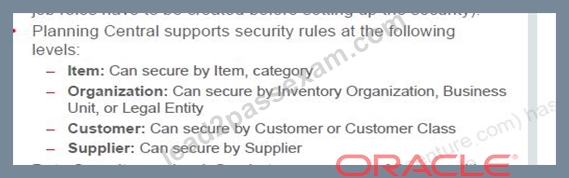
NEW QUESTION # 30
A global company is subject to differing regulations regarding hazardous materials in a product. Version 1 of the product can be sold in North America and Europe. Version 2 of the product can only be sold in Europe.
Which sequence of setups could help a planner ensure that supply is available in a timely fashion per these constraints?
- A. Create an attribute-based netting rule using region and version; map the rule to collectible attributes; associate the rule to a supply plan; run the plan.
- B. Define region and version as planning attributes; map them to collectible attributes; create an attribute-based netting rule using region and version; associate the rule to a supply plan; run the plan.
- C. Define region and version as planning attributes; create an attribute-based netting rule using region and version; associate the rule to a supply plan; run the plan.
- D. Define segment groups based on region and version; execute segmentation; map the segmentation results to an attribute-based netting rule; associate the rule to a supply plan; run the plan.
Answer: D
NEW QUESTION # 31
Which calendar is supported in the supply planning process but does not support bucketing by week?
- A. Lunisolar
- B. Roman
- C. Gregorian
- D. Fiscal
- E. Julian
Answer: E
Explanation:
NEW QUESTION # 32
You are defining material planners for your organization. However, when you go to Manage Material Planners, your organization does not appear in the list of values. Why?
- A. The organization is an Item Organization.
- B. You do not have data access to the organization.
- C. The organization was not enabled for collection under Manage Planning Source Systems.
- D. The organization must be enabled in Manage Planning Parameters.
- E. The organization must be enabled in Manage Planning Profile Options.
Answer: C
NEW QUESTION # 33
As part of the agreement with one of your suppliers, you must always order product by the 100s. For example, if the required supply is 105, you must order 200, if it's 275, you must order 300. Which item attributes will help you achieve this?
- A. Rounding
- B. Minimum Order Quantity
- C. Fixed Order Quantity
- D. Maximum Order Quantity
- E. Fixed Lot Size Multiplier
Answer: E
NEW QUESTION # 34
......
Oracle 1z0-1066-23 Exam Syllabus Topics:
| Topic | Details |
|---|---|
| Topic 1 |
|
| Topic 2 |
|
| Topic 3 |
|
| Topic 4 |
|
| Topic 5 |
|
| Topic 6 |
|
| Topic 7 |
|
| Topic 8 |
|
| Topic 9 |
|
Get New 1z0-1066-23 Certification Practice Test Questions Exam Dumps: https://www.lead2passexam.com/Oracle/valid-1z0-1066-23-exam-dumps.html
Pass 1z0-1066-23 Exam - Real Test Engine PDF with 111 Questions: https://drive.google.com/open?id=17FBHhyu2oFK-clrKRrmkE9DsfcGSt9Ss