

Changing the Concept of FCP_FWB_AD-7.4 Exam Preparation 2025
Getting FCP_FWB_AD-7.4 Certification Made Easy! Get professional help from our FCP_FWB_AD-7.4 Dumps PDF
Fortinet FCP_FWB_AD-7.4 Exam Syllabus Topics:
| Topic | Details |
|---|---|
| Topic 1 |
|
| Topic 2 |
|
| Topic 3 |
|
| Topic 4 |
|
NEW QUESTION # 91
In which two ways does FortiWeb handle traffic that does not match any defined policies? (Choose two.)
- A. In offline protection mode, the traffic is dropped with a TCP reset.
- B. In true transparent mode, ip-forward should be enabled to deny the traffic.
- C. In reverse-proxy mode, the traffic is denied.
- D. In transparent mode, the traffic is passed through.
Answer: C,D
NEW QUESTION # 92
When configuring Auto TX Power control on an AP radio, which two statements best describe how the radio responds? (Choose two.)
- A. When the AP detects any interference from a trusted neighboring AP stronger that -70 dBm, it will reduce its transmission power until it reaches the minimum configured TX power limit.
- B. When the AP detects PF Interference from an unknown source such as a cordless phone with a signal stronger that -70 dBm, it will increase its transmission power until it reaches the maximum configured TX power limit.
- C. When the AP detects any other wireless signal stronger that -70 dBm, it will reduce its transmission power until it reaches the minimum configured TX power limit.
- D. When the AP detects any wireless client signal weaker than -70 dBm, it will reduce its transmission power until it reaches the maximum configured TX power limit.
Answer: A,C
NEW QUESTION # 93
In which two operating modes can FortiWeb modify HTTP packets? (Choose two.)
- A. Reverse proxy
- B. Transparent inspection
- C. True transparent proxy
- D. Virtual proxy
Answer: A,D
Explanation:
Virtual proxy: In virtual proxy mode, FortiWeb acts as an intermediary between clients and the server, and it can modify HTTP packets. It performs various security checks, such as inspecting and filtering HTTP traffic before forwarding it to the web server.
Reverse proxy: In reverse proxy mode, FortiWeb sits between the client and the server, handling incoming requests from clients, modifying or inspecting HTTP packets as needed, and forwarding them to the backend servers.
NEW QUESTION # 94
Refer to the exhibit.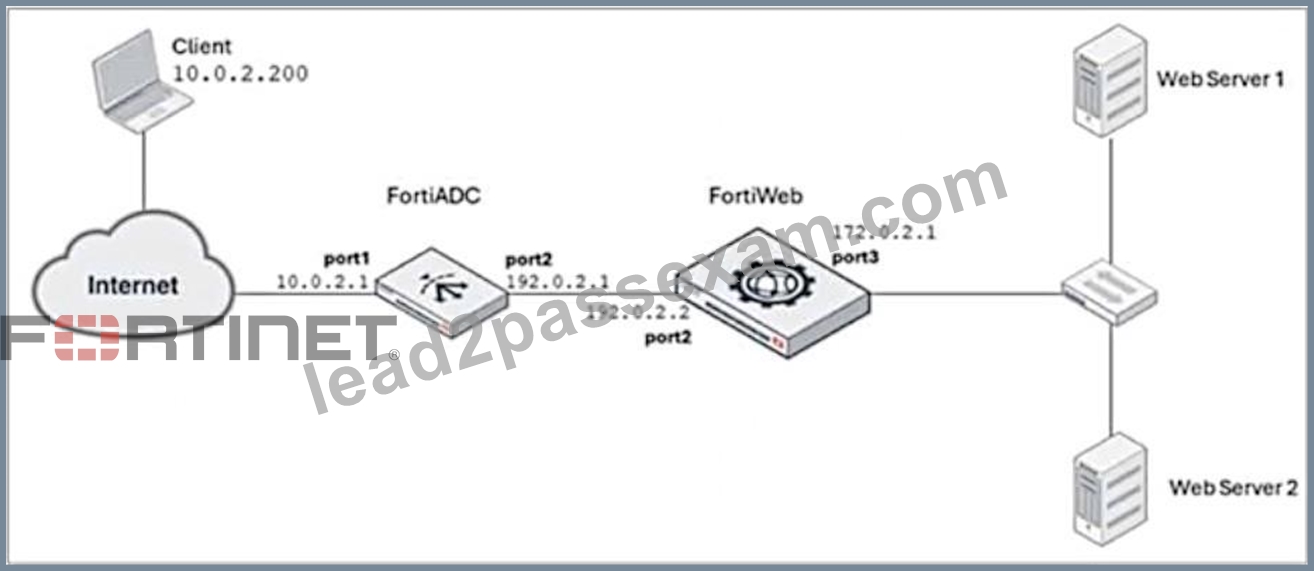
FortiADC is applying SNAT to all inbound traffic going to the servers.
When an attack occurs, FortiWeb blocks traffic based on the 192.0.2.1 source IP address, which belongs to FortiADC. This setup is breaking all connectivity and genuine clients are not able to access the servers.
What can the administrator do to avoid this problem? (Choose two.)
- A. Enable and configure the Preserve Client IP setting on the client.
- B. Enable and configure the Use X-Forwarded-For setting on FortiWeb.
- C. No special configuration is required; connectivity will be re-established for all clients after the set timeout.
- D. Place FortiWeb in front of FortiADC.
Answer: B,D
Explanation:
Place FortiWeb in front of FortiADC: This configuration change places FortiWeb between the client and FortiADC, so that FortiWeb can directly inspect and protect the incoming traffic before FortiADC applies SNAT (Source Network Address Translation). By placing FortiWeb in front, it will have access to the real client IP addresses, and it will be able to properly identify and handle attack traffic without blocking legitimate client traffic.
Enable and configure the Use X-Forwarded-For setting on FortiWeb: This setting allows FortiWeb to extract the original client IP address from the X-Forwarded-For header in the HTTP request, which is inserted by FortiADC when performing SNAT. With this setting enabled, FortiWeb will be able to block traffic based on the original client IP address rather than the SNATed IP address (192.0.2.1), preserving the accuracy of the security measures.
NEW QUESTION # 95
Examine the following code snippet:
servers:
- url: 'http://petstore.swagger.io/v1'
paths:
/pets:
get:
summary: List all pets
operationId: listPets
tags:
- pets
parameters:
- name: limit
in: query
description: How many items to return at one time (max 100)
required: true
schema:
$ref: '#/components/schemas/ref'
What is this a snippet from?
- A. An API schema file
- B. An XML schema file
- C. An HTTP request restriction file
- D. An API machine learning (ML) configuration file
Answer: A
NEW QUESTION # 96
Refer to the exhibit.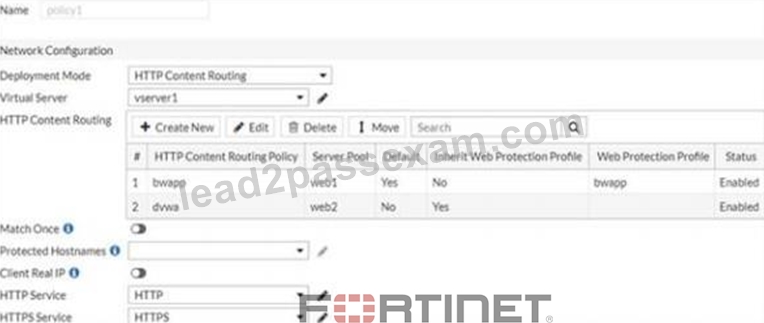
If rule 1 matches http://bwapp.fortinet.demo, rule 2 matches http://dvwa.fortinet.demo, and the default web protection profile is the inline protection profile, which protection profile will be applied to a connection to http://petstore.fortinet.demo?
- A. dwva
- B. Inline protection profile
- C. policy1
- D. bwapp
Answer: D
NEW QUESTION # 97
Which technology is commonly used for machine learning-based threat detection in web applications?
- A. Virtual Private Network (VPN)
- B. Blockchain
- C. Internet of Things (IoT)
- D. Artificial Intelligence (AI)
Answer: D
NEW QUESTION # 98
Refer to the exhibit.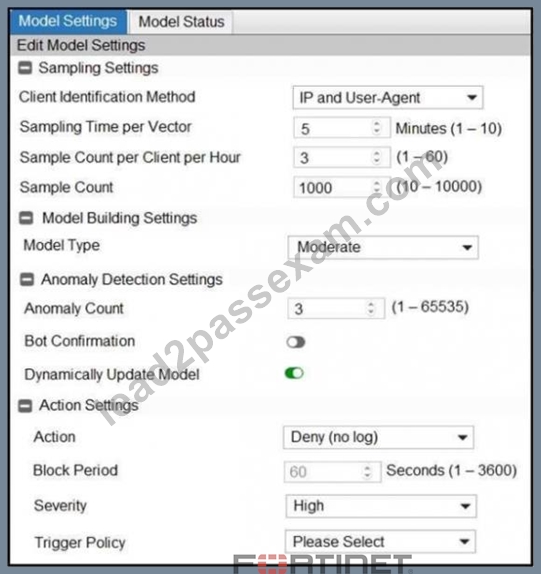
Many legitimate users are being identified as bots. FortiWeb bot detection has been configured with the settings shown in the exhibit. The FortiWeb administrator has already verified that the current model is accurate.
What can the administrator do to fix this problem, making sure that real bots are not allowed through FortiWeb?
- A. Disable Dynamically Update Model
- B. Enable Bot Confirmation
- C. Change Model Type to Strict
- D. Change Action under Action Settings to Alert
Answer: B
NEW QUESTION # 99
Which two FortiWeb operation modes support machine learning? (Choose two.)
- A. Transparent proxy
- B. Reverse proxy
- C. Offline protection
- D. True transparent proxy
Answer: B,D
NEW QUESTION # 100
During FortiWeb deployment, which feature can be used to protect against Distributed Denial of Service (DDoS) attacks?
- A. Rate limiting
- B. Load balancing
- C. Intrusion Prevention System (IPS)
- D. Server pools
Answer: A
NEW QUESTION # 101
Review the following configuration: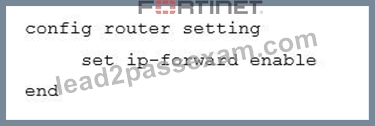
What are two routing behaviors that you can expect on FortiWeb after this configuration change? (Choose two.)
- A. Only ICMP traffic is allowed. All other traffic is dropped.
- B. IPv6 routing is enabled.
- C. Non-HTTP traffic destined to the FortiWeb virtual server IP address is dropped.
- D. Non-HTTP traffic routed through the FortiWeb is allowed.
Answer: C,D
Explanation:
FortiWeb is primarily designed to handle HTTP and HTTPS traffic, protecting web applications from various threats. By default, when operating in reverse proxy mode, FortiWeb does not forward non-HTTP/HTTPS protocols to protected servers. However, administrators can configure FortiWeb to handle non-HTTP/HTTPS traffic differently using the config router setting command. This command allows enabling IP-based forwarding (routing) for non-HTTP/HTTPS traffic. When enabled, FortiWeb can route non-HTTP traffic through itself to the appropriate backend servers.
Despite this capability, any non-HTTP/HTTPS traffic that is destined directly for a FortiWeb virtual server IP address is dropped. This means that while FortiWeb can be configured to forward non-HTTP/HTTPS traffic to backend servers, it will not process non-HTTP/HTTPS traffic targeted at its own virtual server IPs.
Regarding IPv6 routing, FortiWeb does support IPv6 in various operation modes, including reverse proxy, offline inspection, and transparent inspection. However, enabling IPv6 routing requires specific configurations and is not automatically enabled by default.
NEW QUESTION # 102
When configuring access control methods for web application users, which options should be considered for tracking and auditing user actions? (Select all that apply)
- A. Authentication logs
- B. Web server logs
- C. Session logs
- D. Error logs
Answer: A,B,C
NEW QUESTION # 103
When configuring API protection, what security measure is commonly used to verify the identity of clients making API requests?
- A. IP whitelisting
- B. Session cookies
- C. HTTP referrer headers
- D. OAuth 2.0 tokens
Answer: D
NEW QUESTION # 104
Which high availability mode is commonly used to integrate with a traffic distributer like FortiADC?
- A. Load sharing
- B. Active-Passive
- C. Cold standby
- D. Active-Active
Answer: D
Explanation:
In Fortinet's high availability (HA) configurations, integrating FortiWeb with a traffic distributor like FortiADC is best achieved using the Active-Active HA mode. This mode allows multiple FortiWeb appliances to operate simultaneously, distributing traffic loads and enhancing both performance and redundancy.
FortiWeb supports several HA modes:
Active-Passive: One appliance actively handles all traffic, while the other remains on standby, ready to take over if the active unit fails.
Active-Active: Multiple appliances actively process traffic concurrently, sharing the load and providing redundancy.
High Volume Active-Active: An enhanced version of Active-Active, designed for environments with exceptionally high traffic volumes.
When integrating with a traffic distributor like FortiADC, the Active-Active mode is particularly advantageous. FortiADC can intelligently distribute incoming traffic across multiple active FortiWeb appliances, optimizing resource utilization and ensuring high availability. This setup not only balances the load but also provides fault tolerance; if one appliance becomes unavailable, FortiADC can redirect traffic to the remaining active units without service interruption.
This collaborative approach between FortiWeb and FortiADC ensures that web applications remain secure, performant, and resilient against failures.
NEW QUESTION # 105
When viewing the attack logs on FortiWeb, which client IP address is shown when you are using XFF header rules?
- A. FortiWeb IP
- B. FortiGate local IP
- C. Client real IP
- D. FortiGate public IP
Answer: C
NEW QUESTION # 106
......
FCP_FWB_AD-7.4 Exam Crack Test Engine Dumps Training With 157 Questions: https://www.lead2passexam.com/Fortinet/valid-FCP_FWB_AD-7.4-exam-dumps.html
Obtain the FCP_FWB_AD-7.4 PDF Dumps Get 100% Outcomes Exam Questions For You To Pass: https://drive.google.com/open?id=1539ppFYtlL2-3RMibrqS2TvzLKbW-ehQ