

CWAP-404 Training & Certification Get Latest CWAP Wi-Fi Analysis Updated on Sep 14, 2025
Certification Training for CWAP-404 Exam Dumps Test Engine
NEW QUESTION # 101
In which element of a Beacon frame would you look to identify the current HT protection mode in which an AP is operating?
- A. HT Protection Element
- B. HT Capabilities Element
- C. HT Operations Element
- D. HT Information Element
Answer: D
Explanation:
The HT Information Element in a Beacon frame contains information about the current HT (High Throughput) protection mode in which an access point (AP) is operating. This element is used to ensure backward compatibility between HT (802.11n) and non-HT stations.
NEW QUESTION # 102
You are repairing a misconfiguration in WMM settings on an AP.
The aCWmin and aCWmax values were all changed.
What is the default aCWmax for AC_BK?
- A. 0
- B. 1
- C. 2
- D. 3
Answer: C
NEW QUESTION # 103
You're the WLAN administrator for a large retailer based at the HQ in New York. The London- based office has been complaining about WLAN disconnections around lunch time each day. You suspect this might be interference from the staff microwave, how might you test your theory from the New York office?
- A. Ask a local member of staff to change the frequency of the microwave and see if the disconnections stop
- B. Ask a local member of staff to take some pictures of the microwave, including some close-ups of the door seal so that you can access it
- C. Access the microwave remotely and run a diagnostic check
- D. Place one of the London APs into spectrum analyzer mode and monitor the situation over lunch time
Answer: D
Explanation:
The best way to test the theory of microwave interference from the New York office is to use a remote spectrum analyzer. By placing one of the London APs into spectrum analyzer mode, you can capture and analyze the RF spectrum in the London office over lunch time. You can then look for any signs of microwave interference, such as high duty cycle, high amplitude, or frequency hopping on the 2.4 GHz band. This method does not require any physical access to the microwave or any changes to its frequency.
NEW QUESTION # 104
According to 802.11-2007, in what frame type(s) might you find the PMK Count and PMKID List fields?
- A. EAPoL 4-Way Handshake frames
- B. All frames that include the RSN IE
- C. Beacon and Probe Response frames
- D. Only (Re)Association Request frames
- E. Authentication and Association Request and Response frames
Answer: D
NEW QUESTION # 105
You suspect an interfere may exist in a BSS that is experiencing sporadic problems. You want to identify and locate the device. The actual device identify is not known.
What tool should be used for this purpose?
- A. Throughput tester
- B. Protocol analyzer
- C. Cable tester
- D. Spectrum analyzer
Answer: D
NEW QUESTION # 106
Given: The Frame Check Sequence (FCS) is a 32 CRC used for error detection. The CRC is calculated over what?
- A. PHY Header and MAC Header only
- B. PHY Header, MAC Header and Frame Body
- C. Mac Header and Frame Body only
- D. Frame Body only
Answer: C
Explanation:
The CRC is calculated over the MAC Header and Frame Body only. The CRC (Cyclic Redundancy Check) is a 32-bit value that is used for error detection in wireless transmissions.
The CRC is calculated over the MAC Header and Frame Body of a PSDU, which are the parts of the data unit that contain information such as source and destination addresses, frame type, frame control, sequence number, payload, etc. The CRC is appended to the end of the PSDU as a FCS (Frame Check Sequence) field. The CRC is not calculated over the PHY Header or PHY Preamble, which are parts of the PPDU that contain information such as modulation, coding, data rate, etc. The PHY Header and PHY Preamble are added or removed by the PHY layer during the conversion between PSDU and PPDU.
NEW QUESTION # 107
The PHY layer provides framing by adding a header to create what type of data unit?
- A. PSDU
- B. MPDU
- C. MSDU
- D. PPDU
Answer: D
Explanation:
Explanation
The PHY layer provides framing by adding a header to create a PPDU. A PPDU (PHY Protocol Data Unit) is the data unit that is transmitted or received over the wireless medium by the PHY layer. A PPDU consists of a PSDU (PHY Service Data Unit) and a PHY header, which contains information such as modulation, coding, and data rate. The PHY layer adds the PHY header to the PSDU to create a PPDU for transmission, or removes the PHY header from the PPDU to extract the PSDU for reception. The other options are not correct, as they are not created by adding a header at the PHY layer. An MPDU (MAC Protocol Data Unit) is created by adding a MAC header and FCS to an MSDU (MAC Service Data Unit) at the MAC layer. An MSDU is the data unit that is passed from the LLC sublayer to the MAC sublayer or vice versa. References: [Wireless Analysis Professional Study Guide CWAP-404], Chapter 4: 802.11 Physical Layer, page 97-98
NEW QUESTION # 108
Which one of the following statements is not true concerning DTIMs?
- A. The DTIM interval can dictate when an STA will wake up to listen to beacon frames
- B. Every Beacon frame must contain a DTIM
- C. Buffered Broadcast and Multicast traffic will be transmitted following a DTIM
- D. DTIM stands for Delivery Traffic Indication Map
Answer: B
Explanation:
Explanation
Every Beacon frame must contain a DTIM is not a true statement concerning DTIMs. DTIM stands for Delivery Traffic Indication Message, and it is a subfield within the TIM (Traffic Indication Map) element in a Beacon frame. The DTIM indicates how many Beacon frames (including the current one) will appear before the next DTIM. For example, if the DTIM interval is set to 3, it means that every third Beacon frame will contain a DTIM. Buffered broadcast and multicast traffic will be transmitted following a DTIM, so that STAs in power save mode can wake up and receive them. The DTIM interval can also dictate when an STA will wake up to listen to Beacon frames, as some STAs may choose to only listen to Beacon frames that contain a DTIM . References: CWAP-404 Certified Wireless Analysis Professional Study and Reference Guide, Chapter
6: MAC Sublayer Frame Exchanges, page 200; CWAP-404 CertifiedWireless Analysis Professional Study and Reference Guide, Chapter 6: MAC Sublayer Frame Exchanges, page 201.
NEW QUESTION # 109
You are performing a multiple adapter channel aggregation capture to troubleshoot a VoIP roaming problem and would like to measure the roaming time from the last VoIP packet sent on the old AP's channel to the first VoIP packet sent on the new AP's channel. Which timing column in the packet view would measure this for you?
- A. Delta
- B. Absolute
- C. Roaming
- D. Relative
Answer: A
Explanation:
Explanation
Delta is the timing column in the packet view that measures the time difference between two consecutive packets in a capture file. Delta can be used to measure the roaming time from the last VoIP packet sent on the old AP's channel to the first VoIP packet sent on the new AP's channel by selecting these two packets and looking at their delta values. The other timing columns are not suitable for this measurement because they do not show the time difference between two specific packets. Roaming is a column that shows whether a packet belongs to a roaming event or not. Relative is a column that shows the time elapsed since the beginning of the capture file. Absolute is a column that shows the date and time when a packet was captured5 References:
CWAP-404 Study Guide, Chapter 2: Protocol Analysis, page 57
CWAP-404 Objectives, Section 2.4: Analyze timing values
NEW QUESTION # 110
An RST frame should be acknowledged by which frame?
- A. CTS
- B. Ack
- C. RTS-Ack
- D. Block Ack
Answer: A
Explanation:
An RTS (Request to Send) frame should be acknowledged by a CTS (Clear to Send) frame. An RTS and CTS frame are types of control frames that are used to implement a virtual carrier sense mechanism called RTS/CTS. RTS/CTS is a technique that helps to avoid collisions and hidden node problems in wireless transmissions. When a STA (station) wants to send a data frame, it first sends an RTS frame to the intended receiver, indicating the duration of the transmission. The receiver then responds with a CTS frame, also indicating the duration of the transmission. The other STAs in the vicinity hear either the RTS or the CTS frame and update their NAV (Network Allocation Vector) timers accordingly, deferring their access to the medium until the transmission is over. The sender then sends the data frame, followed by an ACK (Acknowledgement) frame from the receiver. The other options are not correct, as they are not used to acknowledge an RTS frame. An ACK frame is used to acknowledge a data frame, not an RTS frame. An RTS-Ack frame does not exist, as there is no such type of control frame in 802.11. A Block Ack (BA) frame is used to acknowledge multiple data frames in a single frame, not an RTS frame.
NEW QUESTION # 111
Given: The graphic is taken from a spectrum analyzer.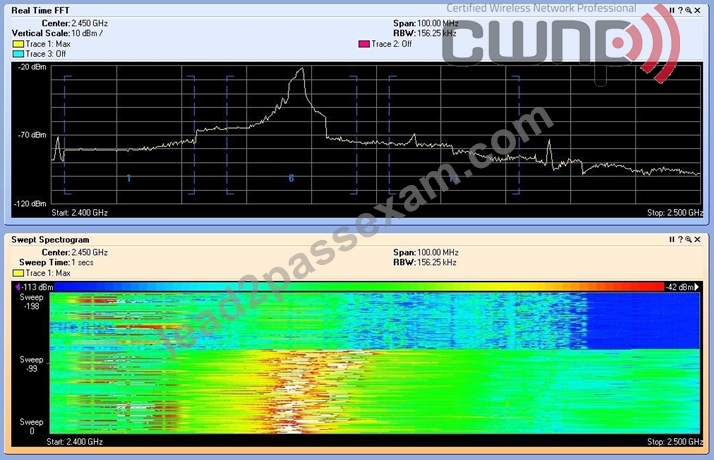
What types of RF transmitters are illustrated?
- A. An IEEE 802.11 HR/DSSS security camera on channel 6 and an RFID tag
- B. A Bluetooth headset and a narrowband RF jamming device
- C. A 2.4 GHz cordless phone and an OpenAir FHSS system
- D. A 20 MHz HT IEEE 802.11 system using channel 1 and a microwave oven
Answer: D
NEW QUESTION # 112
What IEEE 802.11 technology is illustrated by the exhibit?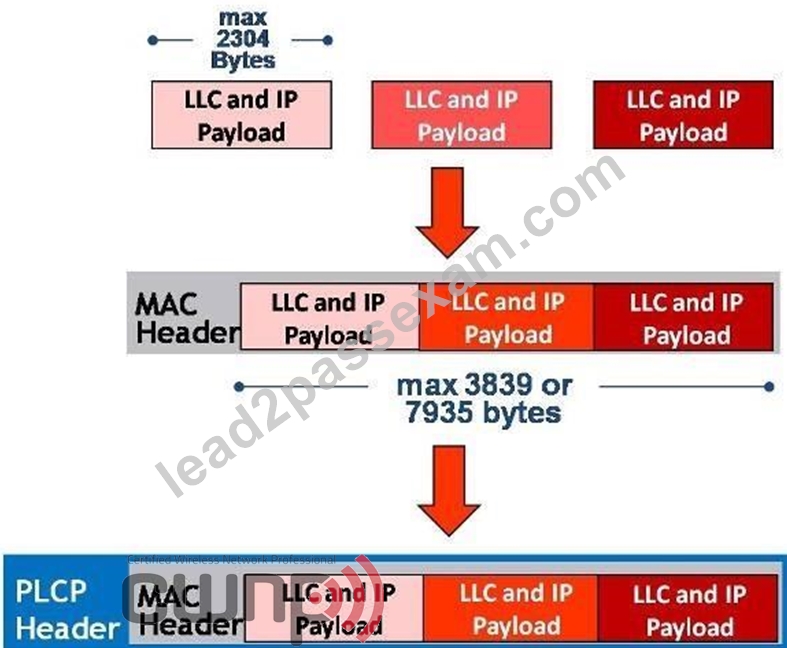
- A. A-MSDU
- B. Fragmentation
- C. A-MPDU
- D. TCP Fragment Bursting
- E. U-APSD
- F. Jumbo frames
Answer: A
NEW QUESTION # 113
As a wireless network consultant you have been called in to troubleshoot a high-priority issue for one of your customers. The customer's office is based on two floors within a multi-tenant office block. On one of these floors (floor 5) users cannot connect to the wireless network. During their own testing the customer has discovered that users can connect on floor 6 but not when they move to the floor 5. This issue is affecting all users on floor 5 and having a negative effect on productivity.
To troubleshoot this issue, you perform both Spectrum and Protocol Analysis. The Spectrum Analysis shows the presence of Bluetooth signals which you have identified as coming from wireless mice. In the protocol analyzer you see the top frame on the network is Deauthentication frames. On closer investigation you see that the Deauthentication frames' source addresses match the BSSIDs of your customers APs and the destination address is FF:FF:FF:FF:FF:FF:FF.
What do you conclude from this troubleshooting exercise?
- A. The customer should replace all their Bluetooth wireless mice as they are stopping the users on floor 5 from connecting to the wireless network
- B. The users on floor 5 are being subjected to a denial of service attack, as this is happening across the entire floor it is likely to be a misconfigured WIPS solution belonging to the tenants on the floor below
- C. The customers APs are misbehaving and a technical support case should be open with the vendor
- D. The CCI from the APs on the floor 4 is the problem and you need to ask the tenant below to turn down their APs Tx power
Answer: B
Explanation:
Explanation
The users on floor 5 are being subjected to a denial of service attack, as this is happening across the entire floor it is likely to be a misconfigured WIPS solution belonging to the tenants on the floor below. This is because the Deauthentication frames have a source address that matches the BSSIDs of the customer's APs and a destination address that is a broadcast address (FF:FF:FF:FF:FF:FF). This indicates that someone is sending spoofed Deauthentication frames to all STAs associated with the customer's APs, causing them to disconnect from the wireless network. This is a common type of DoS attack on wireless networks, and it could be caused by a rogue device or a WIPS solution that is configured to protect the wireless network of another tenant on the floor below12. References: CWAP-404 Certified Wireless Analysis Professional Study and Reference Guide, Chapter 13: Troubleshooting Common Wi-Fi Issues, page 4961; CWAP-404 Certified Wireless Analysis Professional Study and Reference Guide, Chapter 14: Troubleshooting Tools, page 5272.
NEW QUESTION # 114
You work as an SE for a value-added reseller. A client has an existing deployment of 802.11n Aps and wants to upgrade several BSSs to 802.11ac.
What hardware feature of some enterprise Aps may allow for this without a forklift upgrade?
- A. Replace the antennas with 802.11ac antennas
- B. Simply check the Enable 802.11ac checkbox in the web-based configuration interface
- C. Converting the 802.11n radio to an 802.11ac radio through software
- D. Adding an 802.11ac module to the existing APs
Answer: D
NEW QUESTION # 115
What MAC layer information will a dual-band 802.11n protocol analyzer capture if it is capturing data frames encrypted with WPA2-Enterprise? (Choose 2)
- A. Short Interframe Spaces
- B. Legacy Signal field
- C. Source IP Address
- D. TCP SYN datagram
- E. Sequence Control fields
- F. Null Data frames
Answer: E,F
NEW QUESTION # 116
According to the 802.11n-2009 amendment, what security requirement is specified for HT BSSs?
- A. All unicast traffic transmitted by an HT station and destined to an HT station must use AES- CCMP.
- B. In an RSN, HT stations may not communicate with one another using TKIP.
- C. HT BSSs must mandatorily support 802.11r FT.
- D. HT BSSs are prevented from supporting WEP.
- E. TKIP cannot be supported in an HT BSS.
Answer: B
NEW QUESTION # 117
A new firmware has been released for the AP model you use in your WLAN.
You have more than 120 of these APs installed.
What is a good reason for applying a firmware update on an enterprise AP?
- A. Enable new security features and patch vulnerabilities
- B. Enable the short guard interval
- C. Disable lower data rates
- D. Enable 4x4:4 spatial streams on a 3x3:3 AP
Answer: A
NEW QUESTION # 118
You have installed a new 802.11ac WLAN configured with 80 MHz channels. Users in one area are complaining about poor performance. This area is currently served by a single AP. You take a spectrum analysis capture in the poor performing area. While examining the waterfall plot you notice the airtime utilization is higher on the first 20 MHz of the 80 MHz channel when compared to the rest of the channel. What do you conclude?
- A. The AP is misconfigured and needs to be reconfigured to 80MHz operation
- B. Non Wi-Fi interference is preventing the APs 80 MHz operation
- C. The first 20 MHz is the AP's primary channel and higher airtime utilization on the primary channel is normal when an AP Is configured for 80 MHz operation
- D. RRM is enabled and has dynamically picked a 20 MHz channel
Answer: B
Explanation:
The most likely cause of higher airtime utilization on the first 20 MHz of the 80 MHz channel is non- Wi-Fi interference. Non-Wi-Fi interference can prevent an AP from using its full channel width, as it will degrade the signal quality and increase the noise floor on some parts of the channel. This will force the AP to fall back to a narrower channel width, such as 20 MHz or 40 MHz, to maintain communication with its clients. The waterfall plot can help identify non-Wi-Fi interference by showing spikes or bursts of RF energy on specific frequencies or sub-channels.
The other options are not correct, as they do not explain why only the first 20 MHz of the channel has higher airtime utilization.
NEW QUESTION # 119
To what data rates can a 5 GHz PHY device shift when changers occur in the signal strength?
- A. 11, 5.5, 2, 1
- B. 24, 18, 12, 6
- C. 24, 18, 12, 5.5
- D. 24, 18, 11, 2
Answer: B
NEW QUESTION # 120
The network administrator at ABC Engineering has taken a large packet capture from one of their APs running in monitor mode. She has very little knowledge of 802.11 protocols but would like to use the capture file to evaluate the overall health and performance of their wireless network. When she asks your advice, which tool do you recommend she opens the packet capture file with?
- A. WLAN scanner
- B. Python
- C. Capture visualization tool
- D. Spectrum analyzer
Answer: C
Explanation:
Explanation
A capture visualization tool is a software application that can open a packet capture file and display various graphs, charts, tables, and statistics that illustrate the characteristics and behavior of the wireless network. A capture visualization tool can help a network administrator with little knowledge of 802.11 protocols to evaluate the overall health and performance of their wireless network by providing a visual and intuitive representation of the captured data. A spectrum analyzer is a hardware device that measures the radio frequency signals in a given frequency range and displays their amplitude, frequency, and modulation. A spectrum analyzer can help identify sources of interference and noise in the wireless environment, but it cannot open a packet capture file. Python is a programming language that can be used to write scripts or applications that manipulate or analyze packet capture files, but it requires coding skills and knowledge of
802.11 protocols. A WLAN scanner is a software application that scans for available wireless networks and displays information such as SSID, BSSID, channel, signal strength, security type, and vendor. A WLAN scanner can help discover wireless networks and their basic parameters, but it cannot open a packet capture file345 References:
CWAP-404 Study Guide, Chapter 2: Protocol Analysis, page 63
CWAP-404 Objectives, Section 2.5: Use capture visualization tools
CWAP-404 Study Guide, Chapter 4: Spectrum Analysis and Troubleshooting, page 117 CWAP-404 Objectives, Section 4.1: Use spectrum analysis tools CWAP-404 Study Guide, Chapter 2: Protocol Analysis, page 33 CWAP-404 Objectives, Section 2.2: Analyze field values
NEW QUESTION # 121
Which piece of information Is not transmitted in an HT PDDU header?
- A. Number of Spatial Streams
- B. PPDU length
- C. Channel number
- D. MCS index
Answer: C
Explanation:
The channel number is not transmitted in an HT PPDU header. An HT PPDU header is a part of the PPDU that contains information such as modulation, coding, data rate, and number of spatial streams for an 802.11n transmission. The channel number is not included in the HT PPDU header, as it is determined by the frequency band and channel width that are used by the transmitter and receiver. The channel number can be inferred from the frequency band and channel width, which are indicated by bits in different fields of the HT PPDU header, such as HT- SIG and HT-LTF. The other options are not correct, as they are transmitted in an HT PPDU header. The number of spatial streams, PPDU length, and MCS index are indicated by bits in the HT-SIG field of the HT PPDU header.
NEW QUESTION # 122
......
Step by Step Guide to Prepare for CWAP-404 Exam: https://www.lead2passexam.com/CWNP/valid-CWAP-404-exam-dumps.html
CWAP Wi-Fi Analysis CWAP-404 Real Exam Questions and Answers FREE Updated: https://drive.google.com/open?id=1uqQvmI2OmkJnBMOQRJy9Jdb91C2vvP3Y