

[Sep 06, 2022] Get Up-To-Date Real Exam Questions for MB-500 with New Materials
Updated MB-500 Certification Exam Sample Questions
Skills Tested in Microsoft MB-500 Exam
The candidates who want to obtain the passing score in MB-500 test from the first attempt should demonstrate the following skills:
- Test code and development
Within this area, the candidates should become skilled in developing X++ code. So, they should be experienced in implementing and identifying base types and operators. Also, the candidates will need to demonstrate their expertise in identifying and implementing global functions in X++ and ensuring correct usage of Display Fields. The second category included in this chapter focuses on object-oriented code development. With it, for example, the exam-takers should get to know how to implement concepts related to inheritance and abstraction concepts or know how to use QueryBuilder and query objects.
- Developer tools application
The candidates will leverage their chances to pass the Microsoft MB-500 exam if they can use Visual Studio features to customize Finance and Operations apps. For instance, they should know how to use Application Explorer to manage metadata or synchronize data dictionary changes with the help of the application database. Within this topic, the candidates will also need to demonstrate that they can manage artifacts and source code with the help of version control. Thus, they should be able to compare code and resolve version conflicts. The third subtopic included in this chapter is related to the implementation of the Finance and Operation apps framework and ensures the highest level of functionality. For instance, the test-takers should be familiar with SysOperations, workflow, or asynchronous framework implementation.
- AOT elements development and design
This topic covers the highest percentage of the exam questions. The candidates should demonstrate that they can create forms as well as extending tables. For example, they will receive tasks related to adding tables and populating them with the proper field properties. Another subtopic included in this section is related to Extended Data Types and enumeration creation together with AOT elements extension and class creation. Particularly, here, you'll come across such terms as field properties, data connections, enumeration elements, event handler methods, and EDT properties.
- Solution design and architecture planning
Within this topic, the candidates will learn how to identify the essential components of Dynamics 365 Chain Management for Supplies and Dynamics 365 Finance. Therefore, they should know how to identify the architectural differences between Finance and Operations apps in the cloud or on-premise. Also, examinees should demonstrate a strong ability to prepare the deployment package as well as identifying application stack components together with mapping them to the standard models. Another subtopic included in this section is related to the implementation and design of the user interface. For example, the exam-takers will find questions related to page option selection or filtering option identification. Finally, the candidates should develop skills related to Application Lifecycle Management implementation such as creating extension models or configuring the DevOps source control process.
- Performance optimization and security implementation
Within this chapter, the candidates should demonstrate how skilled they are in implementing role-based security requirements and policies. For example, they should become able to enforce permission policy and use Extensible Data Security to implement record-level security. Besides, the examinees should know how to use optimization techniques to apply fundamental performance. This means that they will learn how to apply and identify catching mechanisms or modify queries to ensure the highest level of optimization. The last subtopic included in this scope details optimizing user interface performance.
NEW QUESTION 80
Note: This question is part of a series of questions that present the same scenario. Each question in the series contains a unique solution that might meet the stated goals. Some question sets might have more than one correct solution, while others might not have a correct solution.
After you answer a question in this section, you will NOT be able to return to it. As a result, these questions will not appear in the review screen.
You have an enumeration named truckStatus that has the following statuses:
* Empty
* Loaded
* Completed
You have the following code: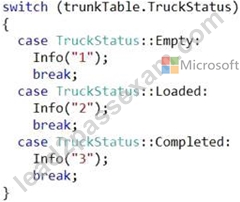
You need to extend this enumeration and add the following statuses to the enumeration: Quarantine, InTransit.
You must then modify code that validates the switch statement.
Solution: Add a post handler to the method that checks the enumeration and logic for your new enumeration values using a range comparison for your new values.
Does the solution meet the goal?
- A. Yes
- B. No
Answer: B
NEW QUESTION 81
A company requires a change to one of the base Microsoft SQL Server Reporting Services (SSRS) reports. The report must include a new field that automatically filters the report based on the user who opens the report.
You need to add the new field as specified.
What should you do? To answer, select the appropriate options in the answer area.
NOTE: Each correct selection is worth one point.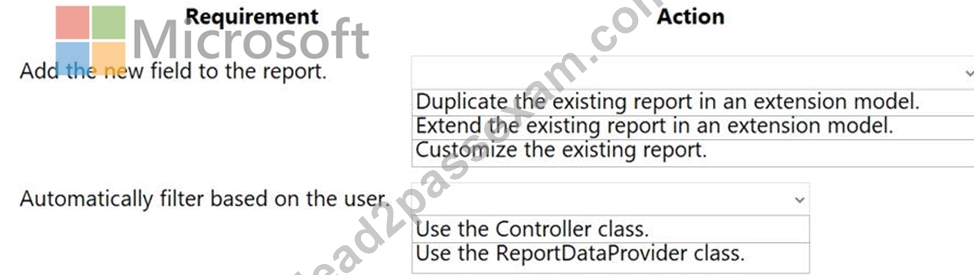
Answer:
Explanation: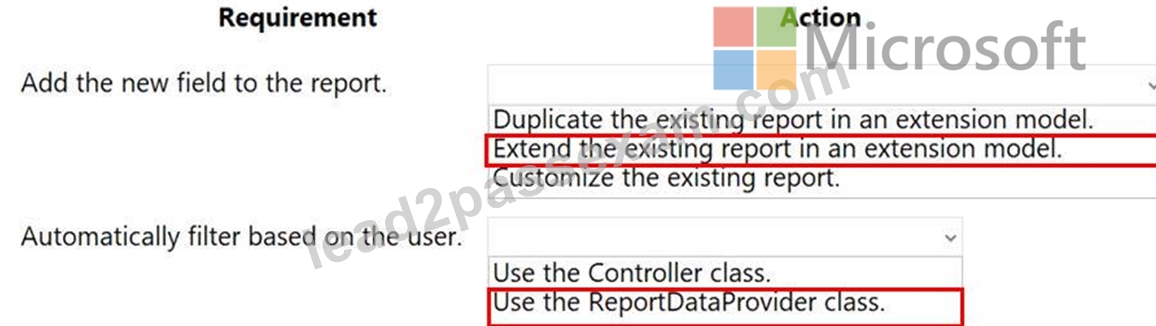
Reference:
https://docs.microsoft.com/en-us/dynamics365/fin-ops-core/dev-itpro/analytics/customize-app-suite-reports-with-extensions
https://community.dynamics.com/ax/b/dynamics101trainingcenterax/posts/developing-a-ssrs-report-using-the-report-data-provider-in-microsoft-dynamics-ax-2012
NEW QUESTION 82
Note: This question is part of a series of questions that present the same scenario. Each question in the series contains a unique solution that might meet the stated goals. Some question sets might have more than one correct solution, while others might not have a correct solution.
After you answer a question in this section, you will NOT be able to return to it. As a result, these questions will not appear in the review screen.
You create a new form in a project.
You need to display tabs in a vertical alignment.
Solution: Apply the Simple List pattern.
Does the solution meet the goal?
- A. No
- B. Yes
Answer: B
Explanation:
Explanation/Reference:
https://docs.microsoft.com/sv-se/dynamics365/fin-ops-core/dev-itpro/user-interface/simple-list-details-form- pattern
NEW QUESTION 83
You are creating a Dynamics 365 Finance report. You cannot query the data for the report directly.
You must include parameters to specify data for the report.
You need to create the report.
What should you use? To answer, select the appropriate options in the answer area.
NOTE: Each correct selection is worth one point.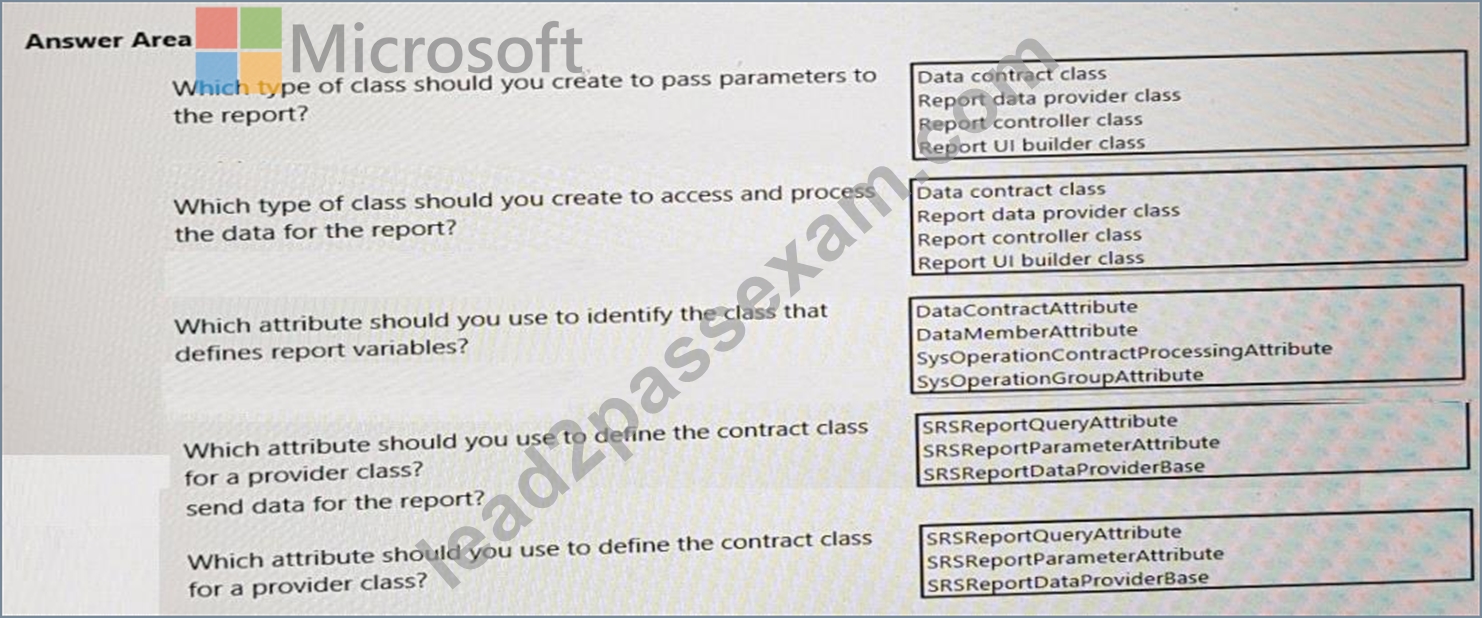
Answer:
Explanation: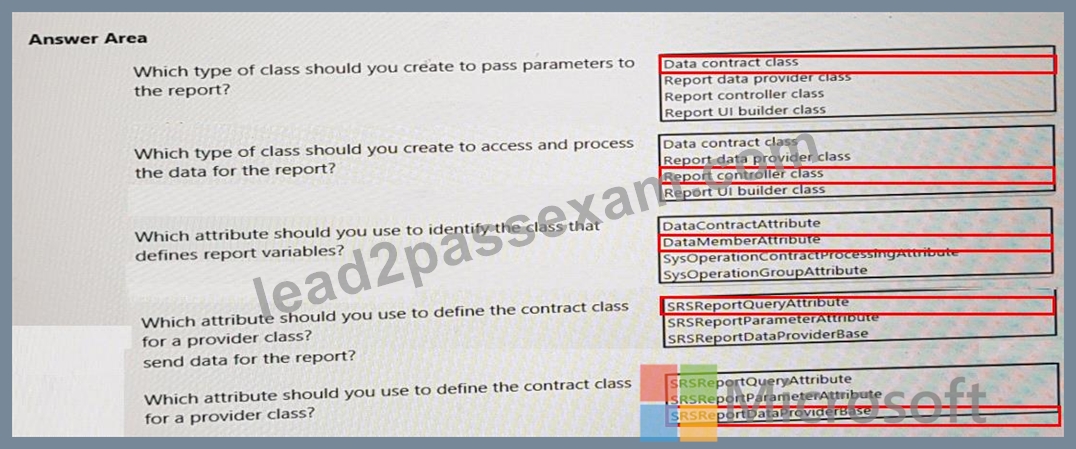
NEW QUESTION 84
You are a Dynamics 365 Finance and Operations developer. You create a class.
You need to mark the class to ensure that when code is compiled, the process fails if a specific method is called in the source code.
Which attribute should you use?
- A. SysAttribute
- B. getAttributes
- C. SysObsoleteAttribute
- D. SysEntryPointAttribute
Answer: C
Explanation:
Explanation
Explanation:
One use of the SysObsoleteAttribute class is to notify the compiler that the compile should fail if a particular method is called in the source code. The compiler rejects the compile, and displays the specific message that is stored in this use of the attribute.
Reference:
https://docs.microsoft.com/en-us/dynamics365/fin-ops-core/dev-itpro/dev-ref/xpp-attribute-classes
NEW QUESTION 85
You are a Dynamics 365 Finance developer. You create a form.
You must ensure that only sales managers can view the form.
You need to set up security for the form.
What should you do? To answer, select the appropriate options in the answer area.
NOTE: Each correct selection is worth one point.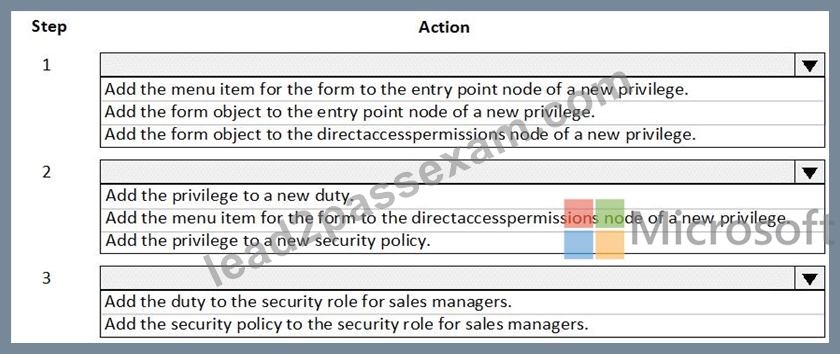
Answer:
Explanation: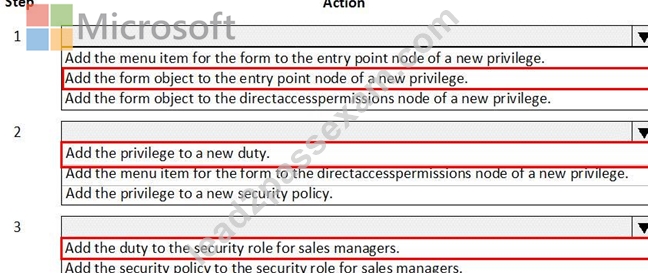
Reference:
https://www.cloudfronts.com/set-form-control-access-via-security-role-in-d365-finance/
NEW QUESTION 86
You need to set up a recurring integration to enable file exchanges between Dynamics 365 Finance and a third-party system.
In which order should you perform the actions? To answer, move all actions from the list of actions to the answer area and arrange them in the correct order.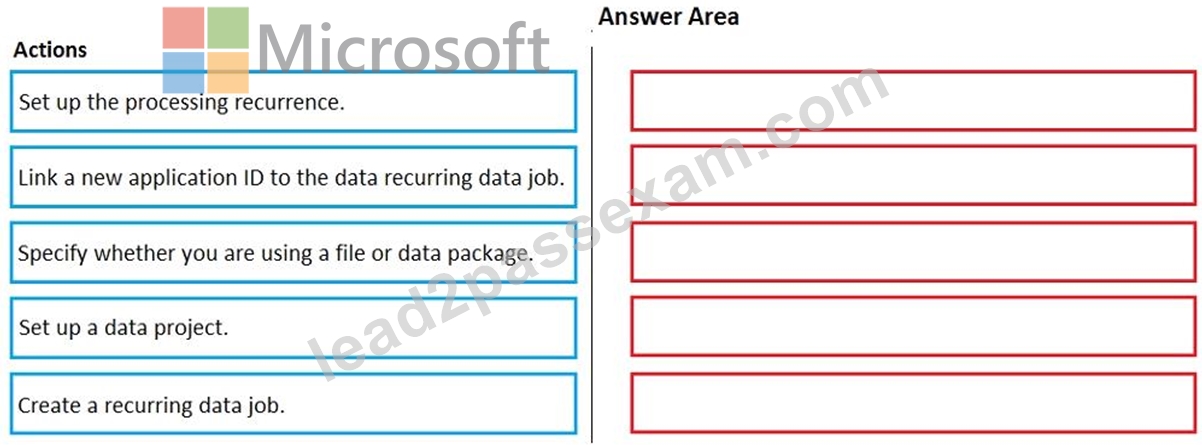
Answer:
Explanation: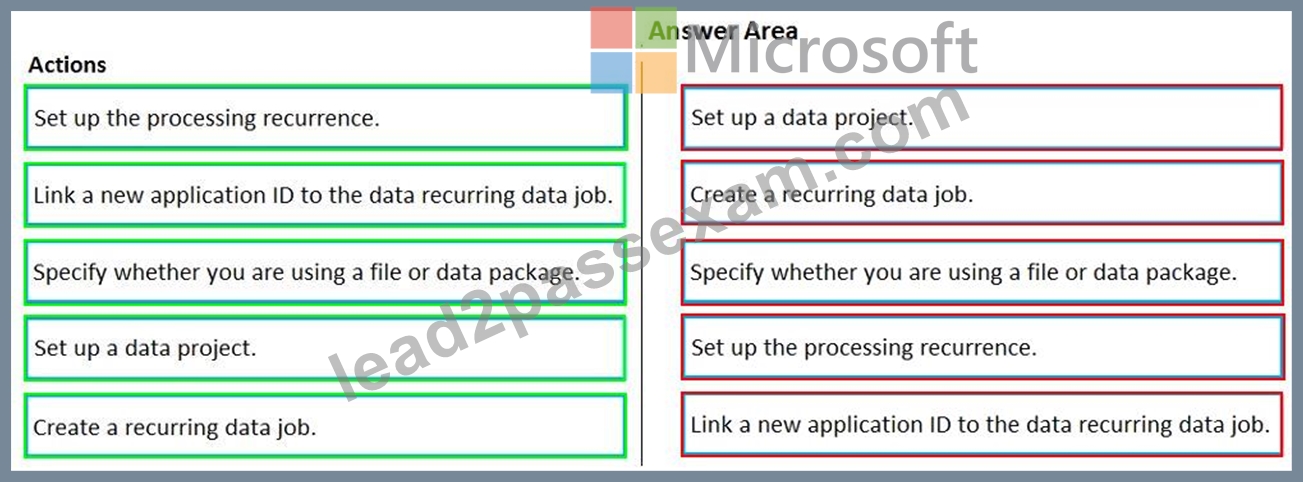
Explanation:
Step 1: Set up a data project
Step 2: Create a recurring data job
* Create a recurring data job
* On the Data project page, select Create recurring data job (Step 2)
* Enter a valid name and a description for the recurring data job.
* On the Set up authorization policy tab, enter the application ID that was generated for your application, and mark it as enabled.
* Expand Advanced options tab, and specify either File or Data package (Step 3)
* Select Set processing recurrence, and then, in the Define recurrence dialog box, set up a valid recurrence for your data job (Step 4) Step 3: Specify whether you are using a file or data package.
Step 4: Set up the processing recurrence
Step 5: Link a new application ID to the data recurring data job
You can use integration REST endpoints to integrate with the client, submit documents (import), or poll available documents for download (export). These endpoints support OAuth.
Reference:
https://docs.microsoft.com/en-us/dynamics365/fin-ops-core/dev-itpro/data-entities/recurring-integrations
NEW QUESTION 87
You are a Dynamics 365 Finance and Operations developer.
You need to monitor system performance.
Which tools should you use? To answer, select the appropriate option in the answer area.
NOTE: Each correct selection is worth one point.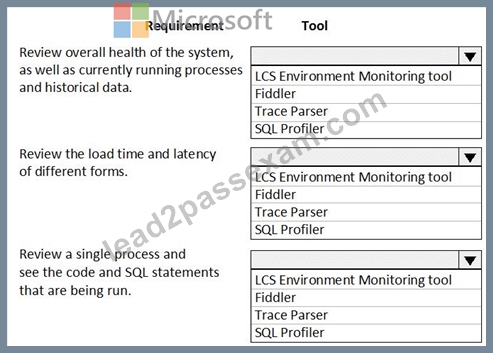
Answer:
Explanation: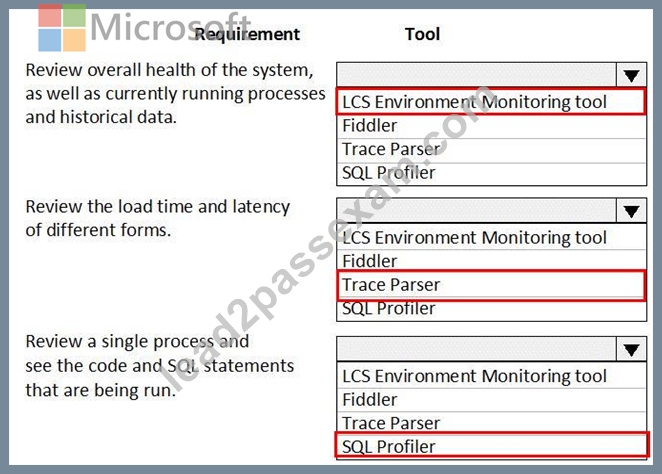
Explanation:
Box 1: LCS Environment Monitoring tool
Microsoft Dynamics Lifecycle Services (LCS) provides to help you monitor, diagnose, and analyze the health of the Finance and Operations environments that you manage.
Box 2: Trace Parser
You can use the Trace parser to consume traces and analyze performance in your deployment.
Box 3: SQL Profiler
Incorrect Answers:
Fiddler:
Fiddler can help in different ways with Dynamics 365 troubleshooting, including determine what errors are being reported, and by speeding up the JavaScript development process.
Reference:
https://docs.microsoft.com/en-us/dynamics365/fin-ops-core/dev-itpro/lifecycle-services/monitoring-diagnostics
NEW QUESTION 88
A company has a Dynamics 365 Finance environment.
You need to implement indices for new tables.
Which types of indexes should you use? To answer, drag the appropriate types of indexes to the correct requirements. Each type of index may be used once, more than once, or not at all. You may need to drag the split bar between panes or scroll to view content NOTE: Each correct selection is worth one point.
Answer:
Explanation:
NEW QUESTION 89
You create the following cloud-based Dynamics 365 Finance environments:
A developer creates code extensions in the Development environment. The developer checks the code changes into an Azure DevOps branch.
You need to deploy the code changes to the Standard Acceptance Test environment.
What should you do? To answer, select the appropriate options in the answer area.
NOTE: Each correct selection is worth one point.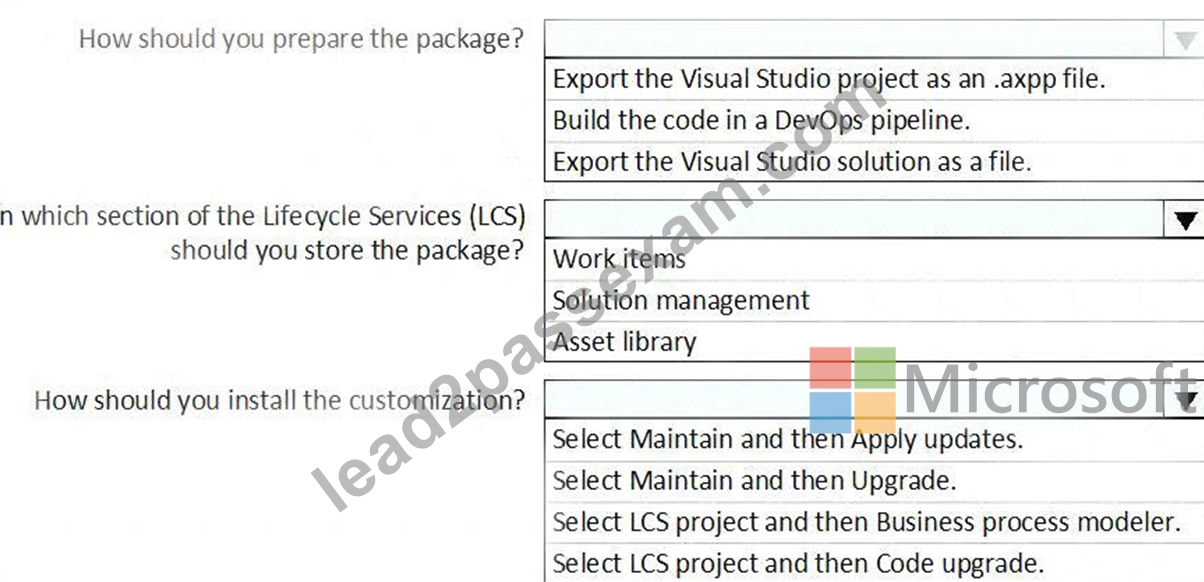
Answer:
Explanation: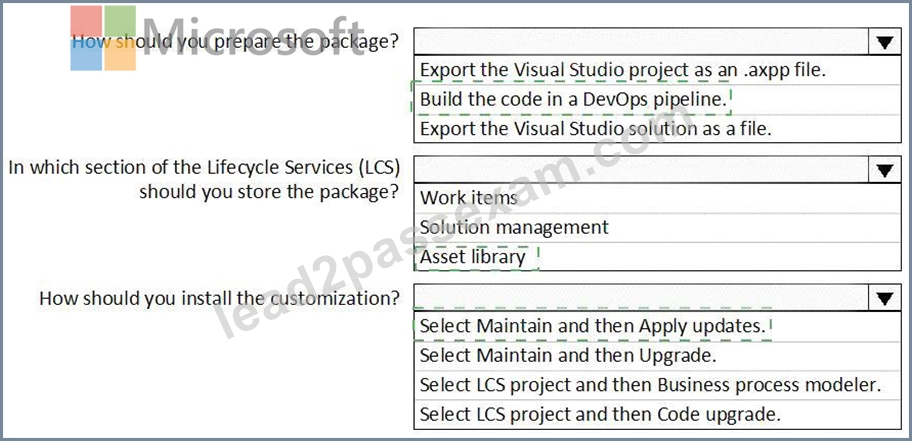
Explanation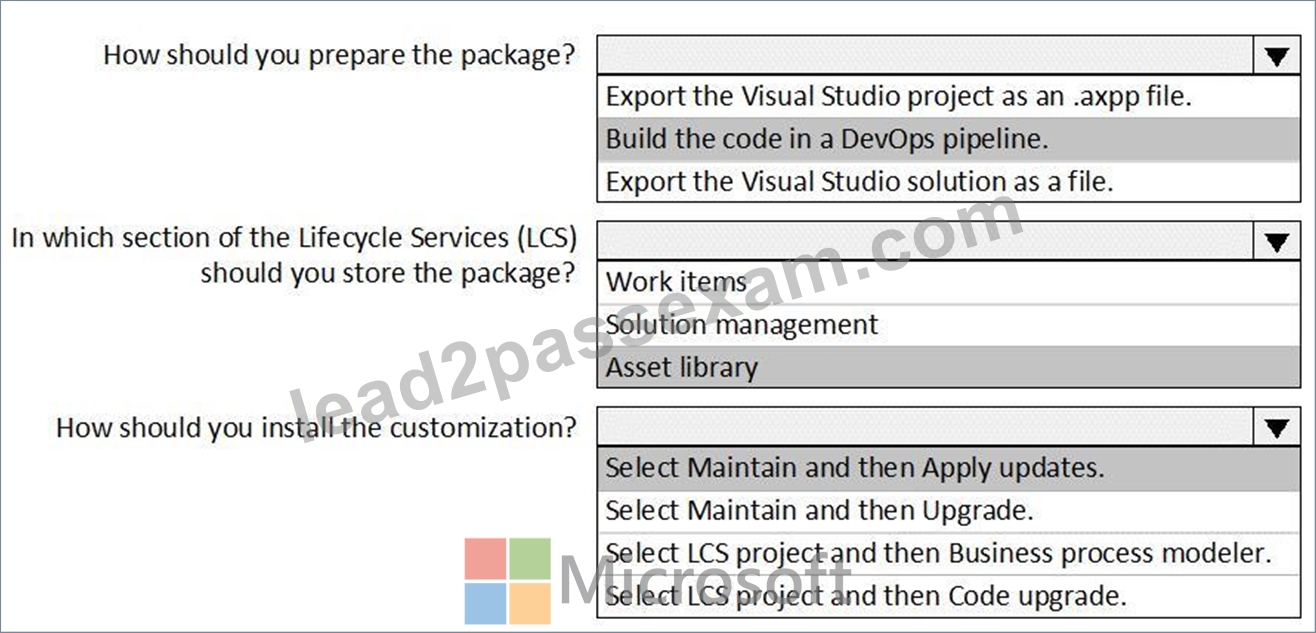
Box 1: Build the code in the DevOps pipeline.
Box 2: Asset library
Run the export to the Asset library in Microsoft Dynamics Lifecycle Services (LCS).
Box 3: Select Maintain and Apply updates.
eprovision the target environment
If you copy a database between environments, the copied database won't be fully functional until you run the Environment reprovisioning tool to make sure that all Commerce components are up to date.
Follow these steps to run the Environment reprovisioning tool.
* In your project's Asset Library, in the Software deployable packages section, click Import.
* From the list of shared assets, select the Environment Reprovisioning Tool.
* On the Environment details page for your target environment, select Maintain > Apply updates.
* Select the Environment Reprovisioning tool that you uploaded earlier, and then select Apply to apply the package.
* Monitor the progress of the package deployment.
Reference:
https://docs.microsoft.com/en-us/dynamics365/fin-ops-core/dev-itpro/database/dbmovement-scenario-exportuat#
NEW QUESTION 90
You need to create the new table for the vendor exclusion list.
What should you do? To answer, select the appropriate options in the answer area.
NOTE: Each correct selection is worth one point.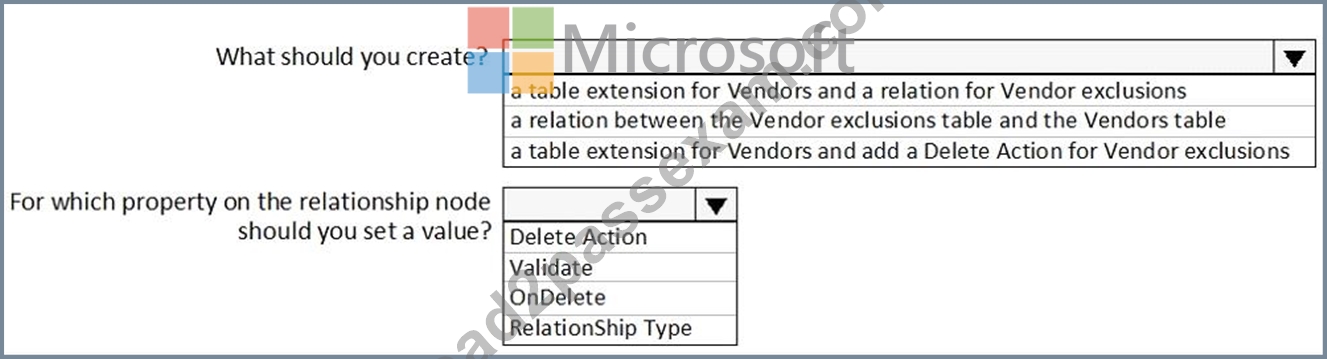
Answer:
Explanation: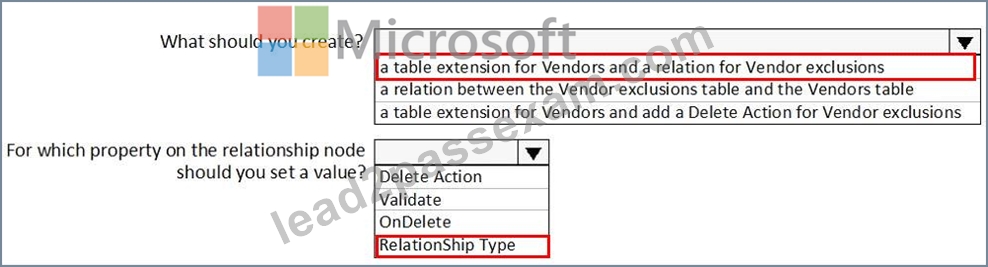
Explanation:
Scenario: You must develop a new solution to maintain a Vendor exclusion list for each customer and item combination. The solution must meet the following requirements:
Isolate all new vendor exclusion codes as a new assembly by creating a table named VendExclusions.
Create an index for the table named PrimaryIdx that uses the following fields: CustAccount, ItemId, VendAccount.
Ensure that users can open the Vendor Exclusion list report from the customer master form. The list must display the customer account, Item ID, and Vendor account fields.
Maintain referential integrity with other tables.
Box 1: a table extension for Vendors and relation for the Vendor exclusions Box 2: RelationShip Type Reference:
https://docs.microsoft.com/en-us/dynamics365/fin-ops-core/dev-itpro/data-entities/develop-composite-data-entities
NEW QUESTION 91
HOTSPOT
You need to modify the CashDisc form to meet the requirements.
Which objects should you use? To answer, select the appropriate options in the answer area.
NOTE: Each correct selection is worth one point.
Hot Area: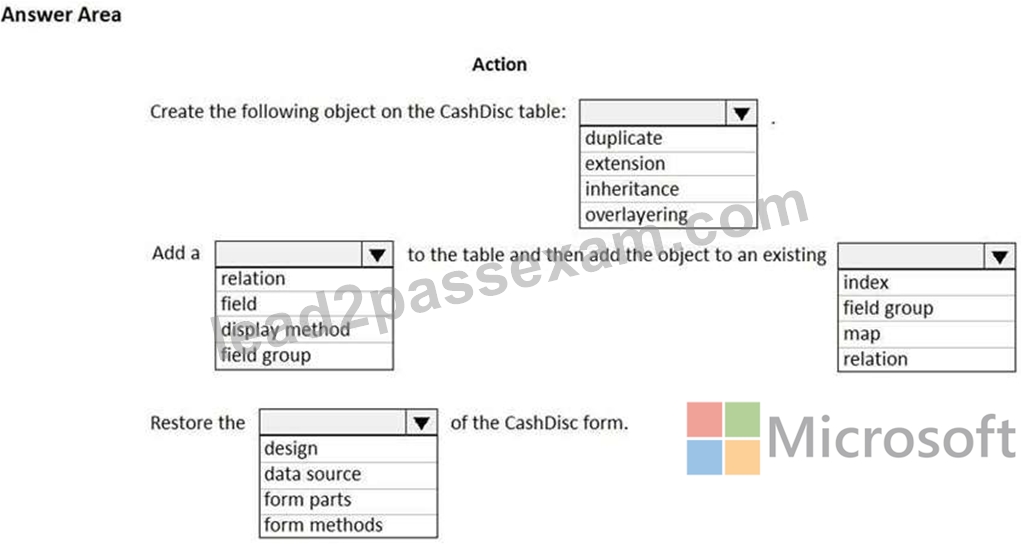
Answer:
Explanation: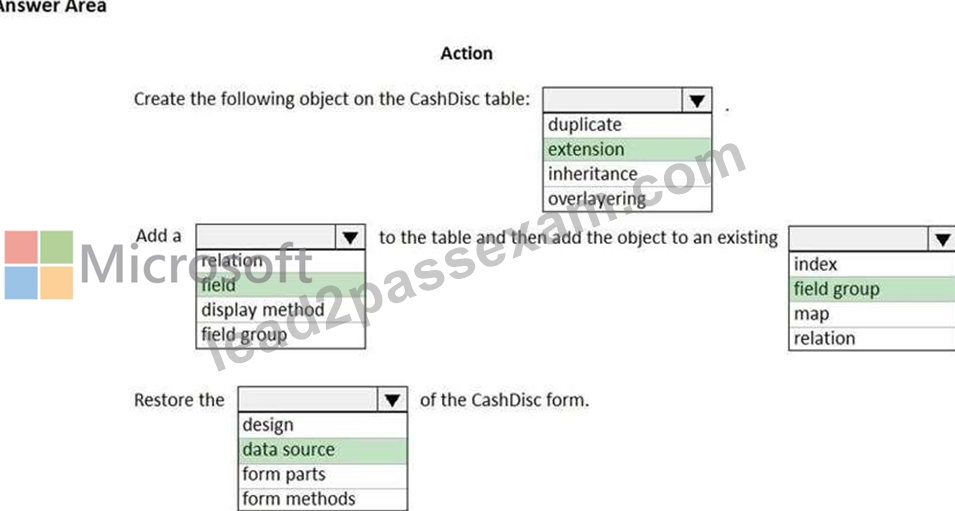
Explanation:
Scenario: CashDisc form
You must extend the CashDisc form to add a new field named MinimumInvoiceAmount to the form. You must add a new Extended Data Type to the extension model for the new field. The new field must be added above the discount method field. The field must display 10 characters.
Box 1: extension
To add a new field to an existing table, you must first create a table extension.
Box 2: field
Box 3: field group
Box 4: data source
Often, the information that is stored in existing tables doesn't satisfy customer requirements. Therefore, additional tables must be created, and data from those tables must be shown on pages.
You can add new data sources to existing forms through extension. Follow these steps.
1. In the extension model, create a form extension for the selected form.
2. Right-click the form extension, and then select New Data Source.
Reference:
https://docs.microsoft.com/en-us/dynamics365/fin-ops-core/dev-itpro/extensibility/add-datasource
NEW QUESTION 92
You need to map the Dynamics 365 Finance components into the standard models.
Which component belongs to which model? To answer, drag the appropriate models to the correct components. Each model may be used once, more than once, or not at all. You may need to drag the split bar between panes or scroll to view content.
NOTE: Each correct selection is worth one point.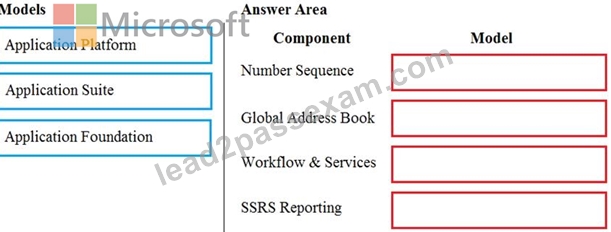
Answer:
Explanation: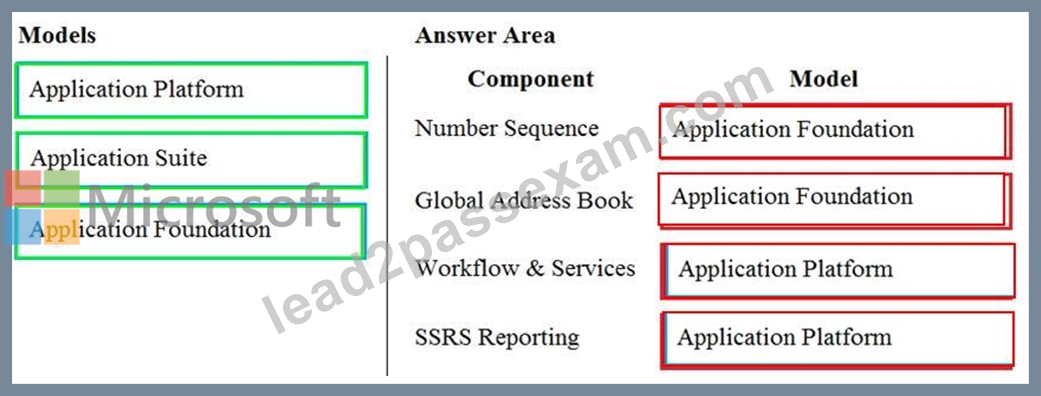
Reference:
https://docs.microsoft.com/en-us/dynamics365/fin-ops-core/dev-itpro/dev-tools/application-stack-server-architecture
NEW QUESTION 93
You need to implement the company's integration requirements.
Which integration strategies should you use? To answer, drag the appropriate integration strategies to the correct requirements. Each integration strategy may be used once, more than once, or not at all. You may need to drag the split bar between panes or scroll to view content.
NOTE: Each correct selection is worth one point.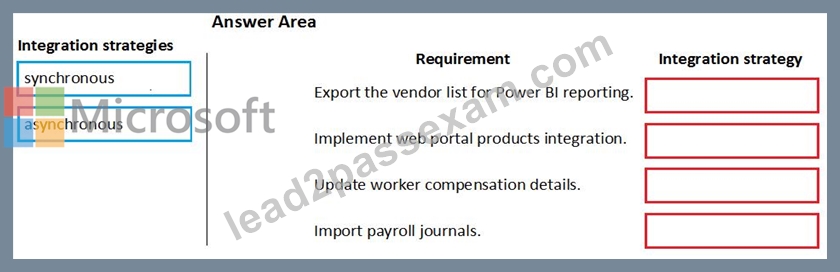
Answer:
Explanation: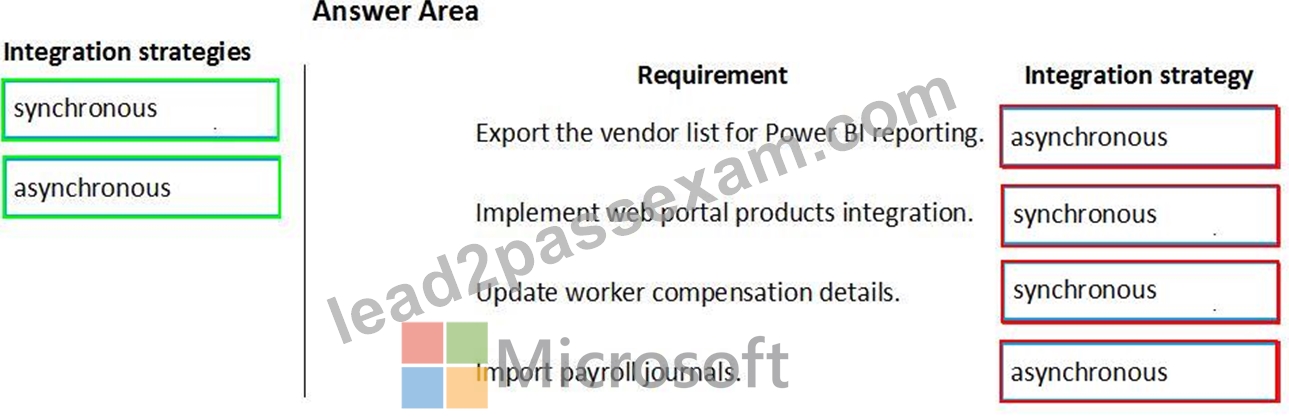
Explanation:
Box 1: asynchronous
An asynchronous pattern is a non-blocking pattern, where the caller submits the request and then continues without waiting for a response.
Box 2: Synchronous
A synchronous pattern is a blocking request and response pattern, where the caller is blocked until the callee has finished running and gives a response.
Box 3: Synchronous
Box 4: asynchronous
Batch data is asynchronous.
Reference:
https://docs.microsoft.com/en-us/dynamics365/fin-ops-core/dev-itpro/data-entities/integration-overview#synchronous-vs-asynchronous-integration-patterns
NEW QUESTION 94
You are a Dynamics 365 Finance developer. You create an integer variable named totalSales.
You need to display the value from totalSales in an info statement.
Which three code segments can you use? Each correct answer presents a complete solution.
NOTE: Each correct selection is worth one point.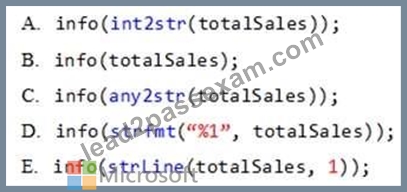
- A. Option B
- B. Option D
- C. Option A
- D. Option C
Answer: B,C,D
Explanation:
A: int2Str converts an integer to the equivalent string.
C: any2Str converts an anytype value to a str value. The anytype data type is a placeholder for any data type.
D: Example:
void MyMethod()
{
for (int i = 0; i < 10; i++)
{
info(strfmt("i is %1", i));
}
}
Reference:
https://docs.microsoft.com/en-us/dynamics365/fin-ops-core/dev-itpro/dev-ref/xpp-variables-data-types
https://docs.microsoft.com/en-us/dynamics365/fin-ops-core/dev-itpro/dev-ref/xpp-data-primitive#anytype Implement Reporting Testlet 1 Case study This is a case study. Case studies are not timed separately. You can use as much exam time as you would like to complete each case. However, there may be additional case studies and sections on this exam. You must manage your time to ensure that you are able to complete all questions included on this exam in the time provided.
To answer the questions included in a case study, you will need to reference information that is provided in the case study. Case studies might contain exhibits and other resources that provide more information about the scenario that is described in the case study. Each question is independent of the other questions in this case study.
At the end of this case study, a review screen will appear. This screen allows you to review your answers and to make changes before you move to the next section of the exam. After you begin a new section, you cannot return to this section.
To start the case study
To display the first question in this case study, click the Next button. Use the buttons in the left pane to explore the content of the case study before you answer the questions. Clicking these buttons displays information such as business requirements, existing environment, and problem statements. If the case study has an All Information tab, note that the information displayed is identical to the information displayed on the subsequent tabs. When you are ready to answer a question, click the Question button to return to the question.
Background
Wide World Importers sell office supplies, furniture, and fittings to their customers across the United States.
The company has the following locations:
* a retail store in Seattle
* a warehouse in Seattle
* a customer support and call center in Atlanta
* a team of field workers that provide furniture installation services at customer sites.
Wide World Importers plans to implement Dynamics 365 Finance and Microsoft Azure cloud platform features.
Current environment
Customers may place orders by email, phone, or by using the company's website. The company authorizes and processes credit card transactions by using a web-based application. Customer, inventory, supplier, and other master and transactional data is stored in a legacy database.
The company collects feedback from customers by phone or a form on the company's website and maintains the data in a Microsoft Excel workbook.
Wide World Importers runs on-premises applications to manage payroll and workers compensation. The company has a set of Microsoft Power BI dashboards that present data from a reporting database.
The company creates a Lifecycle Services (LCS) implementation project and completes Dynamics 365 Finance onboarding.
The company maintains production, quality assurance (QA), development, user acceptance testing (UAT), and build environments.
Requirements
General
* You must configure a cloud-based Dynamics 365 Finance development environment and enable code extension that support updates.
* You must configure version control and a Build environment.
* You must migrate all legacy data to the new system.
* You must implement best practices for X++ coding, the data model, caching, and security.
* All new code must be unit tested in a development environment and then validated by the QA team before code is added to source control.
Business processes
* You must configure vendor trade agreements.
* Products must be shipped directly from suppliers to customers depending on customer location to save indirect costs.
* You must collect customer feedback on products shipped directly from vendors.
* You must deploy code to a UAT environment for testing before deploying code to production.
* You must validate all entries for the purchase order creation form.
* You must develop a web portal that allows customers to browse products, place orders, and check order status. Product data for the web portal must be integrated as periodic batches.
Business systems
* You must install and configure a third-party solution for credit card processing within Dynamics 365 Finance. The third-party company will provide a deployable package.
* The workers compensation application must be able to call an API to update worker compensation details in Dynamics 365 Finance.
* You must develop a process to import payroll journals into the system.
* You must configure the warehouse mobile device portal for warehouse operations.
* You must install a third-party solution to support web portal integration. The solution is supplied as a source code model file.
Vendor exclusion list
You must develop a new solution to maintain a Vendor exclusion list for each customer and item combination.
The solution must meet the following requirements:
* Isolate all new vendor exclusion codes as a new assembly by creating a table named VendExclusions.
* Create an index for the table named PrimaryIdx that uses the following fields: CustAccount, ItemId, VendAccount.
* Ensure that users can open the Vendor Exclusion list report from the customer master form. The list must display the customer account, Item ID, and Vendor account fields.
* Implement the Excel integration for the Vendor Exclusion List form.
* Provide functionality to periodically export the Vendor exclusion list to prepare reports by using standard reporting capabilities of Dynamics 365 Unified Operations.
* Develop necessary security permissions to view and maintain the new Vendor exclusion list functionality and reporting. Users with maintain rights will be able create, update, and delete the exclusion list.
Permissions must be assigned to security roles to match company security model.
* Maintain referential integrity with other tables.
* Users must be presented with a warning message before a direct delivery purchase order is created for a vendor in exclusion list.
* Sales managers must be alerted when a new exclusion record is added to the system.
Security
* You must implement the record level audit feature to identify the users who created the record.
* Grant specific users rights to maintain the vendor exclusion list by using Excel.
* You must implement validation to check whether a proposed direct delivery purchase order vendor is on the exclusion list for the customer and product combination.
Issues
* User1 is not able to access many features in the system. You must provide User1 administrator rights.
* A sales manager suspects a data-related issue in the vendor exclusion list. User1 must identify the user who created the referenced exclusion records.
* Developer2 joins the company and does not have access to a development environment or source control.
* User2 reports performance issues when they generate direct delivery purchase orders after current updates are applied.
* User2 reports that they cannot access new functionality and reports.
Implement Reporting
Testlet 2
Case study
This is a case study. Case studies are not timed separately. You can use as much exam time as you would like to complete each case. However, there may be additional case studies and sections on this exam. You must manage your time to ensure that you are able to complete all questions included on this exam in the time provided.
To answer the questions included in a case study, you will need to reference information that is provided in the case study. Case studies might contain exhibits and other resources that provide more information about the scenario that is described in the case study. Each question is independent of the other questions in this case study.
At the end of this case study, a review screen will appear. This screen allows you to review your answers and to make changes before you move to the next section of the exam. After you begin a new section, you cannot return to this section.
To start the case study
To display the first question in this case study, click the Next button. Use the buttons in the left pane to explore the content of the case study before you answer the questions. Clicking these buttons displays information such as business requirements, existing environment, and problem statements. If the case study has an All Information tab, note that the information displayed is identical to the information displayed on the subsequent tabs. When you are ready to answer a question, click the Question button to return to the question.
Background
Overview
First Up Consultants provides Commercial Cleaning services to its clients. The company purchases all its cleaning supplies from Best For You Organics Company.
First Up Consultants is using a cloud-based Dynamics 365 Finance instance. The system has a foundation table named CashDisc that contains one cash discount record for each cash discount type.
Best For You Organics Company invoices First Up Consultants and allows cash discounts based on how fast an invoice is paid. First Up Consultants is entitled to a two percent discount from Best for You Organics for any invoice that is paid within 10 days and has a minimum invoice amount of $2,500.
Business requirements
All new and extended objects must be located in an existing model named FinanceExt. The creation of new models is not permitted.
Best For You Organics Company requires that First Up Consultants apply specific minimum invoice amounts to each cash discount record. A cash discount may only be applied when the minimum invoice amount requirement has been met. The new field must be added to the CashDisc form grid with the allowable visible number of characters set to 10.
First Up Consultants must retrieve the required Cash Discount methods and corresponding minimum invoice amounts directly from Best For You Organics Company's enterprise resource planning (ERP) system.
The Chief Financial Officer (CFO) requires the following reports:
* A report that shows all outstanding invoices, their cash discount types including the new minimum threshold applicable, and the amount of the discount. The report must only be accessed by users who are members of the Accounts Payable Manager role.
* You must create a Microsoft Excel workbook that lists unpaid invoices to Best For You Organics Company that have a due date earlier than 5/1/2019 and an Invoice Amount between $20,000 and $100,000.
Cash discounts for unpaid invoices must be updated with the new minimum invoice amounts.
Financial requirements
Vendor Invoices Past Due form
You must be able to filter the grid on the Vendor Invoices Past Due form. By default, you must filter the form based on the Due Date, Invoice Amount, and Vendor columns. Users must be able to apply reusable user- specific filters to a page using multiple fields.
CashDisc form
You must extend the CashDisc form to add a new field named MinimumInvoiceAmount to the form. You must add a new Extended Data Type to the extension model for the new field. The new field must be added above the discount method field. The field must display 10 characters.
The accounts payable manager and the accounts payable clerk have Delete access to the form. You must alter permissions to limit accounts payable clerks to have only View access to the form.
Cash Discount Records report
You must create a report that shows a list of CashDisc records. You must include the MinimumInvoiceAmount field and filtered data by using the CashDisc.DiscMethod field. Applicable security objects must be created in the existing "FinanceExt" model and configured so the report is accessible by those users to the accounts payable role.
Batch jobs
You must create a batch job that runs on the last day of each month to update the current unpaid invoices with changes in the minimum invoice amount. The job must meet the following requirements:
* Accept the following parameters: Vendor, DueDate.
* Be callable by an Action menu item.
* Allow users to specify vendors to include in the job.
* Use SysOperation Framework for all batch jobs.
You must create a batch job to identify modified CashDisc.MinimumInvoiceAmount values and apply these to open Purchase Lines.
Implement Reporting
Question Set 3
NEW QUESTION 95
You are a Dynamics 365 Finance and Operations developer.
You need to use the Extensible Data Security (SDS) framework to restrict to the data in the Sales table form based on the customer group and the role of the user.
Which four actions should you perform in sequence? To answer, move the appropriate actions from the list of actions to the answer area and arrange them in the correct order.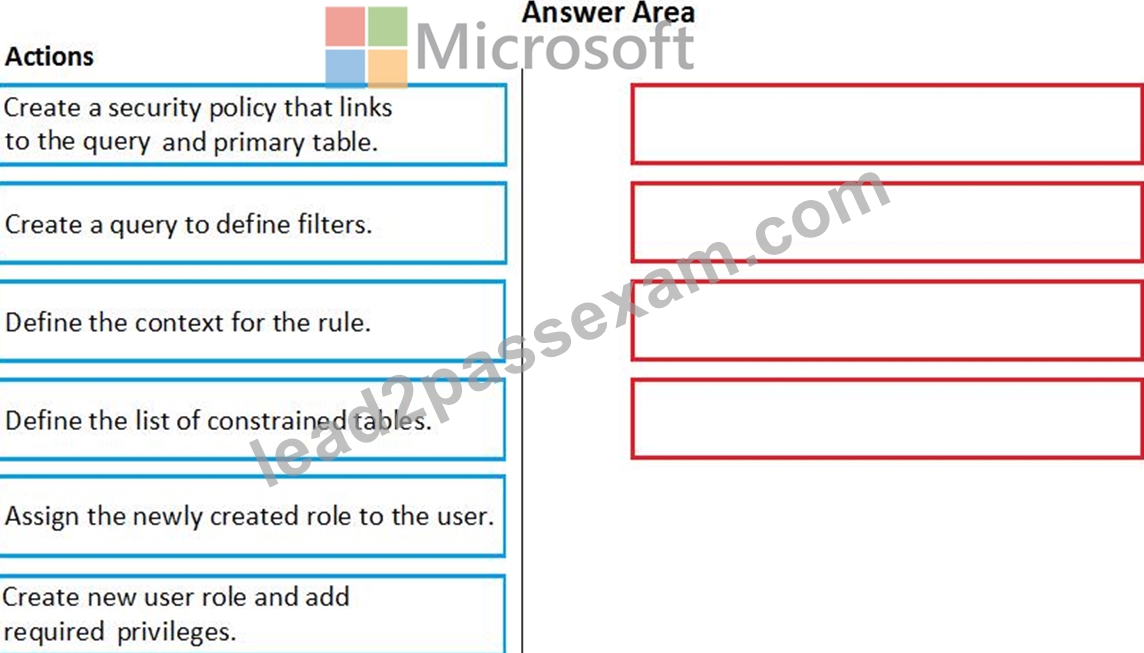
Answer:
Explanation: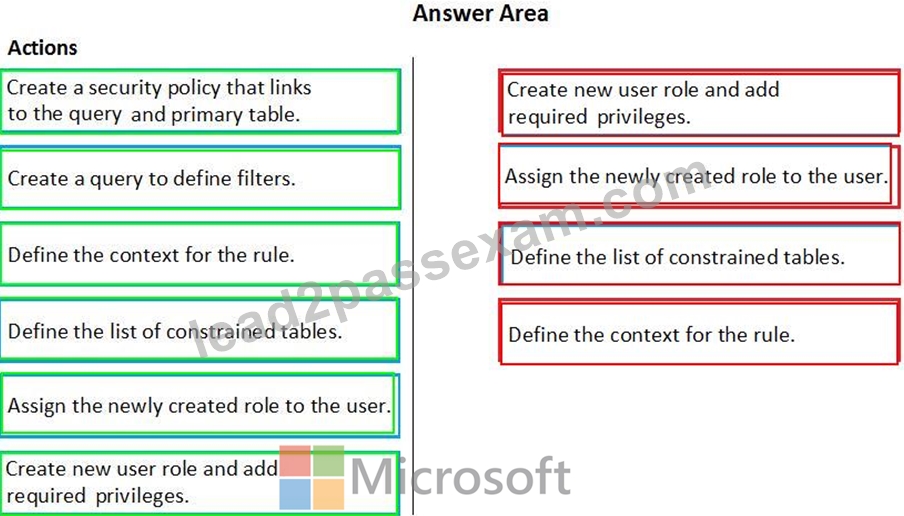
Reference:
https://docs.microsoft.com/en-us/dynamics365/fin-ops-core/dev-itpro/sysadmin/security-architecture
https://community.dynamics.com/365/b/exploringdynamics365/posts/extensible-data-security-in-d365
NEW QUESTION 96
You are working with extended data types in Visual Studio.
You need to create an extension of an Extended Data Types (EDT) that is derived from base data types. Which three properties can be modified? Each correct answer presents a complete solution. NOTE: Each correct selection is worth one point.
- A. Form help
- B. IsExtensible
- C. Label
- D. Alignment
- E. String size
Answer: A,C,E
Explanation:
Explanation
String size can be defined only on root EDTs. The system will use the largest value that is defined across the EDT and its extensions.
Labels and Help text properties can be changed by an extension, but only one value can remain.
Reference:
https://docs.microsoft.com/en-us/dynamics365/fin-ops-core/dev-itpro/extensibility/extensible-edts
NEW QUESTION 97
You are configuring your developer environment by using Team Explorer.
There are several developers working on a customization.
You need to ensure that all code is checked in and then merged to the appropriate branches.
In which order should you perform the actions? To answer, move all actions from the list of actions to the answer area and arrange them in the correct order.
NOTE: More than one order of answer choices is correct. You will receive credit for any of the correct orders you select.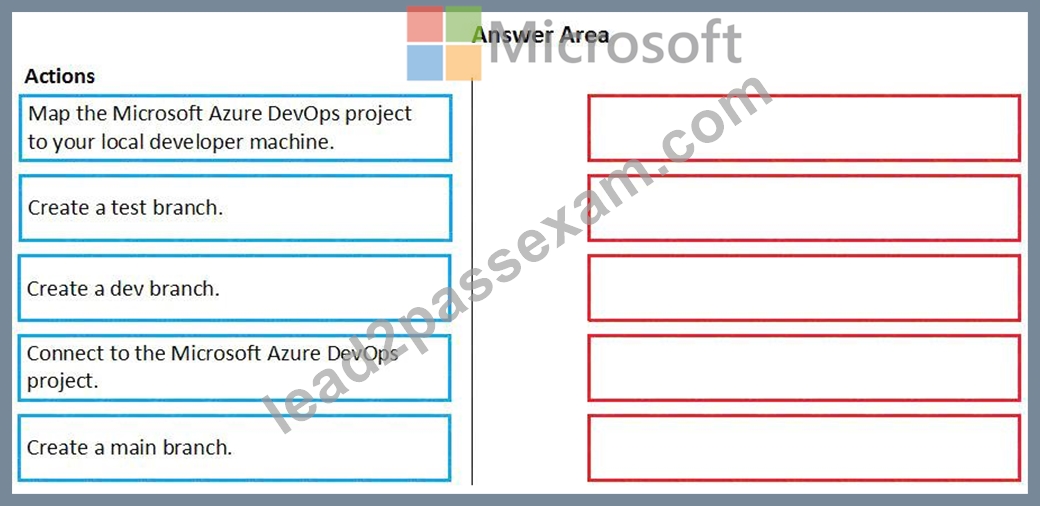
Answer:
Explanation: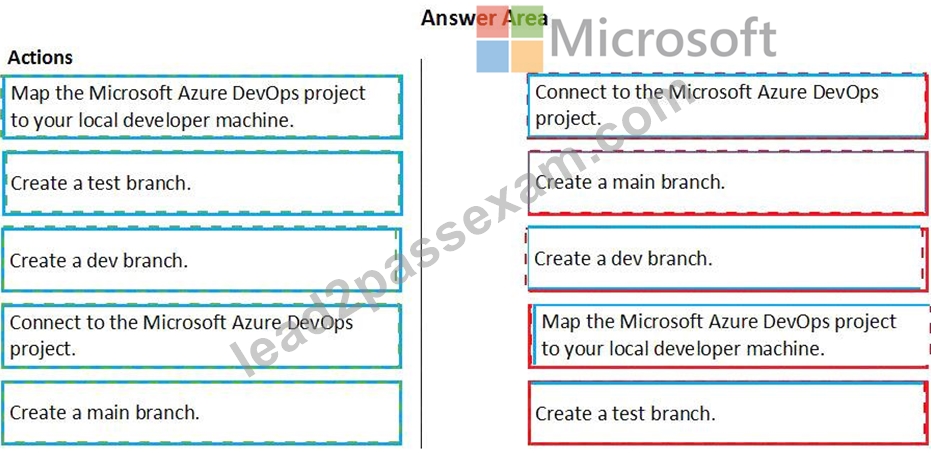
Explanation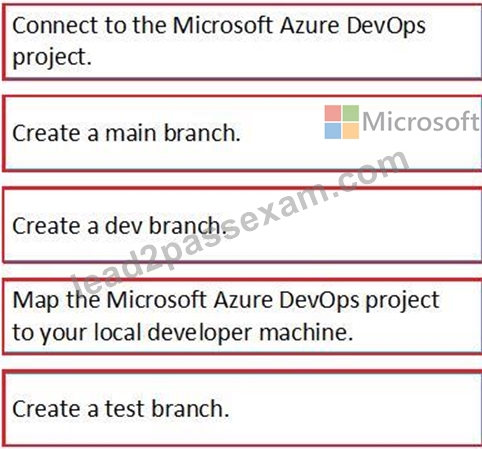
Reference:
https://docs.microsoft.com/en-us/azure/devops/repos/tfvc/branching-strategies-with-tfvc?view=azure-devops
NEW QUESTION 98
You are a Dynamics 365 Finance developer.
You launch the Performance Timer tool to troubleshoot performance issues with a business process.
You need to view the results from the tool.
What does the tool present? To answer, select the appropriate options in the answer area.
NOTE: Each correct selection is worth one point.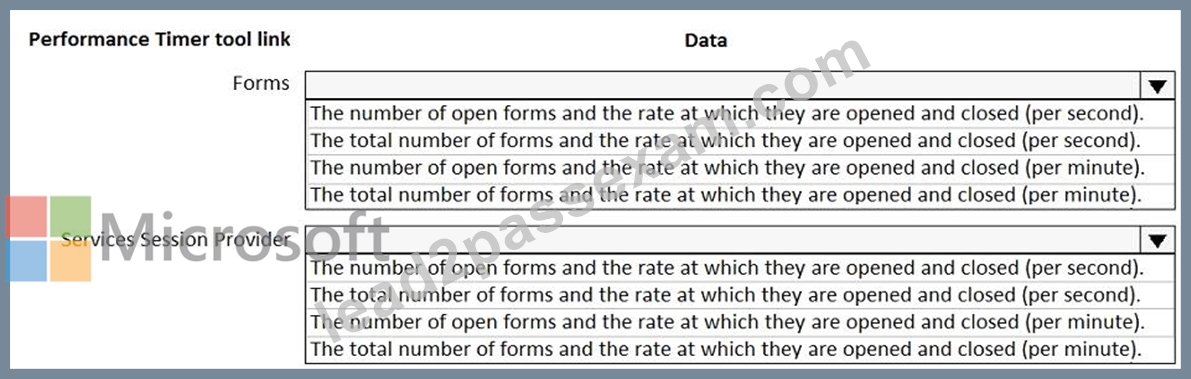
Answer:
Explanation: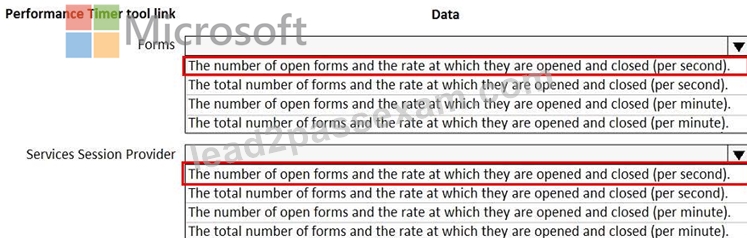
Reference:
https://docs.microsoft.com/en-us/dynamics365/fin-ops-core/dev-itpro/perf-test/performance-timer
NEW QUESTION 99
You are a Dynamics 365 Finance developer.
You have a report in an existing model that connects with the following objects:
In-memory table
Data provider class
Controller class
Contract class
The report is locked for modifications.
You need to create an extension of the in-memory table in a model and you add the new field to the extension.
Which three actions should you perform in sequence? To answer, move the appropriate actions from the list of actions to the answer area and arrange them in the correct order.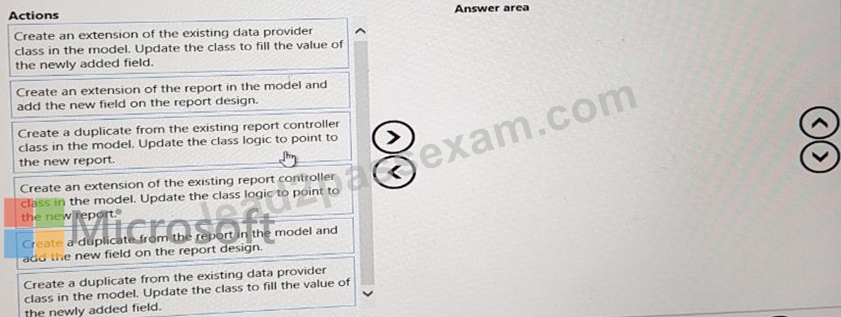
Answer:
Explanation: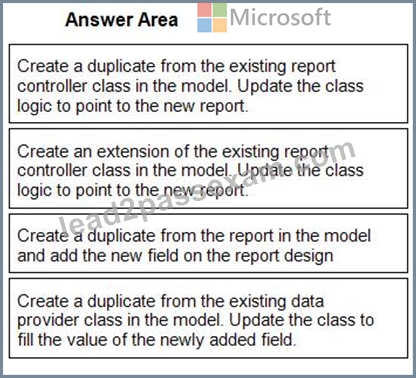
1 - Create a duplicate from the existing report controller class in the model. Update the class logic to point to the new report.
2 - Create an extension of the existing report controller class in the model. Update the class logic to point to the new report.
3 - Create a duplicate from the report in the model and add the new field on the report design
4 - Create a duplicate from the existing data provider class in the model. Update the class to fill the value of the newly added field.
NEW QUESTION 100
You are a Dynamics 365 Finance developer.
Users must be able to view a filtered customer list from within a workspace.
You need to add the customer form to a workspace.
Which four actions should you perform in sequence? To answer, move the appropriate actions from the list of actions to the answer area and arrange them on the correct order.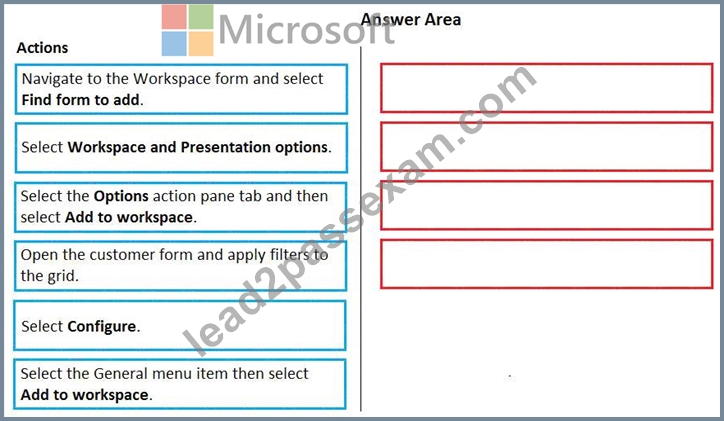
Answer:
Explanation: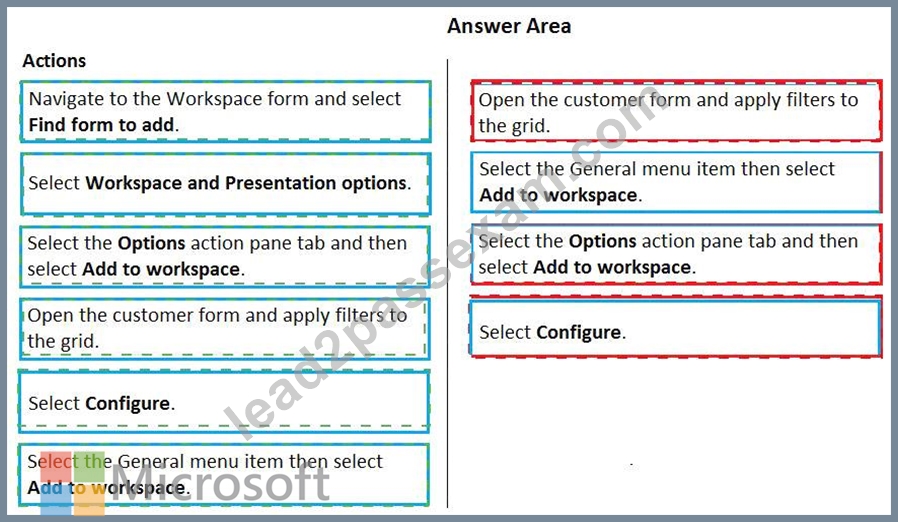
Explanation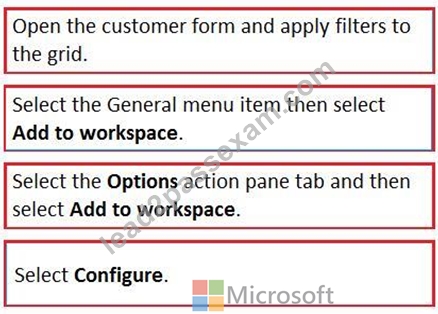
Step 1:Open the customer form and apply filters to the grid.
To add a list to a workspace, first sort or filter the list on the page so that it shows the information as you want it to appear in the workspace.
Step 2: Select the General menu item then select Add to workspace
This workspace will be selected in step 3.
Step 3: Select the Options actions pane tab and then select Add to workspace.
For some pages that include lists, the Add to workspace personalization feature is available in the Personalize group on the Options tab of the Action Pane. This feature lets you push relevant information from the current list to a specific workspace.
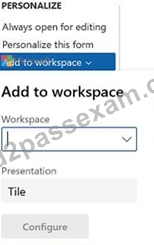
Step 4: Select Configure
After you select Configure, a dialog box appears, where you can select the columns that should appear in the list in the workspace.
Reference:
https://docs.microsoft.com/en-us/dynamics365/fin-ops-core/fin-ops/get-started/personalize-user-experience
NEW QUESTION 101
You are a Dynamics 365 Finance developer. You have two tables as shown in the following exhibit:
You need to configure Table1 to ensure that records cannot be deleted from Table1 if Table2 contains related records.
Which value should you use for the OnDelete property?
- A. Cascade + Restricted
- B. Cascade
- C. Restricted
- D. None
Answer: C
Explanation:
Example of Restricted
Suppose we have two tables (Customer & Order) and the relation is of One-To-Many i.e Customer can have many orders.
So on a parent table i.e.(Customer) if I set a delete action property to "RESTRICTED" for Order table. Then If I go and delete the record from a Customer table. It will first check the record in the child table and if exist that warning prompt saying that first we need to delete a record from child table.
Incorrect Answers:
B: Example of Cascade:
Suppose we have two tables (Customer & Order) and the relation is of One-To-Many i.e. Customer can have many orders.
So on a parent table i.e.(Customer) if I set a delete action property to "CASCADE" for Order table. Then If I go and delete the record from a Customer table. It will also delete all the related records in Order table automatically.
C: Example of Cascade + Restricted
Suppose we have three tables (Person ,Customer & Order) Now Person is a parent of Customer table, and Customer is a parent of Order table having (One-To-Many) relations If I set a Delete action property on Person table to "CASCADE" for customer table and If I set a Delete Action property on a CUSTOMER table for Order table to "CASCADE +RESTRICTED".
So if I delete a record from Customer table then It will first check the record in the child table(order table) and if exist that warning prompt saying that first we need to delete a record from child table.
But if I delete a record from Person table it will automatically delete a record in Customer table and all records related to customer table in Order table would also be deleted.
Reference:
https://amazingax.wordpress.com/2013/01/13/microsoft-dynamics-ax-2012example-of-cascaderestricted-and- cascade-restricted-delete-action-property-for-a-table-relation/ Developer Tools Testlet 1 Case study This is a case study. Case studies are not timed separately. You can use as much exam time as you would like to complete each case. However, there may be additional case studies and sections on this exam. You must manage your time to ensure that you are able to complete all questions included on this exam in the time provided.
To answer the questions included in a case study, you will need to reference information that is provided in the case study. Case studies might contain exhibits and other resources that provide more information about the scenario that is described in the case study. Each question is independent of the other questions in this case study.
At the end of this case study, a review screen will appear. This screen allows you to review your answers and to make changes before you move to the next section of the exam. After you begin a new section, you cannot return to this section.
To start the case study
To display the first question in this case study, click the Next button. Use the buttons in the left pane to explore the content of the case study before you answer the questions. Clicking these buttons displays information such as business requirements, existing environment, and problem statements. If the case study has an All Information tab, note that the information displayed is identical to the information displayed on the subsequent tabs. When you are ready to answer a question, click the Question button to return to the question.
Background
Wide World Importers sell office supplies, furniture, and fittings to their customers across the United States.
The company has the following locations:
* a retail store in Seattle
* a warehouse in Seattle
* a customer support and call center in Atlanta
* a team of field workers that provide furniture installation services at customer sites.
Wide World Importers plans to implement Dynamics 365 Finance and Microsoft Azure cloud platform features.
Current environment
Customers may place orders by email, phone, or by using the company's website. The company authorizes and processes credit card transactions by using a web-based application. Customer, inventory, supplier, and other master and transactional data is stored in a legacy database.
The company collects feedback from customers by phone or a form on the company's website and maintains the data in a Microsoft Excel workbook.
Wide World Importers runs on-premises applications to manage payroll and workers compensation. The company has a set of Microsoft Power BI dashboards that present data from a reporting database.
The company creates a Lifecycle Services (LCS) implementation project and completes Dynamics 365 Finance onboarding.
The company maintains production, quality assurance (QA), development, user acceptance testing (UAT), and build environments.
Requirements
General
* You must configure a cloud-based Dynamics 365 Finance development environment and enable code extension that support updates.
* You must configure version control and a Build environment.
* You must migrate all legacy data to the new system.
* You must implement best practices for X++ coding, the data model, caching, and security.
* All new code must be unit tested in a development environment and then validated by the QA team before code is added to source control.
Business processes
* You must configure vendor trade agreements.
* Products must be shipped directly from suppliers to customers depending on customer location to save indirect costs.
* You must collect customer feedback on products shipped directly from vendors.
* You must deploy code to a UAT environment for testing before deploying code to production.
* You must validate all entries for the purchase order creation form.
* You must develop a web portal that allows customers to browse products, place orders, and check order status. Product data for the web portal must be integrated as periodic batches.
Business systems
* You must install and configure a third-party solution for credit card processing within Dynamics 365 Finance. The third-party company will provide a deployable package.
* The workers compensation application must be able to call an API to update worker compensation details in Dynamics 365 Finance.
* You must develop a process to import payroll journals into the system.
* You must configure the warehouse mobile device portal for warehouse operations.
* You must install a third-party solution to support web portal integration. The solution is supplied as a source code model file.
Vendor exclusion list
You must develop a new solution to maintain a Vendor exclusion list for each customer and item combination.
The solution must meet the following requirements:
* Isolate all new vendor exclusion codes as a new assembly by creating a table named VendExclusions.
* Create an index for the table named PrimaryIdx that uses the following fields: CustAccount, ItemId, VendAccount.
* Ensure that users can open the Vendor Exclusion list report from the customer master form. The list must display the customer account, Item ID, and Vendor account fields.
* Implement the Excel integration for the Vendor Exclusion List form.
* Provide functionality to periodically export the Vendor exclusion list to prepare reports by using standard reporting capabilities of Dynamics 365 Unified Operations.
* Develop necessary security permissions to view and maintain the new Vendor exclusion list functionality and reporting. Users with maintain rights will be able create, update, and delete the exclusion list.
Permissions must be assigned to security roles to match company security model.
* Maintain referential integrity with other tables.
* Users must be presented with a warning message before a direct delivery purchase order is created for a vendor in exclusion list.
* Sales managers must be alerted when a new exclusion record is added to the system.
Security
* You must implement the record level audit feature to identify the users who created the record.
* Grant specific users rights to maintain the vendor exclusion list by using Excel.
* You must implement validation to check whether a proposed direct delivery purchase order vendor is on the exclusion list for the customer and product combination.
Issues
User1 is not able to access many features in the system. You must provide User1 administrator rights.
A sales manager suspects a data-related issue in the vendor exclusion list. User1 must identify the user who created the referenced exclusion records.
Developer2 joins the company and does not have access to a development environment or source control.
User2 reports performance issues when they generate direct delivery purchase orders after current updates are applied.
User2 reports that they cannot access new functionality and reports.
NEW QUESTION 102
You are a Dynamics 365 Finance developer.
You need configure table caching.
Which CacheLookup properties should you use? To answer, drag the CacheLookup properties to the correct table. Each property may be used once, more than once, or not at all. You may need to drag the split bar between panes or scroll to view content.
NOTE: Each correct selection is worth one point.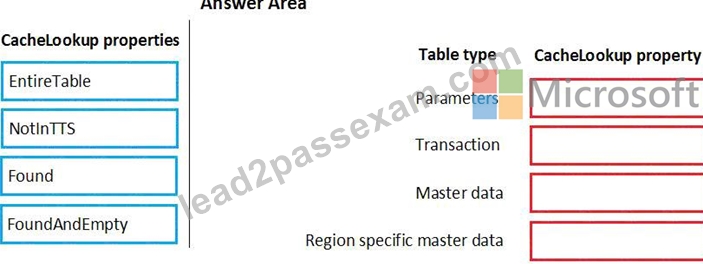
Answer:
Explanation: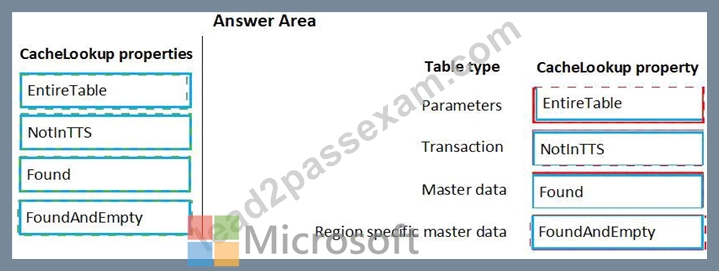
Explanation
Parameters: EntireTable
Transaction: NotInTTS
Master Data: Found
Region specific master data: FoundAndEmpty
https://community.dynamics.com/365/financeandoperations/b/performancetipsandtricks/posts/dynamics-365-for-
NEW QUESTION 103
You are a Dynamics 365 Finance developer. You have two tables as shown in the following exhibit:
You need to configure Table1 to ensure that records cannot be deleted from Table1 if Table2 contains related records.
Which value should you use for the OnDelete property?
- A. Cascade + Restricted
- B. Cascade
- C. Restricted
- D. None
Answer: C
Explanation:
Example of Restricted
Suppose we have two tables (Customer & Order) and the relation is of One-To-Many i.e Customer can have many orders.
So on a parent table i.e.(Customer) if I set a delete action property to "RESTRICTED" for Order table. Then If I go and delete the record from a Customer table. It will first check the record in the child table and if exist that warning prompt saying that first we need to delete a record from child table.
Incorrect Answers:
B: Example of Cascade:
Suppose we have two tables (Customer & Order) and the relation is of One-To-Many i.e. Customer can have many orders.
So on a parent table i.e.(Customer) if I set a delete action property to "CASCADE" for Order table. Then If I go and delete the record from a Customer table. It will also delete all the related records in Order table automatically.
C: Example of Cascade + Restricted
Suppose we have three tables (Person ,Customer & Order) Now Person is a parent of Customer table, and Customer is a parent of Order table having (One-To-Many) relations If I set a Delete action property on Person table to "CASCADE" for customer table and If I set a Delete Action property on a CUSTOMER table for Order table to "CASCADE +RESTRICTED".
So if I delete a record from Customer table then It will first check the record in the child table(order table) and if exist that warning prompt saying that first we need to delete a record from child table.
But if I delete a record from Person table it will automatically delete a record in Customer table and all records related to customer table in Order table would also be deleted.
Reference:
https://amazingax.wordpress.com/2013/01/13/microsoft-dynamics-ax-2012example-of-cascaderestricted-and- cascade-restricted-delete-action-property-for-a-table-relation/
NEW QUESTION 104
......
MB-500 Study Guide Cover to Cover as Literally: https://www.lead2passexam.com/Microsoft/valid-MB-500-exam-dumps.html
Get Unlimited Access to MB-500 Certification Exam Cert Guide: https://drive.google.com/open?id=1QOuYCwKKlZTWT7JekAZ3T30NXmWkeKDG