

2026 Realistic N10-009 100% Pass Guaranteed Download Exam Q&A
Accurate N10-009 Answers 365 Days Free Updates
NEW QUESTION # 100
Which of the following connection methods allows a network engineer to automate configuration deployment for network devices across the environment?
- A. GUI
- B. Telnet
- C. RDP
- D. SSH
Answer: D
Explanation:
Comprehensive and Detailed Explanation (paraphrased, aligned to N10-009):
SSH provides secure, scriptable remote access used by automation/orchestration tools (e.g., leveraging CLI, NETCONF over SSH, or Ansible modules) to push configurations at scale.
* A. RDP is primarily for Windows GUI sessions and is not commonly used for network device automation.
* B. Telnet can be scripted but is insecure (plaintext); modern best practice is to use SSH.
* D. GUI access is typically manual and not ideal for scalable, repeatable automation.
References (CompTIA Network+ N10-009):
* Domain: Network Operations - Configuration management, automation/orchestration, secure management protocols (SSH vs. Telnet), change at scale.
NEW QUESTION # 101
Which of the following should be configured so users can authenticate to a wireless network using company credentials?
- A. MFA
- B. SAML
- C. RADIUS
- D. SSO
Answer: C
Explanation:
RADIUS (Remote Authentication Dial-In User Service) is a networking protocol that provides centralized Authentication, Authorization, and Accounting (AAA) management for users who connect and use a network service. RADIUS is often used to manage access to wireless networks, enabling users to authenticate with their company credentials, ensuring secure access to the network.Reference: CompTIA Network+ study materials.
NEW QUESTION # 102
Which of the following is enforced through legislation?
- A. Code of conduct
- B. GDPR
- C. AUP
- D. EULA
Answer: B
Explanation:
GDPR (General Data Protection Regulation)is alegal frameworkenforced by the European Union to protect personal data and privacy. Unlike internal organizational policies such as AUPs or codes of conduct, GDPR is alegislated regulation, and organizations must comply or face legal consequences.
Reference:
NEW QUESTION # 103
To reduce costs and increase mobility, a Chief Technology Officer (CTO) wants to adopt cloud services for the organization and its affiliates. To reduce the impact for users, the CTO wants key services to run from the on-site data center and enterprise services to run in the cloud. Which of the following deployment models is the best choice for the organization?
- A. SaaS
- B. Private
- C. Hybrid
- D. Public
Answer: C
Explanation:
A hybrid cloud deployment model is the best choice for the CTO's requirements. It allows the organization to run key services from the on-site data center while leveraging the cloud for enterprise services. This approach provides flexibility, scalability, and cost savings, while also minimizing disruptions to users by keeping critical services local. The hybrid model integrates both private and public cloud environments, offering the benefits of both.
NEW QUESTION # 104
Which of the following most likely requires the use of subinterfaces?
- A. A hub utilizing jumbo frames
- B. A firewall performing deep packet inspection
- C. A switch using Spanning Tree Protocol
- D. A router with only one available LAN port
Answer: D
Explanation:
Introduction to Subinterfaces:
Subinterfaces are logical interfaces created on a single physical interface. They are used to enable a router to support multiple networks on a single physical interface.
Use Case for Subinterfaces:
Subinterfaces are commonly used in scenarios where VLANs are implemented. A router with a single physical LAN port can be configured with multiple subinterfaces, each associated with a different VLAN.
This setup allows the router to route traffic between different VLANs.
Example Configuration:
Consider a router with a single physical interface GigabitEthernet0/0 and two VLANs, 10 and 20.
interface GigabitEthernet0/0.10
encapsulation dot1Q 10
ip address 192.168.10.1 255.255.255.0
!
interface GigabitEthernet0/0.20
encapsulation dot1Q 20
ip address 192.168.20.1 255.255.255.0
The encapsulation dot1Q command specifies the VLAN ID.
Explanation of the Options:
A . A router with only one available LAN port: This is correct. Subinterfaces allow a single physical interface to manage multiple networks, making it essential for routers with limited physical interfaces.
B . A firewall performing deep packet inspection: Firewalls can use subinterfaces, but it is not a requirement for deep packet inspection.
C . A hub utilizing jumbo frames: Hubs do not use subinterfaces as they operate at Layer 1 and do not manage IP addressing.
D . A switch using Spanning Tree Protocol: STP is a protocol for preventing loops in a network and does not require subinterfaces.
Conclusion:
Subinterfaces provide a practical solution for routing between multiple VLANs on a router with limited physical interfaces. They allow network administrators to optimize the use of available hardware resources efficiently.
Reference:
CompTIA Network+ guide detailing VLAN configurations and the use of subinterfaces (see page Ref 9 Basic Configuration Commands).
NEW QUESTION # 105
An IT department is considering implementing a SIEM solution to improve network security. The department wants to ensure that the SIEM system is able to ingest and analyze logs from all of the company's core devices. Which of the following is the most important consideration when selecting a SIEM solution?
- A. Compatibility
- B. Features
- C. Easy to manage
- D. Cost
Answer: A
Explanation:
The correct answer is C. Compatibility . A SIEM is only effective if it can successfully collect, normalize, and analyze data from the systems the organization relies on. Since the question specifically says the department wants the SIEM to ingest and analyze logs from all core devices , the most important factor is whether the SIEM is compatible with those devices, their log formats, and their supported methods of exporting events.
This includes support for common logging methods such as syslog , SNMP traps, API integrations, agent- based collection, and vendor-specific event formats. Even a SIEM with excellent features will not deliver value if it cannot properly receive and interpret logs from firewalls, routers, switches, servers, and security appliances already in use.
The other choices matter, but they come after compatibility. Ease of management is helpful for daily operations. Cost is always a practical concern. Features can improve visibility and automation. However, none of those benefits matter much if the SIEM cannot integrate with the organization's actual environment.
For Network+ exam purposes, when log ingestion across many device types is the requirement, the top selection criterion is compatibility . Without that foundation, correlation, alerting, and security analysis will be incomplete.
NEW QUESTION # 106
A medical clinic recently configured a guest wireless network on the existing router. Since then, guests have been changing the music on the speaker system. Which of the following actions should the clinic take to prevent unauthorized access? (Choose two.)
- A. Configure GRE on the wireless router.
- B. Isolate smart devices to their own network segment.
- C. Change the default credentials.
- D. Configure IPS to prevent guests from making changes.
- E. Install a new AP on the network.
- F. Set up a syslog server to log who is making changes.
Answer: B,C
Explanation:
Isolate smart devices to their own network segment: Network segmentation using VLANs or separate SSIDs ensures that smart devices (like speakers) are not on the same network as guests, preventing unauthorized control.
Change the default credentials: Many IoT devices (e.g., smart speakers) come with default usernames and passwords. If these are not changed, unauthorized users can easily take control.
NEW QUESTION # 107
Which of the following allows for interactive, secure remote management of a network infrastructure device?
- A. VNC
- B. SNMP
- C. RDP
- D. SSH
Answer: D
Explanation:
SSH (Secure Shell) provides interactive, secure remote command-line access to network devices (e.g., switches, routers, firewalls). It's widely used for remote management in network infrastructure.
VNC provides graphical remote access but is not typically used for network devices. RDP is used for GUI-based remote access to Windows systems, not for infrastructure devices. SNMP is used for monitoring and managing devices, not for interactive remote sessions.
SSH is the best choice for interactive and secure remote management of network infrastructure.
NEW QUESTION # 108
A critical infrastructure switch is identified as end-of-support. Which of the following is the best next step to ensure security?
- A. Isolate the switch from the network.
- B. Decommission and replace the switch.
- C. Ensure the current firmware has no issues.
- D. Apply the latest patches and bug fixes.
Answer: B
Explanation:
* Understanding End-of-Support:
* End-of-Support Status: When a vendor declares a device as end-of-support, it means the device will no longer receive updates, patches, or technical support. This poses a security risk as new vulnerabilities will not be addressed.
* Risks of Keeping an End-of-Support Device:
* Security Vulnerabilities: Without updates, the switch becomes susceptible to new security threats.
* Compliance Issues: Many regulatory frameworks require that critical infrastructure be maintained with supported and secure hardware.
* Best Next Step - Replacement:
* Decommission and Replace: The most secure approach is to replace the end-of-support switch with a new, supported model. This ensures the infrastructure remains secure and compliant with current standards.
* Planning and Execution: Plan for the replacement by evaluating the network's needs, selecting a suitable replacement switch, and scheduling downtime for the hardware swap.
* Comparison with Other Options:
* Apply the Latest Patches: While helpful, this does not address future vulnerabilities since no further patches will be provided.
* Ensure the Current Firmware Has No Issues: This is only a temporary measure and does not mitigate future risks.
* Isolate the Switch from the Network: Isolating the switch may disrupt network operations and is not a viable long-term solution.
NEW QUESTION # 109
Which of the following is the most likely benefit of installing server equipment in a rack?
- A. Improved network performance
- B. Increased compute density
- C. Simplified troubleshooting process
- D. Decreased power consumption
Answer: B
Explanation:
Installing server equipment in a rack increases compute density by allowing multiple servers to be organized efficiently in a vertical configuration, saving space while housing more devices in a smaller footprint. This is critical for data centers and businesses with high hardware demands.
NEW QUESTION # 110
Which of the following is the first step in a problem-solving process when you want to understand the underlying cause of an issue?
- A. Use a top-down approach
- B. Create a theory about the possible root cause
- C. Handle multiple problems individually
- D. Conduct tests to verify ideas
Answer: B
NEW QUESTION # 111
Which of the following network devices converts wireless signals to electronic signals?
- A. Access point
- B. Firewall
- C. Load balancer
- D. Router
Answer: A
Explanation:
Role of an Access Point (AP):
Wireless to Wired Conversion: An access point (AP) is a device that allows wireless devices to connect to a wired network using Wi-Fi. It converts wireless signals (radio waves) into electronic signals that can be understood by wired network devices.
Functionality:
Signal Conversion: The AP receives wireless signals from devices such as laptops, smartphones, and tablets, converts them into electronic signals, and transmits them over the wired network.
Connectivity: APs provide a bridge between wireless and wired segments of the network, enabling seamless communication.
NEW QUESTION # 112
After a recent power outage, users are reporting performance issues accessing the application servers.
Wireless users are also reporting intermittent Internet issues.
INSTRUCTIONS
Click on each tab at the top of the screen. Select a widget to view information, then use the drop-down menus to answer the associated questions. If at any time you would like to bring back the initial state of the simulation, please click the Reset All button.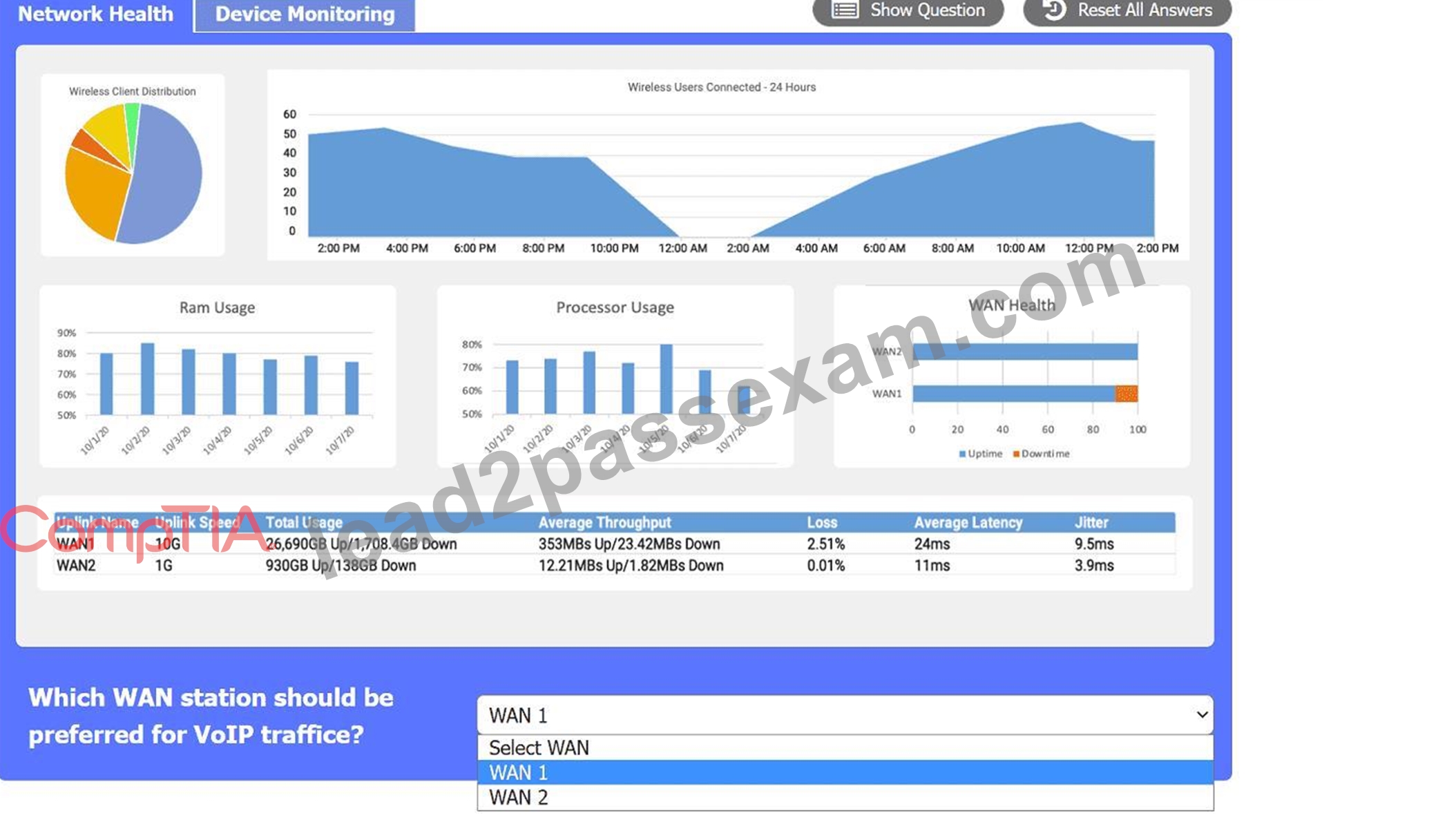
Answer:
Explanation:
See the answer and solution below.
Explanation:
Network Health:
WAN 2 appears to have a lower average latency and loss percentage, which would make it the preferred WAN station for VoIP traffic. VoIP traffic requires low latency and packet loss to ensure good voice quality and reliability. WAN 1 seems to have higher RAM and processor usage, which could also affect the performance of VoIP traffic.
Here's the summary of the key metrics for WAN 1 and WAN 2 from the image provided:
WAN 1:
Uplink Speed: 10G
Total Usage: 26.969GB Up / 1.748GB Down
Average Throughput: 353MBps Up / 23.42MBps Down
Loss: 2.51%
Average Latency: 24ms
Jitter: 9.5ms
WAN 2:
Uplink Speed: 1G
Total Usage: 930GB Up / 138GB Down
Average Throughput: 12.21MBps Up / 1.82MBps Down
Loss: 0.01%
Average Latency: 11ms
Jitter: 3.9ms
For VoIP traffic, low latency and jitter are particularly important to ensure voice quality. While WAN 1 has higher bandwidth and throughput, it also has higher latency and jitter compared to WAN 2. However, WAN 2 has much lower loss, lower latency, and lower jitter, which are more favorable for VoIP traffic that is sensitive to delays and variation in packet arrival times.
Given this information, WAN 2 would generally be preferred for VoIP traffic due to its lower latency, lower jitter, and significantly lower loss percentage, despite its lower bandwidth compared to WAN 1. The high bandwidth of WAN 1 may be more suitable for other types of traffic that are less sensitive to latency and jitter, such as bulk data transfers.
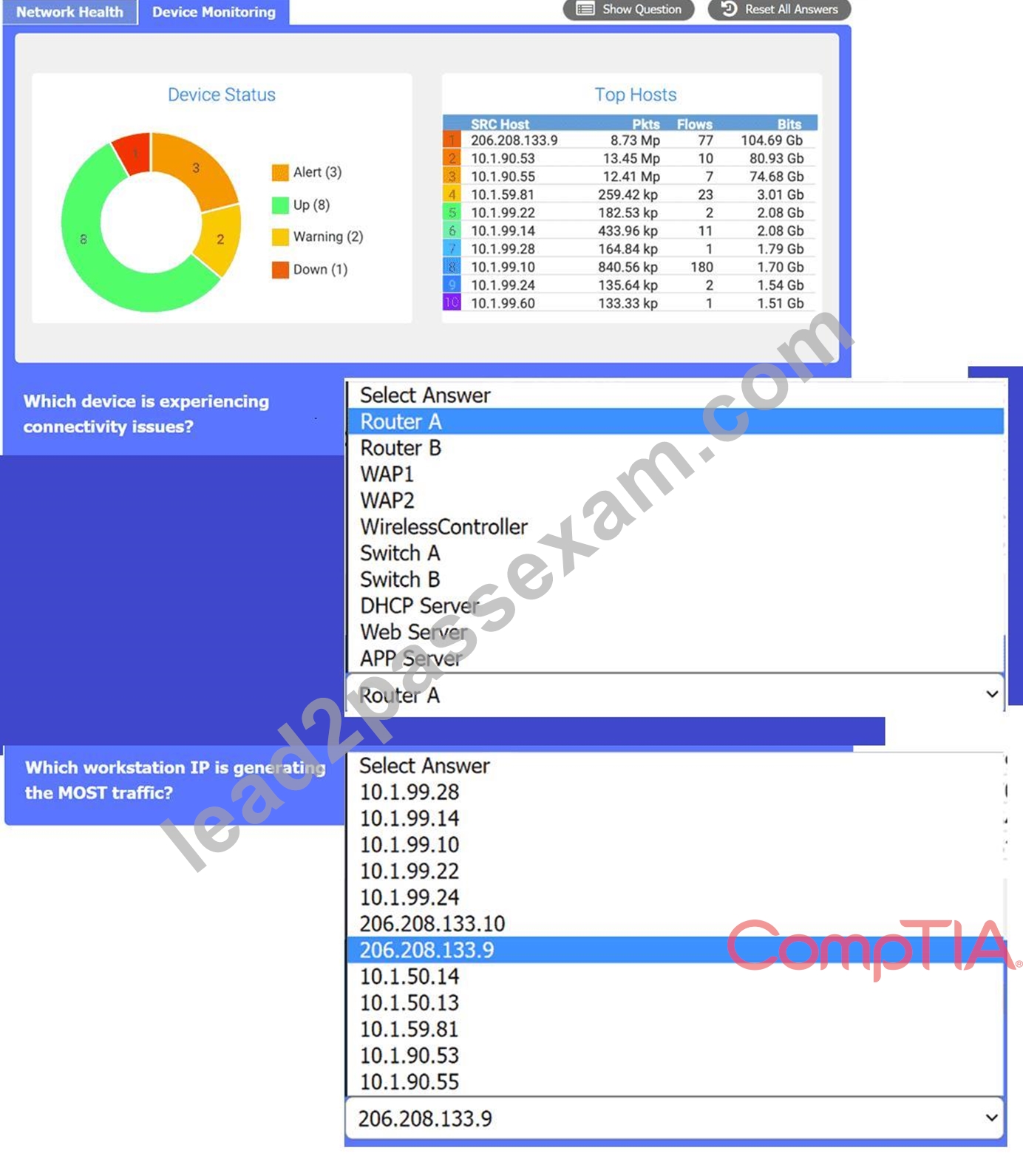
Device Monitoring:
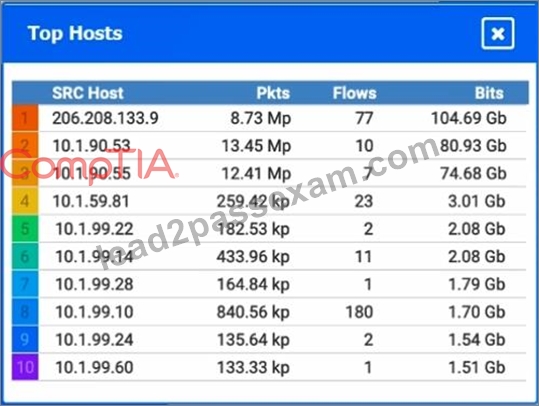
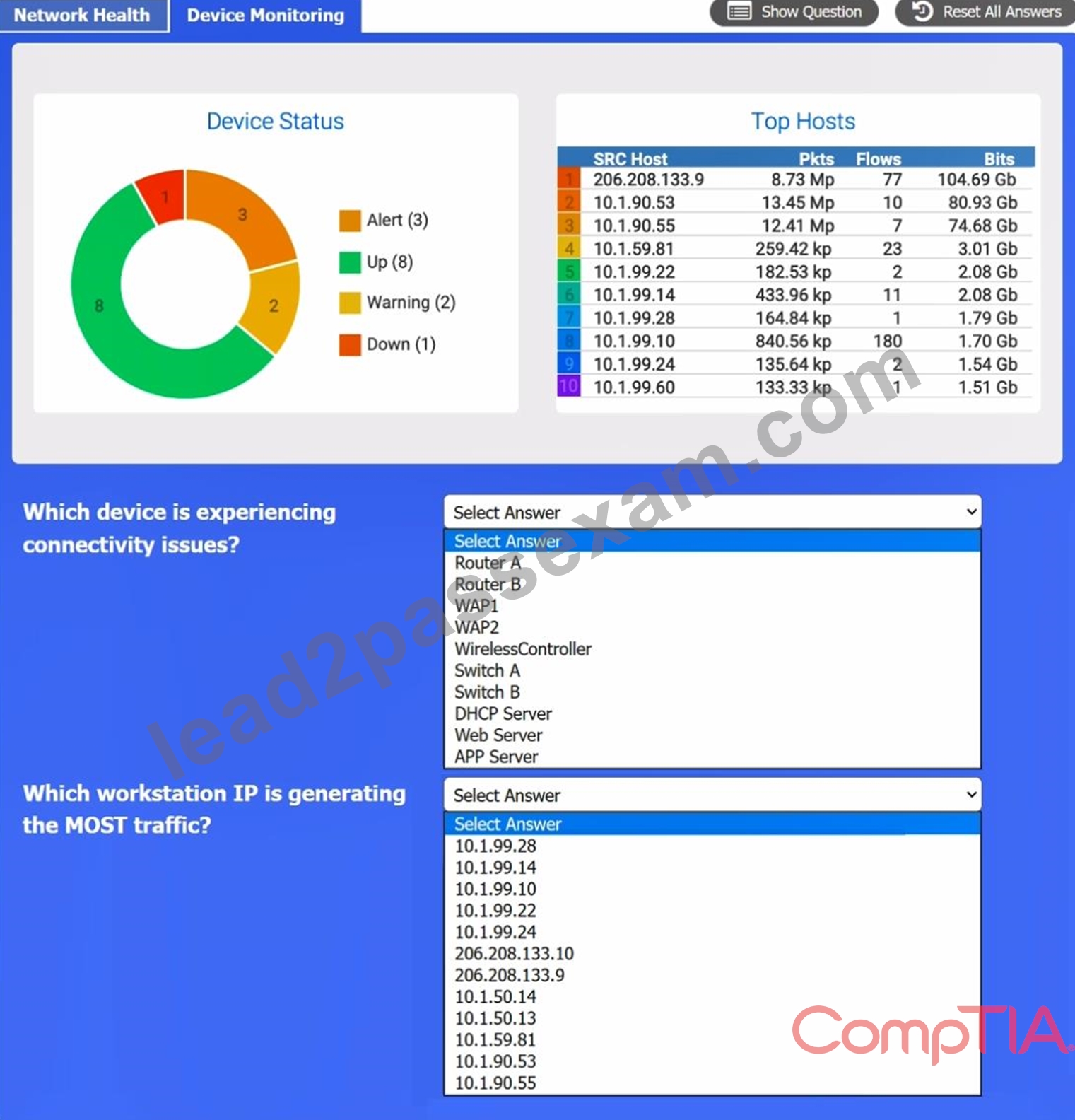
the device that is experiencing connectivity issues is the APP Server or Router 1, which has a status of Down.
This means that the server is not responding to network requests or sending any data. You may want to check the physical connection, power supply, and configuration of the APP Server to troubleshoot the problem.
A screenshot of a computer AI-generated content may be incorrect.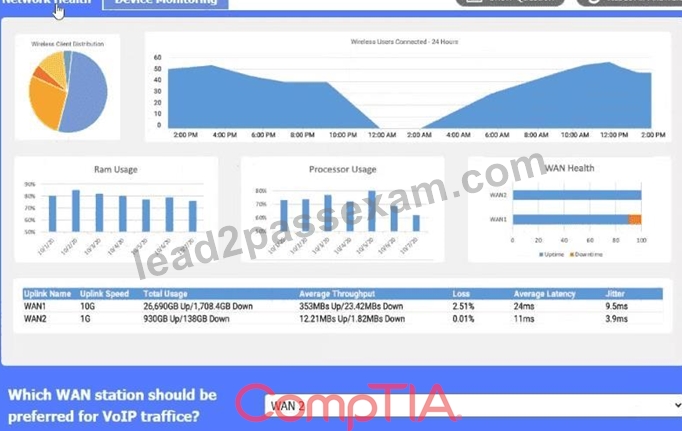
NEW QUESTION # 113
Users on the network are experiencing slow throughput. A technician wants to increase throughput without changing any switch hardware. Which of the following solutions should the technician implement?
- A. SVI configuration
- B. VLAN trunking
- C. Link aggregation
- D. 802.1Q tagging
Answer: C
Explanation:
Link aggregation combines multiple physical links into one logical connection, increasing available throughput without replacing switch hardware.
NEW QUESTION # 114
A systems administrator is looking for operating system information, running services, and network ports that are available on a server. Which of the following software tools should the administrator use to accomplish this task?
- A. nslookup
- B. traceroute
- C. nmap
- D. netstat
Answer: C
Explanation:
Nmap performs active scanning of a target system to identify open ports, running services, and operating system details, providing a comprehensive view of the server.
NEW QUESTION # 115
Which of the following impacts the availability of a web-based customer portal?
- A. MAC flooding
- B. ARP spoofing
- C. Rogue devices
- D. DoS
Answer: D
Explanation:
A DoS (Denial of Service) attack directly targets availability, one of the core security goals (CIA triad) emphasized in Network+ (N10-009) security objectives. A web-based customer portal depends on reachable services (web servers, load balancers, DNS, upstream bandwidth). In a DoS, an attacker attempts to overwhelm the portal or its supporting infrastructure-consuming bandwidth, exhausting server resources, or saturating state tables-so legitimate users cannot connect or experience severe degradation. This is the most direct and common scenario where "availability" is impacted for a public web service.
MAC flooding aims to overflow a switch's CAM table and can lead to traffic being broadcast out ports, which is more commonly associated with enabling sniffing or disruption within a local switched network segment-not typically the primary attack described for a web portal's availability. ARP spoofing is a local network man-in-the-middle/redirection technique affecting integrity/confidentiality and potentially availability for local hosts, but it is not the best match for a public portal availability impact. Rogue devices can introduce risk, but the option is broad and indirect; DoS is the clearest availability-focused threat.
NEW QUESTION # 116
A network administrator is migrating the existing phone system to VoIP. The vendor requires a separate voice network for the phones to function. Which of the following technologies should the administrator use to allow for this configuration?
- A. VLAN
- B. VPN
- C. VXLAN
- D. VPC
Answer: A
Explanation:
A Virtual LAN segments the network into separate broadcast domains on the same physical infrastructure, allowing you to isolate voice traffic on its own voice VLAN while using existing switches.
NEW QUESTION # 117
SIMULATION
After a recent power outage, users are reporting performance issues accessing the application servers. Wireless users are also reporting intermittent Internet issues.
INSTRUCTIONS
Click on each tab at the top of the screen. Select a widget to view information, then use the drop- down menus to answer the associated questions.
If at any time you would like to bring back the initial state of the simulation, please click the Reset All button.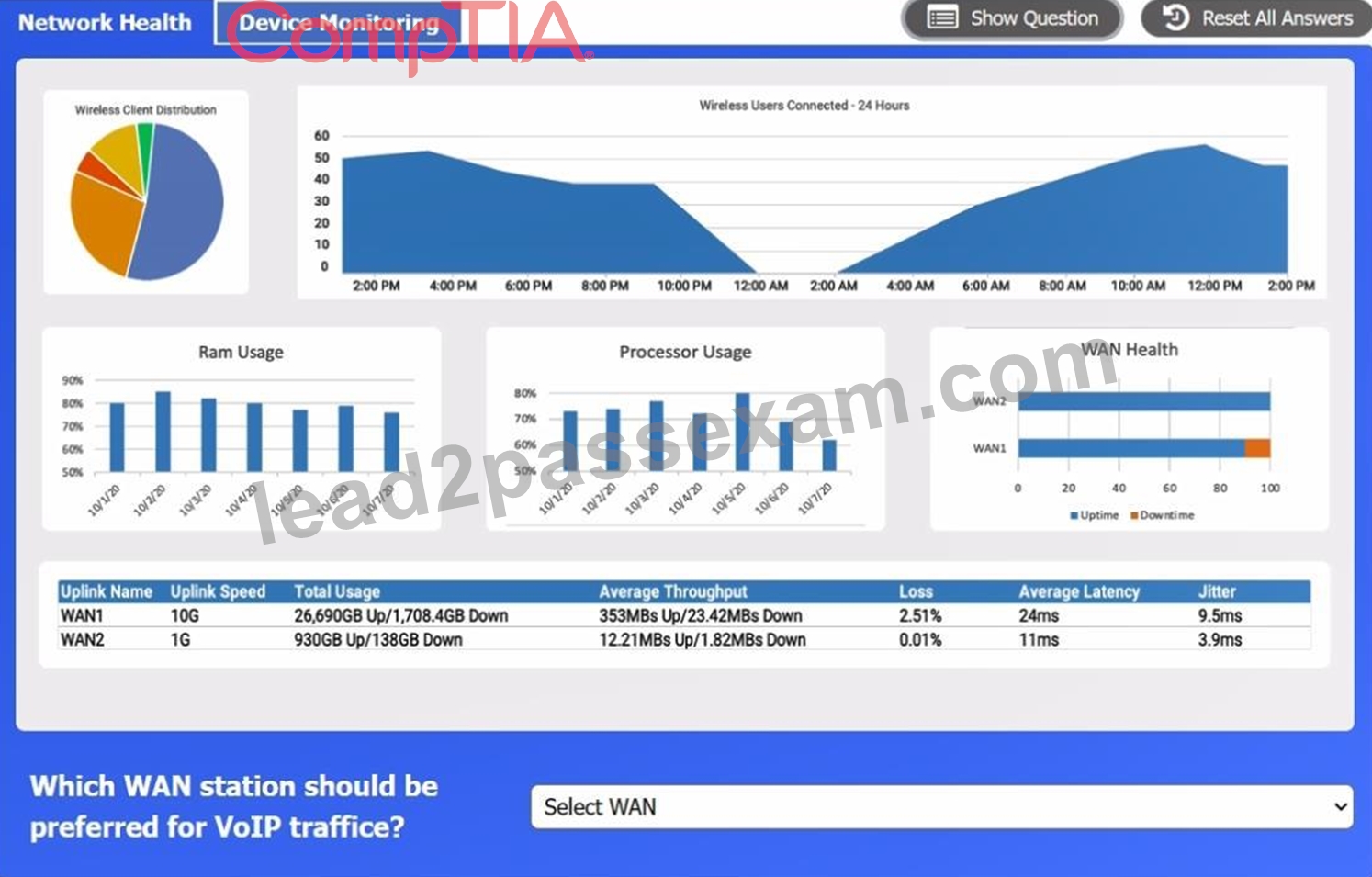
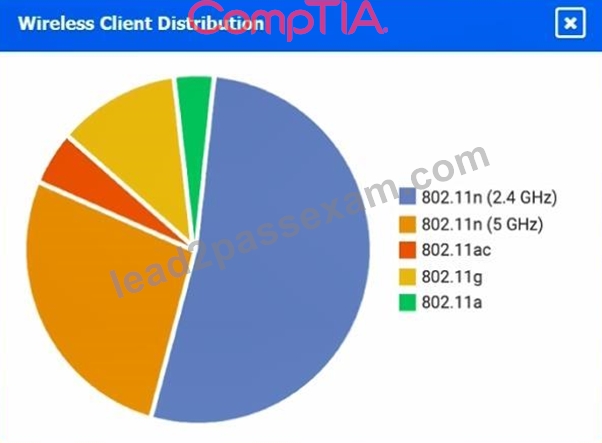
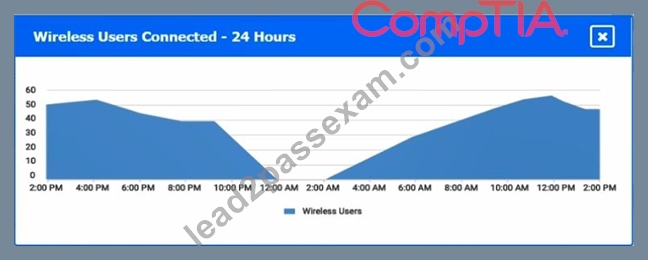
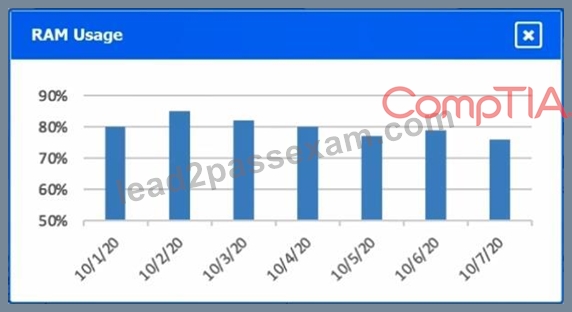
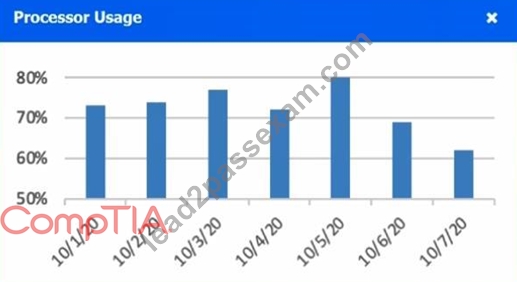

Answer:
Explanation:
Network Health:
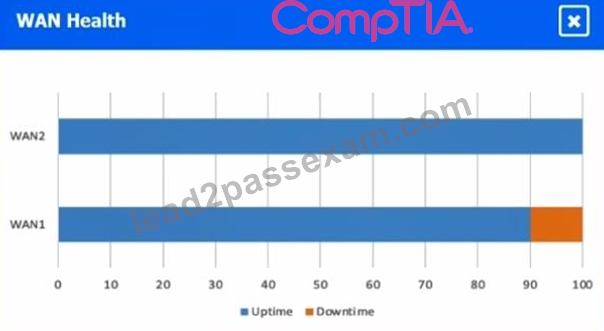
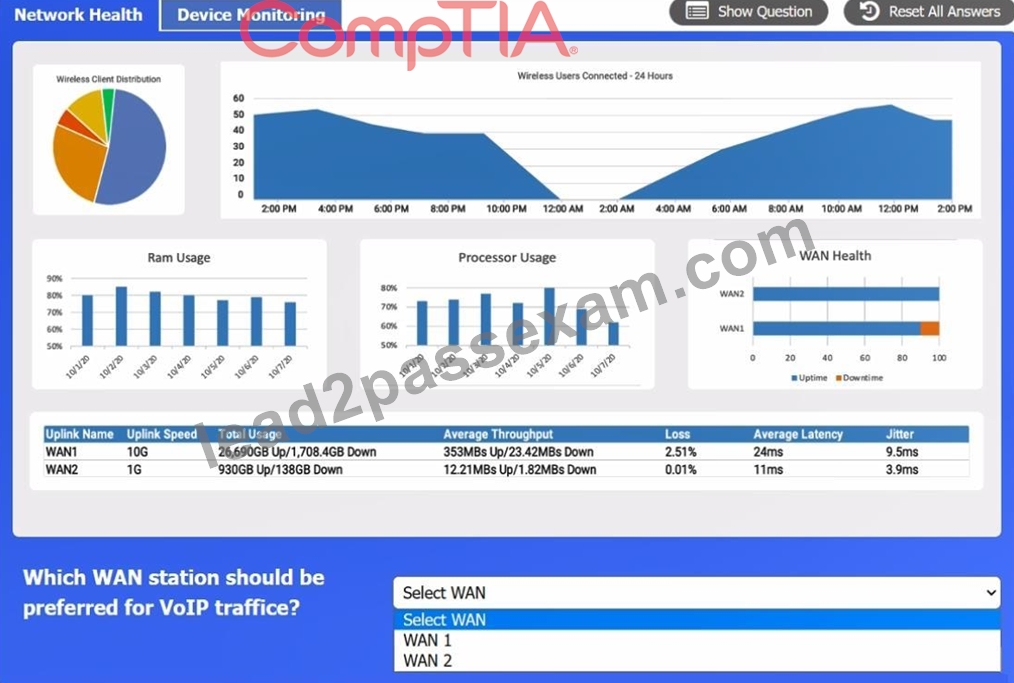
WAN 2 appears to have a lower average latency and loss percentage, which would make it the preferred WAN station for VoIP traffic. VoIP traffic requires low latency and packet loss to ensure good voice quality and reliability. WAN 1 seems to have higher RAM and processor usage, which could also affect the performance of VoIP traffic.
Here's the summary of the key metrics for WAN 1 and WAN 2 from the image provided:
WAN 1:
Uplink Speed: 10G
Total Usage: 26.969GB Up / 1.748GB Down
Average Throughput: 353MBps Up / 23.42MBps Down
Loss: 2.51%
Average Latency: 24ms
Jitter: 9.5ms
WAN 2:
Uplink Speed: 1G
Total Usage: 930GB Up / 138GB Down
Average Throughput: 12.21MBps Up / 1.82MBps Down
Loss: 0.01%
Average Latency: 11ms
Jitter: 3.9ms
For VoIP traffic, low latency and jitter are particularly important to ensure voice quality. While WAN 1 has higher bandwidth and throughput, it also has higher latency and jitter compared to WAN 2. However, WAN 2 has much lower loss, lower latency, and lower jitter, which are more favorable for VoIP traffic that is sensitive to delays and variation in packet arrival times.
Given this information, WAN 2 would generally be preferred for VoIP traffic due to its lower latency, lower jitter, and significantly lower loss percentage, despite its lower bandwidth compared to WAN 1. The high bandwidth of WAN 1 may be more suitable for other types of traffic that are less sensitive to latency and jitter, such as bulk data transfers.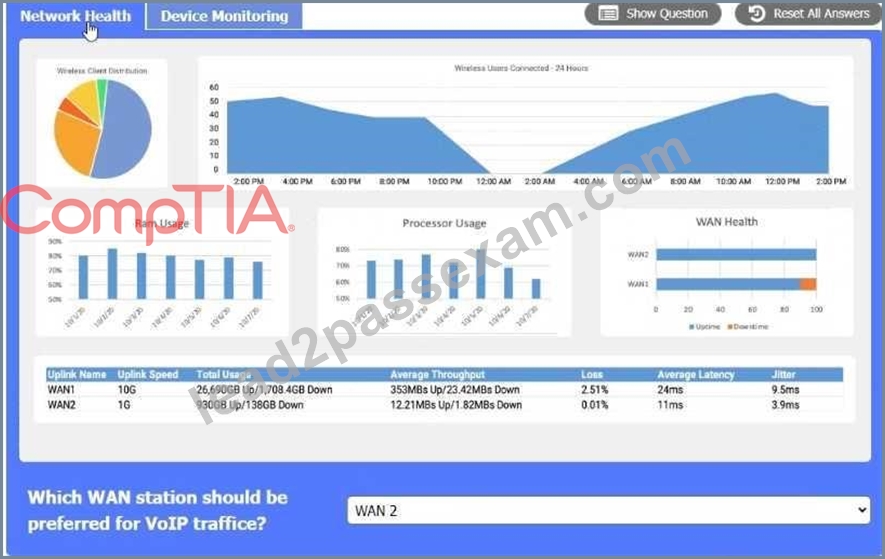
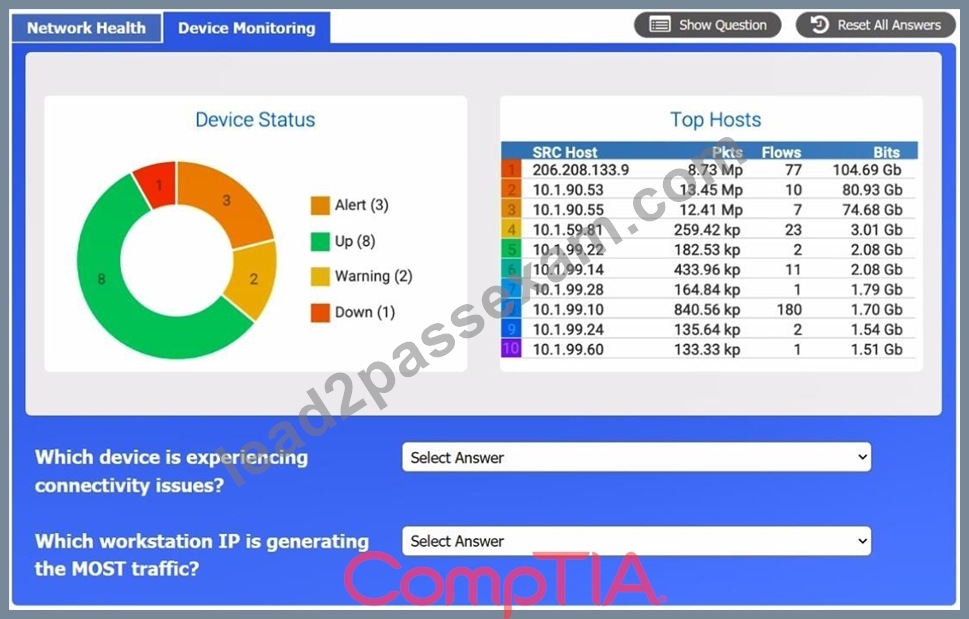
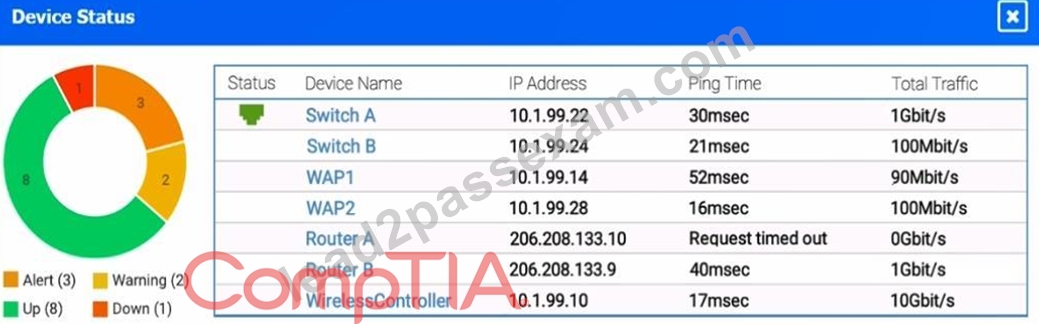
Device Monitoring:
the device that is experiencing connectivity issues is the APP Server or Router 1, which has a status of Down. This means that the server is not responding to network requests or sending any data. You may want to check the physical connection, power supply, and configuration of the APP Server to troubleshoot the problem.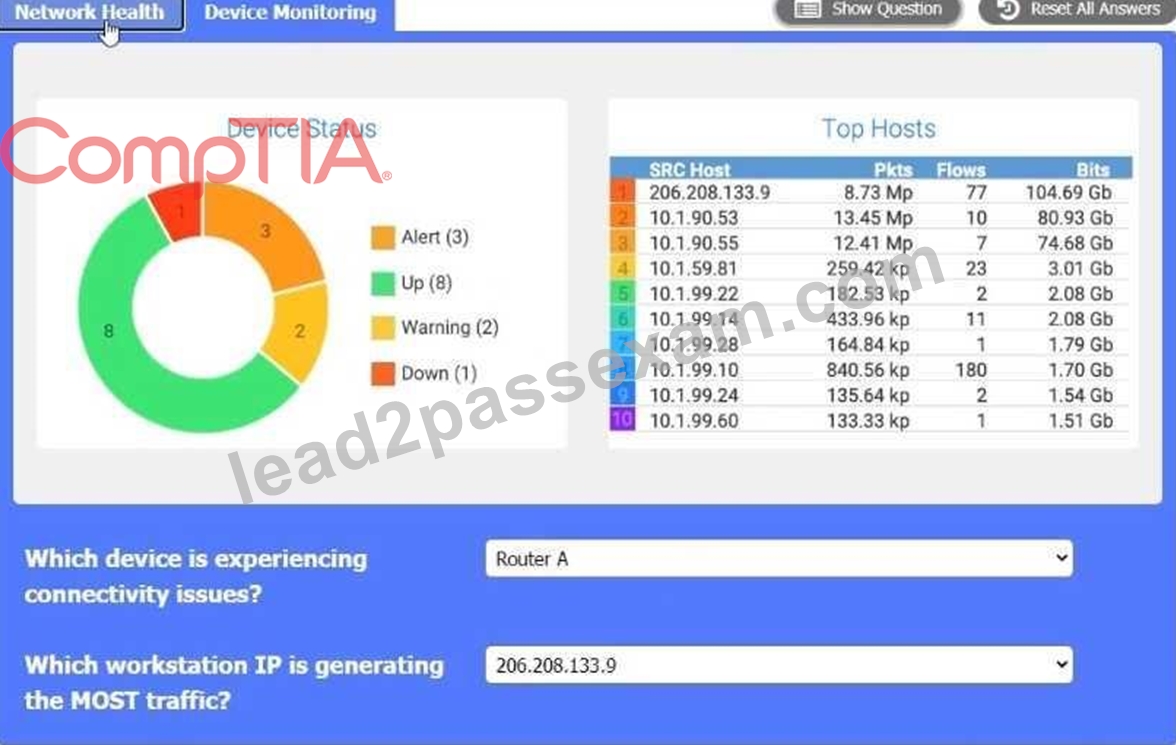
NEW QUESTION # 118
Which of the following will allow secure, remote access to internal applications?
- A. IDS
- B. SAN
- C. CDN
- D. VPN
Answer: D
Explanation:
Comprehensive and Detailed In-Depth Explanation:
A Virtual Private Network (VPN) creates an encrypted connection between a remote user and an internal network, ensuring secure access to internal applications.
* VPNs use encryption protocols like IPSec and SSL/TLS to protect data during transmission.
* They are widely used for secure remote work, accessing company resources, and bypassing geographic restrictions.
* Option B (CDN - Content Delivery Network): Used for speeding up website content delivery, not for remote access security.
* Option C (SAN - Storage Area Network): Used for high-speed storage, unrelated to remote access.
* Option D (IDS - Intrusion Detection System): Monitors for malicious activities but does not provide secure access to applications.
? Reference: CompTIA Network+ (N10-009) Official Study Guide - Section: Secure Remote Access Technologies
NEW QUESTION # 119
A network administrator is deploying a new switch and wants to make sure that the default priority value was set for a spanning tree. Which of the following values would the network administrator expect to see?
- A. 0
- B. 1
- C. 2
- D. 3
Answer: A
Explanation:
* Understanding Spanning Tree Protocol (STP):
* STP is used to prevent network loops in Ethernet networks by creating a spanning tree that selectively blocks some redundant paths.
* Default Priority Value:
* Bridge Priority: STP uses bridge priority to determine which switch becomes the root bridge.
The default bridge priority value for most switches is 32768.
* Priority Range: The bridge priority can be set in increments of 4096, ranging from 0 to 61440.
* Configuration and Verification:
* When deploying a new switch, the network administrator can verify the bridge priority using commands such as show spanning-tree to ensure it is set to the default value of 32768.
* Comparison with Other Values:
* 4096 and 8192: Lower than the default priority, indicating these would be manually configured for higher preference.
* 36684: A non-standard value, likely a result of specific configuration changes.
References:
* CompTIA Network+ study materials on Spanning Tree Protocol and network configuration.
NEW QUESTION # 120
An office network is experiencing significant lag when accessing the company's shared drive. A systems administrator wants to investigate the cause of the problem, focusing on network latency. Which of the following tools should the administrator use first?
- A. Wireshark
- B. Traceroute
- C. SNMP
- D. NetFlow
Answer: B
Explanation:
Traceroute identifies where latency is being introduced along the path to the shared drive by showing each hop and the response time at each step, making it the quickest first tool to isolate where delays begin.
NEW QUESTION # 121
A network administrator suspects users are being sent to malware sites that are posing as legitimate sites. The network administrator investigates and discovers that user workstations are configured with incorrect DNS IP addresses. Which of the following should the network administrator implement to prevent this from happening again?
- A. DHCP snooping
- B. Access control lists
- C. Dynamic ARP inspection
- D. Port security
Answer: A
Explanation:
DHCP snooping is a security feature on network switches that helps to prevent unauthorized (rogue) DHCP servers from assigning IP addresses to clients. By implementing DHCP snooping, the network administrator can restrict DHCP responses to authorized servers only, preventing unauthorized DHCP configurations, such as incorrect DNS IPs, from being assigned to clients.
This helps prevent man-in-the-middle attacks where malicious actors misconfigure DNS to redirect users to fraudulent sites.
NEW QUESTION # 122
......
N10-009 dumps Exam Material with 792 Questions: https://www.lead2passexam.com/CompTIA/valid-N10-009-exam-dumps.html
N10-009 DUMPS Q&As with Explanations Verified & Correct Answers: https://drive.google.com/open?id=1StQ7SbgYHAQnzfR_DCRlBBfjIHl91SY-